
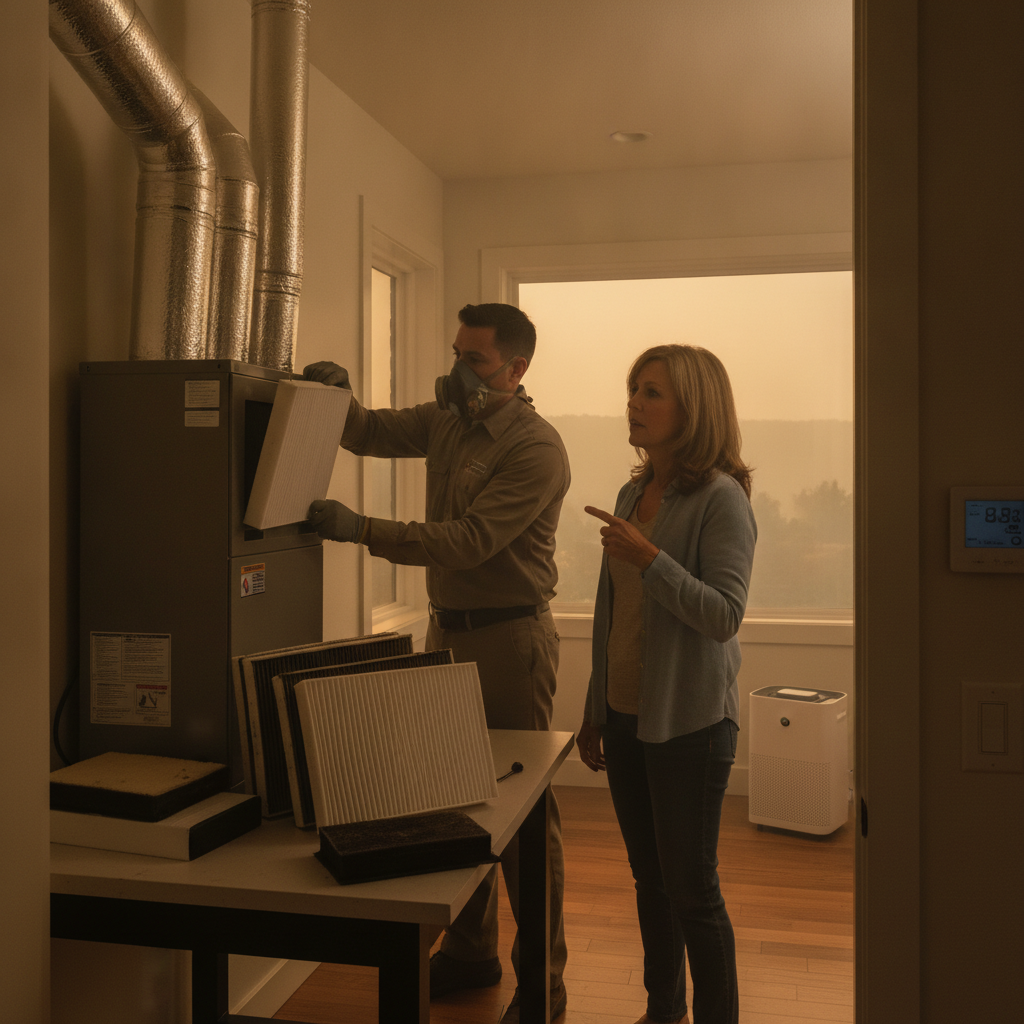
What Windsor and Healdsburg Homeowners Should Know About HVAC and Wildfire Season Air Quality — How to Actually Protect Your Indoor Air When the Hills Are Burning
If you live in Windsor, Healdsburg, or anywhere in the northern reaches of Sonoma County, you already know what late summer and fall look like around here: dry hills, east winds, and the smell of smoke drifting down from the ridges. When a fire ignites near Cloverdale or in the hills above the Alexander Valley, indoor air quality can drop fast — and what happens inside your home depends heavily on what your HVAC system is doing at that moment. This isn’t a theoretical concern. It’s a practical one that affects how you run your heating and cooling equipment every fire season.
Your HVAC System Can Help or Hurt During a Smoke Event
Most homeowners assume that staying indoors with the windows closed is enough to protect themselves from wildfire smoke. That’s true as far as it goes, but it misses a critical variable: your HVAC system may be actively pulling outdoor air into your home without you realizing it.
Many central forced-air systems have a fresh air intake — a duct that deliberately draws outside air into the return side of the system. This is a good thing for everyday ventilation, but during a smoke event, it’s pulling contaminated air directly into your home and distributing it through every vent. If your system has a fresh air damper, knowing how to close it before smoke arrives is one of the most effective things you can do.
At the same time, if you simply turn your system off during a smoke event to avoid drawing air in, you lose the filtration benefit your system provides when it’s running in recirculation mode. The goal is to keep the system running on recirculate, with the right filter installed, with any outdoor air intake closed or minimized. That combination is significantly more effective than just shutting everything down.
What “The Right Filter” Actually Means for Smoke
This is where most homeowner guidance falls short. Generic advice says to use a “high-MERV filter,” but that phrase covers a wide range, and not all systems can handle a high-MERV filter without problems.
MERV ratings run from 1 to 16 for residential use, with higher numbers capturing smaller particles. Wildfire smoke particles — including the fine particulate matter (PM2.5) that causes the most health damage — require a MERV 13 or higher to filter effectively. A standard MERV 8 filter, which is what most hardware stores stock, removes larger dust and pollen particles but does very little for smoke.
The catch is that MERV 13 filters are significantly denser than MERV 8 filters. In older systems, or systems with undersized blower motors, jumping to a MERV 13 can restrict airflow enough to cause the system to work harder, run longer, and potentially freeze up the coil or overheat the heat exchanger. Before you install a higher-rated filter, it’s worth having someone verify that your system can handle it. If your existing equipment can’t support a MERV 13, a MERV 11 is a reasonable middle ground — better than a MERV 8 and less likely to cause airflow problems.
During active smoke events, even a MERV 13 filter will load up faster than usual. Checking and replacing your filter every two to three weeks during fire season isn’t excessive — it’s just necessary.
Ductless Systems and Wildfire Smoke: A Different Problem
If your Healdsburg or Windsor home uses a ductless mini-split rather than a central forced-air system, the filtration situation is different. Ductless units don’t use standard 1-inch MERV-rated filters — they use washable mesh filters designed mainly to protect the indoor unit’s coil from dust. These filters do very little for fine smoke particles.
That doesn’t mean ductless systems are a liability during fire season, but it does mean that filtration needs to be addressed separately — typically through a standalone air purifier with a true HEPA filter running in the same space. Some newer mini-split models from manufacturers like Mitsubishi Electric and Daikin include enhanced filtration options or ionization features that offer some improvement, but they’re not equivalent to a ducted system with a MERV 13 filter installed on the air handler.
If wildfire smoke is a recurring concern for your home and you’re considering a system upgrade, this is one of the factors worth discussing. Whole-house ventilation options that integrate filtration with your existing system can bridge the gap for homes that don’t have centralized ductwork.
What Healdsburg and Wine Country Homes Face That Others Don’t
Homes in and around Healdsburg sit in a geography that creates specific fire smoke exposure patterns. The Dry Creek Valley, Alexander Valley, and Knight’s Valley corridors channel air movement in ways that can concentrate smoke in low-lying areas even when a fire is miles away. Add the Diablo winds that push fires west from the inland hills, and you have a situation where smoke can go from barely noticeable to hazardous in a matter of hours.
Many of the homes in older Healdsburg neighborhoods and surrounding rural parcels also have aging HVAC equipment with less sophisticated airflow controls — systems installed in the 1990s or early 2000s that weren’t designed with smoke management in mind. If your system is more than 15 to 20 years old, it’s worth asking an HVAC technician specifically about its fresh air intake configuration and whether any damper or control upgrades make sense.
Practical Steps to Take Before Fire Season, Not During It
The worst time to figure out your system’s fresh air intake configuration is when you can already smell smoke outside. Here’s what’s worth doing in advance:
- Locate your fresh air intake damper and learn whether it’s manual or motorized. If it’s motorized, confirm that it can be closed from your thermostat or a manual override.
- Have a MERV 13 filter on hand before fire season starts. If your system can’t support a MERV 13, know that in advance so you can plan accordingly.
- Schedule a system check in late summer — not just for cooling performance, but to verify airflow, confirm filtration is working as expected, and address any duct leakage that might be drawing unconditioned air in from attic spaces or crawlspaces during smoke events.
- Consider a whole-home air purification unit if smoke events are a recurring problem. Products that install directly into your air handler — rather than portable units sitting in a single room — provide whole-house coverage every time your system runs.
Stout’s Heating & AC has been helping North Sonoma County homeowners prepare for fire season since 1992. If you want someone to walk through your system’s current configuration and make honest recommendations before the next smoke event rolls in, that’s exactly the kind of visit we do. Request a free estimate and we’ll come take a look.
FAQ: HVAC and Wildfire Smoke in Windsor and Healdsburg
Should I turn my HVAC system off during a wildfire smoke event?
Not necessarily. If your system is set to recirculate indoor air rather than draw in fresh air from outside, running it with a quality filter actually helps clean the air. The key is to verify that your outdoor air intake is closed or minimized before you run it during active smoke conditions.
What MERV rating filter should I use during wildfire season?
MERV 13 is the standard recommendation for capturing fine smoke particulates, but only if your system’s airflow can support it. MERV 11 is a reasonable fallback if airflow restriction is a concern. Either way, check and replace the filter more frequently than usual during heavy smoke periods.
My home has a ductless mini-split. How do I filter wildfire smoke?
Ductless systems don’t use standard MERV-rated filters, so a standalone HEPA air purifier in the main living area is the most practical solution. Some newer mini-split models include enhanced filtration, so it’s worth checking your unit’s specs or asking your HVAC technician what options exist for your specific system.
How do I know if my HVAC system has a fresh air intake?
Look for a duct connection near your air handler or return plenum that terminates through an exterior wall or into an attic space. It’s often equipped with a damper. If you’re not sure, an HVAC technician can identify it quickly during a service visit.
Is there a whole-home air purification system that works with my existing HVAC?
Yes. Several manufacturers offer in-duct air purifiers that install directly on your air handler and provide filtration every time your system runs. These are significantly more effective than room-sized portable units during extended smoke events. We can evaluate your current system and recommend options that fit your equipment and your budget.
Ready to Get Your System Smoke-Ready Before the Next Event?
At Stout’s Heating & AC, Inc., we’ve been serving Windsor, Healdsburg, Santa Rosa, and the surrounding communities for over 30 years. We know this area, we know how fire season affects local homes, and we’re not going to sell you something you don’t need. If you want an honest assessment of how your system handles smoke and what — if anything — is worth changing, give us a call at (707) 527-1504 or reach out through our contact page to schedule a visit. We offer same-day service when it’s available, and we’ll always tell you straight what we find.