
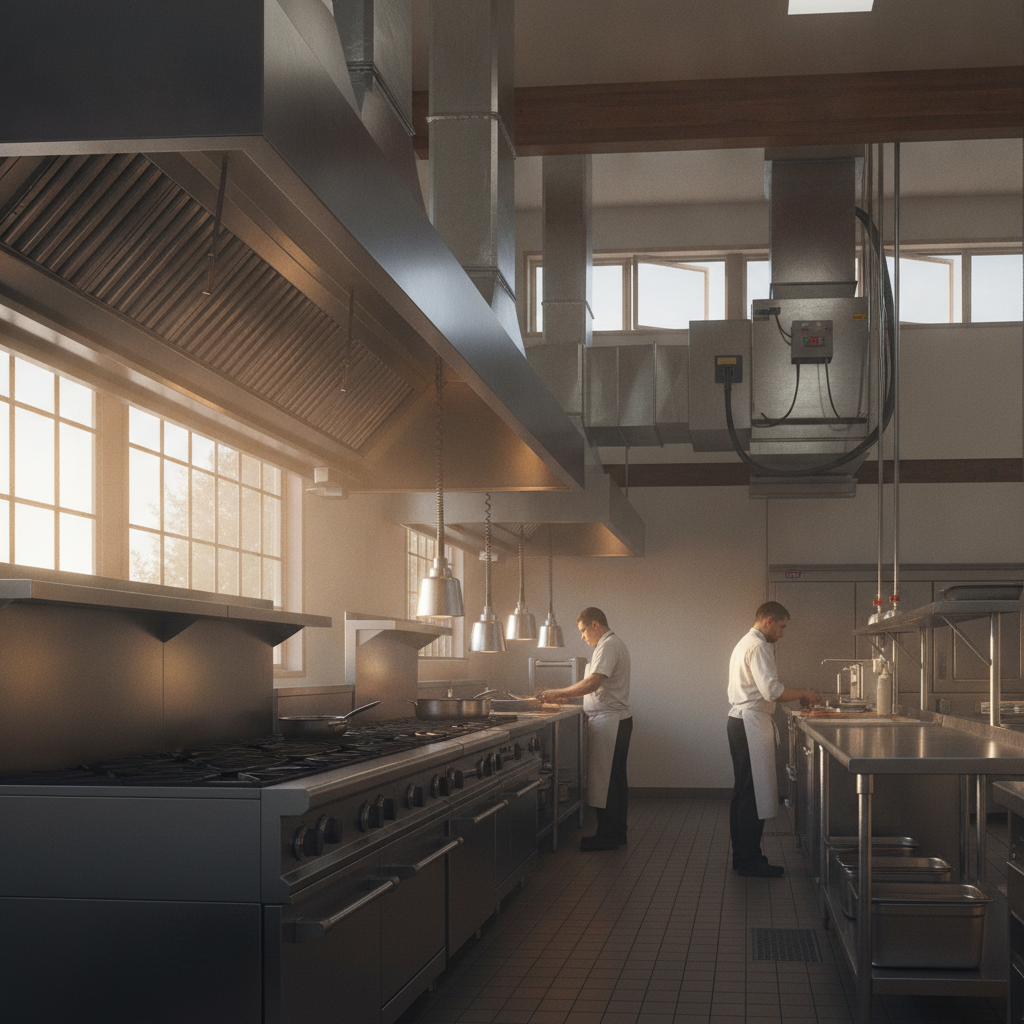
What Sonoma County Restaurant and Food Service Owners Should Know About Kitchen Exhaust and HVAC — Why Your Hood System and Your HVAC Are More Connected Than You Think
If you own or manage a restaurant, café, tasting room kitchen, or any commercial food service space in Sonoma County, your kitchen exhaust hood and your HVAC system are not independent pieces of equipment. They work as a single, interdependent system — and when they’re not balanced with each other, you’ll feel it immediately. Sweltering back-of-house temperatures, front-of-house doors that feel like they’re fighting you, grease and odors migrating into the dining room, and energy bills that don’t make sense are all symptoms of the same underlying problem: your ventilation and HVAC aren’t talking to each other properly.
This is a topic that gets almost no attention in the local HVAC conversation, even though it affects hundreds of food service businesses throughout Santa Rosa and the surrounding communities. Here’s what you actually need to understand.
The Core Problem: Exhaust Without Makeup Air Creates Negative Pressure
Your commercial kitchen hood does one job — it exhausts heat, grease-laden air, smoke, and combustion byproducts up and out of your building. A properly rated hood running over a commercial range can move an enormous volume of air — anywhere from several hundred to a few thousand cubic feet per minute, depending on the equipment underneath it.
Here’s the issue: every cubic foot of air you push out of the building has to be replaced by air coming in from somewhere. If you don’t have a dedicated makeup air unit supplying that replacement air in a controlled way, your building will pull it in through whatever gaps are available — around doors, through gaps in the building envelope, through your HVAC system’s return air pathways, or through combustion appliance flues. That last one is especially dangerous, because it can cause back-drafting in gas appliances, pulling combustion gases — including carbon monoxide — back into the occupied space instead of venting them outside.
Beyond safety, the more immediate and common complaint is comfort. When a building is running significant negative pressure, your dining room doors become hard to open from the outside, conditioned air you’ve paid to cool or heat gets yanked toward the kitchen and exhausted before anyone benefits from it, and your HVAC system works harder than it should trying to maintain temperature in a space that’s essentially leaking air at a high rate.
What a Makeup Air Unit Does — and Why It Has to Be Sized Correctly
A makeup air unit (sometimes called an MUA unit) is a dedicated piece of commercial HVAC equipment that introduces conditioned or tempered fresh air into the kitchen at roughly the same rate the hood is exhausting it. Done correctly, the system stays in rough pressure balance — neither positive nor negative — and the hood can do its job without creating problems elsewhere in the building.
The critical detail is that makeup air units have to be sized and positioned in relation to the hood they’re supporting. An undersized MUA unit doesn’t solve the negative pressure problem. An oversized one can actually pressurize the kitchen and push heat and odors into the dining room. And if the makeup air isn’t tempered — that is, heated or cooled before it enters the space — you’re blowing raw outdoor air directly onto your kitchen staff, which creates its own comfort and food safety complications.
In Sonoma County’s climate, this matters year-round. During a July heat wave in Santa Rosa, unconditioned makeup air coming in at 100°F makes an already-hot kitchen genuinely dangerous for workers. During a cold December service in Healdsburg or Sebastopol, unconditioned makeup air in the 40s creates drafts, affects cook times on open-flame equipment, and makes your staff miserable.
How Your Dining Room HVAC Gets Pulled Into the Problem
This is the part most restaurant owners don’t realize until a technician points it out. When your kitchen is running negative pressure, your dining room HVAC system — whether it’s a rooftop unit, a ductless mini-split, or a central system — becomes part of the path air takes to equalize pressure. Air flows from high pressure to low pressure, and if your kitchen is a low-pressure zone, it will pull conditioned dining room air toward it constantly.
The practical result: your dining room never quite reaches the set temperature, guests near the kitchen pass-through feel drafts, and your AC or heating system runs more cycles than it should trying to compensate. You may have already called someone about this and had the refrigerant checked or the thermostat replaced — and it didn’t fix the problem, because the problem was never the HVAC equipment itself.
Commercial ventilation for food service is one of those areas where an HVAC contractor genuinely needs to understand how exhaust, makeup air, and conditioning systems interact — not just how to install equipment in isolation.
What Local Restaurants and Tasting Room Kitchens Are Actually Running Into
In our work across Sonoma County, a few patterns come up repeatedly in food service spaces:
- Older buildings repurposed as restaurants — Many spaces along Santa Rosa’s downtown corridors, in Petaluma’s historic waterfront district, or in older commercial strips in Windsor and Rohnert Park were not originally built for commercial cooking. Hood systems were added later, sometimes without corresponding makeup air, and the building’s HVAC was never updated to account for the new exhaust load.
- Tasting room kitchens in converted winery facilities — Wine country has seen significant growth in food service attached to tasting rooms. Many of these spaces weren’t designed with a full commercial kitchen in mind. As the kitchen equipment load grows, the original HVAC can’t keep up.
- Underpowered or improperly positioned makeup air — We see MUA units installed in technically compliant configurations that still don’t solve the actual airflow problem because they’re not positioned to work with the hood’s capture velocity or the building’s overall air movement.
- Grease and odor migration — When negative pressure is pulling air from the dining room through every gap it can find, grease-laden air from the kitchen finds its way into the same paths. This creates persistent odor problems and accelerates grease buildup in areas that aren’t part of your regular cleaning schedule.
What to Ask When Getting This Work Evaluated
If you’re having a contractor evaluate your kitchen ventilation situation, here are the questions worth asking:
- Are you going to measure the actual exhaust volume of our hood system, or are you just looking at the nameplate rating?
- How will you determine whether our makeup air is correctly matched to exhaust volume?
- Will you assess how the dining room HVAC is being affected by kitchen pressure dynamics?
- If we’re back-drafting on any gas appliances, how will that be identified and corrected?
- Are there California energy code requirements (Title 24) that apply to the makeup air system — and will the work be permitted?
A contractor who can’t answer these questions clearly — or who only looks at the hood system without considering the rest of the building — isn’t equipped to solve the full problem.
For food service operators who also need to think about dining room comfort equipment, our commercial AC repair and service work is done with the whole building in mind, not just the unit on the roof.
A Note on Health Code and Fire Code Compliance
In Sonoma County, commercial kitchen exhaust systems are subject to inspection by the local fire authority, and makeup air requirements are addressed in both the California Mechanical Code and Title 24 energy standards. If your system was installed without permits, or if it was grandfathered in under older code requirements, a renovation or equipment change can trigger a compliance review. It’s worth understanding where your system stands before you expand your kitchen or add cooking equipment — not after.
Frequently Asked Questions
Do I need a makeup air unit if my kitchen already has good exhaust?
Yes — in most cases, yes. Exhaust without a corresponding supply of replacement air is what creates negative pressure. How significant the problem is depends on the size of your exhaust system, the tightness of your building envelope, and how your other HVAC equipment is configured. A proper assessment will tell you what’s needed.
Can my existing rooftop HVAC unit serve as makeup air for my kitchen?
Standard commercial HVAC rooftop units are not designed to serve as makeup air units for kitchen exhaust. They’re designed to condition and recirculate air within a zone. Using them as a substitute for dedicated makeup air typically doesn’t solve the pressure problem and can cause premature wear on the equipment.
My kitchen staff constantly complains about heat — is that a ventilation problem or an AC problem?
Often both, and they’re connected. An unbalanced exhaust-to-makeup-air ratio means conditioned air is being pulled out of the building before it can do its job. Addressing the ventilation balance often improves kitchen temperature more than adding more cooling capacity does. That said, some kitchens genuinely need additional spot cooling as well.
How often should commercial kitchen ventilation be professionally serviced?
Hood cleaning frequency is determined by the type of cooking you’re doing and is typically mandated by your fire authority — quarterly for high-volume cooking, semi-annually or annually for lower-volume operations. Beyond hood cleaning, your makeup air unit and exhaust fan motor should be inspected at least annually as part of a broader commercial HVAC maintenance visit.
Does this apply to smaller food service operations, like a café with just espresso equipment and light cooking?
It depends on what’s under the hood and the total exhaust volume. Lighter cooking loads generate less exhaust, and the pressure dynamics are less severe. But if you have a Type I hood over any cooking equipment that produces grease-laden vapors, the same principles apply — just at a smaller scale. A quick assessment will tell you whether your current setup is balanced.
Talk to Someone Who Understands the Full Picture
At Stout’s Heating & AC, Inc., we’ve been working with commercial properties across Santa Rosa and Sonoma County since 1992 — including food service spaces where ventilation, exhaust, and conditioning systems all have to work together. We’re not going to show up, look at one component in isolation, and hand you a quote. We look at how the whole building breathes.
If you’re dealing with hot kitchens, uncomfortable dining rooms, persistent odors, or energy bills that don’t make sense for your square footage, the issue is often something that can be diagnosed and corrected without replacing everything from scratch. Let’s take a look at what’s actually happening.
Contact Stout’s Heating & AC, Inc. to schedule a commercial ventilation assessment or to talk through what you’re experiencing. We serve restaurants, cafés, tasting rooms, and food service operations throughout Sonoma County, from Petaluma to Healdsburg and everywhere in between. Call us at (707) 527-1504 or reach out online.