
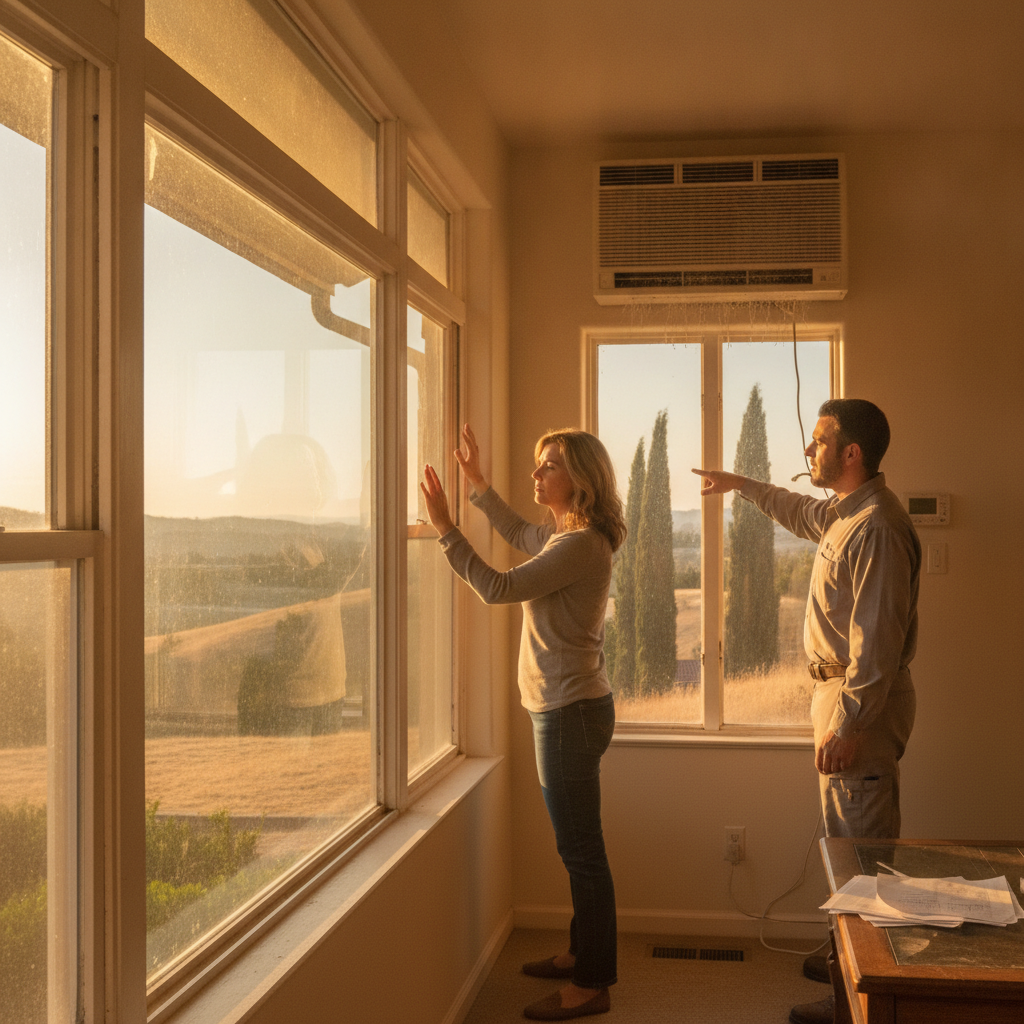
What Sonoma County Homeowners Should Know About HVAC and Windows — How Glazing, Orientation, and Window Age Are Quietly Undermining Your System’s Performance
If your HVAC system runs longer than it should, your energy bills keep climbing, and certain rooms never seem to reach a comfortable temperature no matter what you do — there’s a good chance your windows are part of the problem. In Santa Rosa and throughout Sonoma County, we work in homes where the HVAC system is actually doing its job fine, but the windows are undoing most of that work. It’s one of the most overlooked comfort problems in the region, and it’s almost never discussed by HVAC contractors or window companies — because neither one wants to point at the other.
This article covers what you actually need to know: how your windows affect your heating and cooling system’s performance, what’s different about Sonoma County homes specifically, and what your practical options are when windows are the root cause of comfort or efficiency problems.
Why Windows and HVAC Are More Connected Than Most People Realize
Your heating and cooling system is sized based on a calculation called a load calculation — essentially, how much heat your home gains in summer and loses in winter. Windows are one of the biggest variables in that equation. A standard single-pane window loses heat roughly five to six times faster than a well-insulated wall. In summer, unshaded south- or west-facing windows can drive more heat gain into a room than everything else combined.
This matters because when your system was originally installed — or when it was sized for replacement — whoever did that calculation made assumptions about your windows. If those windows have since deteriorated, if the home was sold with the original 1960s single-pane glass still in place, or if you’ve added a room with more glazing than the original design, your system may simply not be able to keep up. It’s not that the equipment is failing. It’s that it’s fighting a losing battle.
We see this regularly in older Santa Rosa neighborhoods like the West End, South Park, and Railroad Square, where homes built in the 1940s through 1970s often still have their original aluminum-framed single-pane windows. The houses have character, but the thermal performance of those windows is genuinely poor by modern standards.
The Sonoma County Climate Factor: Why This Matters More Here Than Most Places
Sonoma County has a Mediterranean climate — hot, dry summers and cool, wet winters — that swings hard enough to stress HVAC systems in both directions. What makes our region a little unusual is how variable conditions can be even within a short distance. A home in Petaluma near the bay corridor deals with different wind and moisture exposure than a home in Kenwood or the Sonoma Valley. A house in Healdsburg can see summer temperatures 15 to 20 degrees hotter than a home a few miles west toward Guerneville and the river corridor.
That variability affects how much your windows are working against you — or for you. West-facing windows in Healdsburg or Rincon Valley that bake in afternoon sun from June through September are a completely different problem than north-facing windows in a shaded Sebastopol neighborhood that lose heat steadily through a damp, overcast January.
The point is that generic advice — “get double-pane windows” — doesn’t really tell you what’s happening in your specific home or what the right fix actually is. That requires someone looking at your situation honestly, not just selling you something.
How Window Orientation Affects Heating and Cooling Load
Not all windows are created equal in terms of their impact, and orientation matters a lot:
- South-facing windows are generally your friend in winter — they allow passive solar gain during the day when the sun is lower. In summer, a properly designed roof overhang can shade them. Problems arise when there’s no overhang or when interior blinds are the only barrier.
- West-facing windows are the most common trouble spot for summer overheating in Sonoma County. Afternoon sun hits these windows at a lower angle and with full intensity, pushing heat directly into living spaces during the hottest part of the day. Rooms with large west-facing glass are notoriously hard to cool, no matter how capable the system is.
- North-facing windows rarely cause summer overheating but can be a significant source of winter heat loss, especially if they’re single-pane or if the seals have failed on older double-pane units.
- East-facing windows receive morning sun and generally present fewer problems, though they can contribute to early-morning overheating in summer.
When we’re called to diagnose a room that’s consistently hot or cold, orientation is one of the first things we look at. A ductless mini-split in a problematic west-facing room, for example, can solve a comfort problem that a central system simply cannot address effectively — not because the central system is undersized for the whole house, but because that particular room has a thermal load the central system was never designed to handle on its own. Heat pump technology in a ductless configuration is often the most practical solution for exactly this kind of situation.
The Problem With Failed Double-Pane Seals — A Gap Nobody Talks About
One issue that doesn’t get enough attention is failed insulated glass unit (IGU) seals in double-pane windows. When the seal between the two panes fails, the insulating gas (usually argon) escapes and moisture enters. You’ll often see this as fogging or condensation between the panes that you can’t wipe away. The visible fogging is annoying, but the real problem is thermal — that window has now reverted to performing nearly as poorly as single-pane glass.
In Sonoma County, where homes built in the 1980s and 1990s often have original double-pane windows that are now 30 to 40 years old, failed seals are extremely common. Homeowners assume they have double-pane protection because they installed it once. But if the seals have failed, they don’t — and their HVAC system is compensating for it on every hot or cold day without anyone realizing why.
If your energy bills have crept up over the last several years and your home was reasonably efficient before, this is worth investigating before you assume the HVAC system itself needs to be replaced or upsized.
What This Means for Your HVAC System Specifically
When windows are underperforming significantly, the practical effects on your HVAC system include:
- Longer run times, which increase wear and operating costs
- Difficulty reaching or maintaining set temperature in affected rooms
- Uneven comfort across the house — some rooms fine, others perpetually uncomfortable
- Condensation issues in winter near poorly sealed windows, which can also affect air quality
- Oversizing pressure — some homeowners are told they need a bigger system when what they really need is better windows
Upsizing your HVAC system to compensate for window problems is the wrong answer almost every time. A larger system will short-cycle — it’ll reach thermostat setpoint quickly in the areas it can condition and shut off, leaving poorly insulated areas still uncomfortable while also running less efficiently overall. Addressing the windows, or adding targeted supplemental conditioning to problematic zones, is the more effective path.
If you’re dealing with uneven comfort and you’re not sure whether your system or your windows are to blame, an honest HVAC contractor should be willing to walk through this with you rather than immediately recommending new equipment. That’s the kind of assessment we do before recommending anything. You can learn more about what we offer for residential heating repair and related diagnostics on our services page.
Practical Options When Windows Are the Problem
You have a few directions you can go, and the right answer depends on your budget, your home’s age, and the severity of the issue:
- Window replacement is the most complete fix. Modern double- or triple-pane windows with low-e coatings and argon fill make a meaningful difference in both heat gain and heat loss. This is a significant investment, but California utilities and some rebate programs may offset part of the cost depending on your situation.
- Window film can reduce solar heat gain considerably on problem windows, especially west-facing glass, without the cost of full replacement. Quality matters here — professionally installed low-e window film performs meaningfully better than DIY options.
- Exterior shading — awnings, overhangs, or shade screens — addresses the heat gain problem at the source before sunlight even hits the glass. This is often the most cost-effective intervention for summer overheating.
- Supplemental zone conditioning via ductless mini-splits addresses rooms that are chronically uncomfortable regardless of what the central system does. This doesn’t fix the window problem, but it gives that space dedicated conditioning capacity matched to its actual thermal load.
In many Sonoma County homes, especially older ones in Fountaingrove, Windsor, or the rural areas around Sonoma and Kenwood, the most practical near-term solution is a combination of simple shading measures plus targeted mini-split conditioning in the worst rooms — while a longer-term window upgrade plan is developed. That’s a real conversation to have, and one we’re happy to have with you without any pressure to buy equipment you may not need.
Frequently Asked Questions
How do I know if my windows are making my HVAC system work harder?
The most common signs are rooms that stay uncomfortable despite the system running, energy bills that have increased without explanation, visible fogging between double-pane glass, and drafts near window frames even when windows are closed. An HVAC technician doing a thorough assessment should factor in your window condition — not just inspect the mechanical system.
Can I just upsize my AC to compensate for bad windows?
It’s not recommended. Oversizing causes short-cycling, which reduces efficiency, increases wear, and can create humidity problems in winter. Addressing the root cause — the windows — or adding targeted zone conditioning is a better long-term approach.
Do ductless mini-splits work well in rooms with a lot of glass?
Yes, and they’re often a good fit precisely because they provide dedicated capacity to a specific zone. A mini-split in a sun-room or a west-facing great room can condition that space independently without pulling from the central system’s limited capacity. They’re also highly efficient, which helps offset the extra load those windows create.
Does window orientation matter differently in Sonoma County than in other parts of California?
To some extent, yes. Our Mediterranean climate means hot, dry summers and mild, wet winters — so both summer heat gain and winter heat loss are real concerns. In more coastal areas near Bodega Bay or Petaluma, marine influence moderates temperatures but increases moisture exposure, which can accelerate window seal failure. Inland areas like Healdsburg or Kenwood face more extreme temperature swings that amplify the impact of poor-performing windows in both seasons.
Should I fix my windows before replacing my HVAC system?
If your windows are significantly degraded and your HVAC system still functions, it can make sense to improve the windows first — or at least plan both upgrades together. Replacing your HVAC system without addressing poor windows means your new system gets sized and installed without accounting for improvements that could reduce the required capacity. Talk to a contractor who will walk through the full picture with you, not just focus on selling equipment.
Talk to Someone Who’ll Give You a Straight Answer
At Stout’s Heating & AC, Inc., we’ve been serving homeowners across Santa Rosa and Sonoma County since 1992. We’re not going to tell you that you need a new system if your windows are the actual problem — and we’re not going to ignore window-related issues and let you wonder why your system never quite keeps up. If you want an honest assessment of what’s happening in your home and what your real options are, we’re here for that conversation.
Whether you’re dealing with an uncomfortable room, climbing energy bills, or just want to understand your system better before making any decisions, reach out to us and we’ll schedule a time to take a look. No pressure, no upsell — just straight talk from people who’ve been doing this work in this community for over 30 years.