
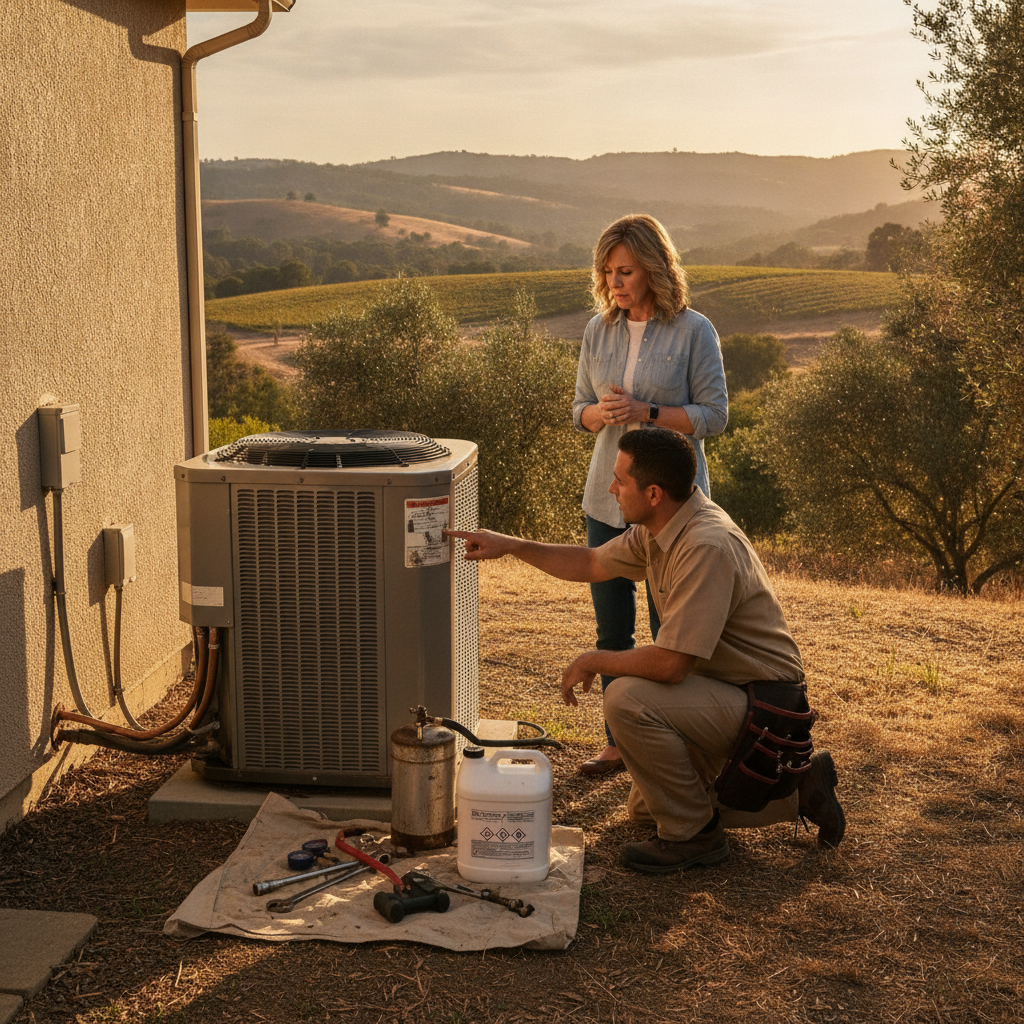
What Sonoma County Homeowners Should Know About HVAC Refrigerant Changes — How the R-22 to R-410A to R-454B Transition Affects Your System and Your Wallet
If your central air conditioner is more than ten years old, there’s a real chance it runs on a refrigerant that’s either already been banned or is heading toward phase-out within the next few years. For homeowners in Santa Rosa and across Sonoma County, this isn’t abstract regulatory news — it’s the kind of thing that turns a routine AC repair into an unexpected replacement conversation. Understanding where things stand right now, and what’s coming next, can save you from getting blindsided during a summer heat wave.
The Short Version: Three Refrigerants, Three Different Situations
There are essentially three refrigerants you need to know about right now: R-22, R-410A, and R-454B. Each one represents a different era of air conditioning equipment, and each one carries different implications depending on how old your system is.
R-22 (Freon): Already Gone
R-22 — commonly called Freon — was the standard refrigerant in residential AC systems for decades. The EPA banned its production and import in the United States as of January 1, 2020. If your system still uses R-22 and develops a refrigerant leak, any technician who services it has to source R-22 from existing stockpiles. Those stockpiles are shrinking, which means prices have climbed sharply. What used to cost a modest per-pound charge can now run several hundred dollars per pound depending on supply at any given time.
If you’re in an older home — say, in Rincon Valley, Fountaingrove, or one of the neighborhoods around Sebastopol that saw a lot of construction in the 1990s and early 2000s — and your AC hasn’t been touched in a while, it’s worth asking your technician which refrigerant your system uses before a problem develops. Finding out during a repair call in August is the worst time to learn this.
The honest advice here: if your R-22 system is leaking refrigerant and the repair cost plus refrigerant cost is approaching $1,500 or more, you’re usually better off putting that money toward a new system. A functioning R-22 system that isn’t leaking can still run, but you’re carrying real financial risk the longer you hold onto it.
R-410A (Puron): Still Here, But on a Clock
R-410A replaced R-22 as the industry standard for most of the 2000s and 2010s and is still in the majority of central AC systems installed in Santa Rosa and across Sonoma County in the last fifteen years. The good news: R-410A equipment is still fully serviceable, refrigerant is still available, and your system isn’t going anywhere soon.
The less good news: the EPA has been progressively restricting R-410A as part of the AIM Act, which targets high-global-warming-potential refrigerants. New residential AC equipment using R-410A can no longer be manufactured as of January 1, 2025. Contractors can still install existing R-410A inventory for some time, and service — including refrigerant recharging — is still permitted. But you should be aware that over the coming years, R-410A will follow the same trajectory R-22 did: gradually tightening supply and rising prices as production winds down globally.
This doesn’t mean you need to panic or replace a healthy R-410A system. It means you should factor this into your long-term planning. If your R-410A system is eight to twelve years old and starting to need more frequent repairs, the math of repair-versus-replace is shifting.
R-454B: What’s Coming Out of the Factory Now
New residential air conditioning equipment manufactured after January 1, 2025 is moving to lower-GWP refrigerants — with R-454B (sold commercially as Puron Advance by Carrier, among others) being the primary replacement for R-410A in residential systems. R-32 is also being adopted in some equipment lines.
R-454B is mildly flammable — classified as A2L — which has required equipment manufacturers and installers to adapt their practices. It’s not a significant hazard in normal residential use, but it does mean installation and servicing requires technicians with proper current training and certification. This is one more reason to work with an established local contractor rather than whoever quotes the lowest number online.
If you’re in the market for a new central AC system or a heat pump in Sonoma County right now, what you’re buying is R-454B or R-32 equipment. This is not a reason to delay a purchase — the equipment is well-tested, efficient, and performing well in real-world use. But it’s something to be aware of when comparing quotes or evaluating what a contractor is proposing.
What This Actually Means for Your Repair-or-Replace Decision
The refrigerant transition is one of several factors that should inform whether you repair an aging system or replace it. Here’s how to think through it practically:
- If your system uses R-22 and is leaking: Get a real cost estimate for the repair including refrigerant, then compare it to the installed cost of a new system. In most cases in the current market, replacement makes more sense — and you’ll gain a far more efficient system in the process.
- If your system uses R-22 and is NOT leaking: Keep maintaining it with regular tune-ups, but start budgeting for replacement within the next few years. Don’t let an unexpected failure during a heat wave make the decision for you.
- If your system uses R-410A and is under ten years old: No immediate action needed. Keep up with maintenance and don’t let anyone pressure you into replacement based on refrigerant type alone. R-410A service will remain available for years.
- If your system uses R-410A, is ten-plus years old, and is having problems: Factor refrigerant availability trends into your repair-versus-replace math. A system that’s already showing its age is a system where expensive refrigerant recharges are a poor investment.
One thing we’d caution against: any contractor who tells you that you need to replace your R-410A system immediately just because of the refrigerant phase-out is getting ahead of the facts. A well-maintained R-410A system can and should serve you for several more years. The question is whether the specific system in front of you is worth continuing to invest in — and that depends on age, condition, repair history, and efficiency, not just refrigerant type.
The Efficiency Angle: Why Now Can Be a Good Time to Upgrade
Here in Sonoma County, PG&E electricity rates have been climbing steadily, and summer heat waves along the Highway 101 corridor — from Petaluma up through Windsor and Healdsburg — are driving longer AC run times. If your existing system is a 10-SEER or 12-SEER unit from fifteen years ago, you’re paying significantly more to run it than you would with a modern 18-SEER or higher system.
Combine that with available California and federal incentives — including federal tax credits for high-efficiency systems and heat pumps, plus PG&E rebate programs — and the total cost of upgrading is meaningfully lower than the sticker price suggests. Check our current financing and rebate information to see what’s available right now, because these programs change periodically and the amounts are worth knowing before you make a decision.
A Gap Competitors Aren’t Filling: The Technician Training Question
Something we’ve noticed most local HVAC websites don’t address is what the refrigerant transition means for technician qualifications. Servicing A2L refrigerants like R-454B requires updated EPA 608 certification knowledge and awareness of specific handling protocols. Not every technician who was trained ten years ago has stayed current.
When you’re hiring someone to work on newer equipment, it’s completely reasonable to ask whether their technicians are current on A2L refrigerant handling. At Stout’s, we’ve been servicing this industry since 1992, and staying current on regulatory changes and equipment evolution is part of what that means — not just for new installations, but for making sure repairs on transitional equipment are done correctly the first time.
Frequently Asked Questions
My AC is still blowing cold — do I need to worry about refrigerant type right now?
Not urgently. If your system is cooling well and not losing refrigerant, the phase-out doesn’t require immediate action. It’s worth knowing what refrigerant your system uses so you’re prepared if a repair need arises.
Can I convert my R-22 system to use a newer refrigerant?
There are R-22 “drop-in” substitute refrigerants on the market, but they’re a temporary workaround, not a true solution. Most HVAC manufacturers don’t recommend or warranty this approach. If your R-22 system is leaking and aging, a proper replacement is a better investment than a stop-gap refrigerant swap.
Is R-454B safe? I heard it’s flammable.
R-454B is classified as mildly flammable (A2L), but this refers to its behavior under specific lab conditions, not normal residential use. It has a much lower flammability risk than, say, natural gas. It’s in use globally in millions of systems. The main implication for homeowners is making sure your contractor is properly trained to handle it — which any reputable company will be.
Will my R-410A system suddenly stop being serviceable?
No. Servicing existing R-410A equipment — including recharging refrigerant — remains permitted under current EPA rules. What changed is that new equipment can no longer be manufactured using R-410A. Your existing system won’t become illegal to service, but refrigerant costs will gradually rise over time as supply tightens.
Are there rebates available if I replace my old AC with a new high-efficiency system?
Yes — federal tax credits, California state programs, and PG&E rebates can all apply depending on the equipment type and efficiency rating. Heat pumps in particular qualify for significant incentives right now. The amounts and eligibility rules change, so it’s worth getting current information when you’re ready to move forward.
Talk to Someone Who Knows Your System
The refrigerant transition is genuinely complicated, and the right answer for your home in Sonoma County depends on what equipment you have, how old it is, and what condition it’s in — not on a one-size-fits-all rule. We’ve been helping homeowners in Santa Rosa and surrounding communities navigate these decisions since 1992, and we’re happy to give you a straight answer without steering you toward something you don’t need.
If you’re not sure what refrigerant your system uses, whether a repair makes sense, or what a replacement would actually cost, request a free estimate and we’ll take a look. No pressure — just honest information so you can make the right call for your home and your budget.
You can also reach us directly at (707) 527-1504 or email help@stoutshvac.com. We offer same-day and emergency service throughout Sonoma County when you need it.