
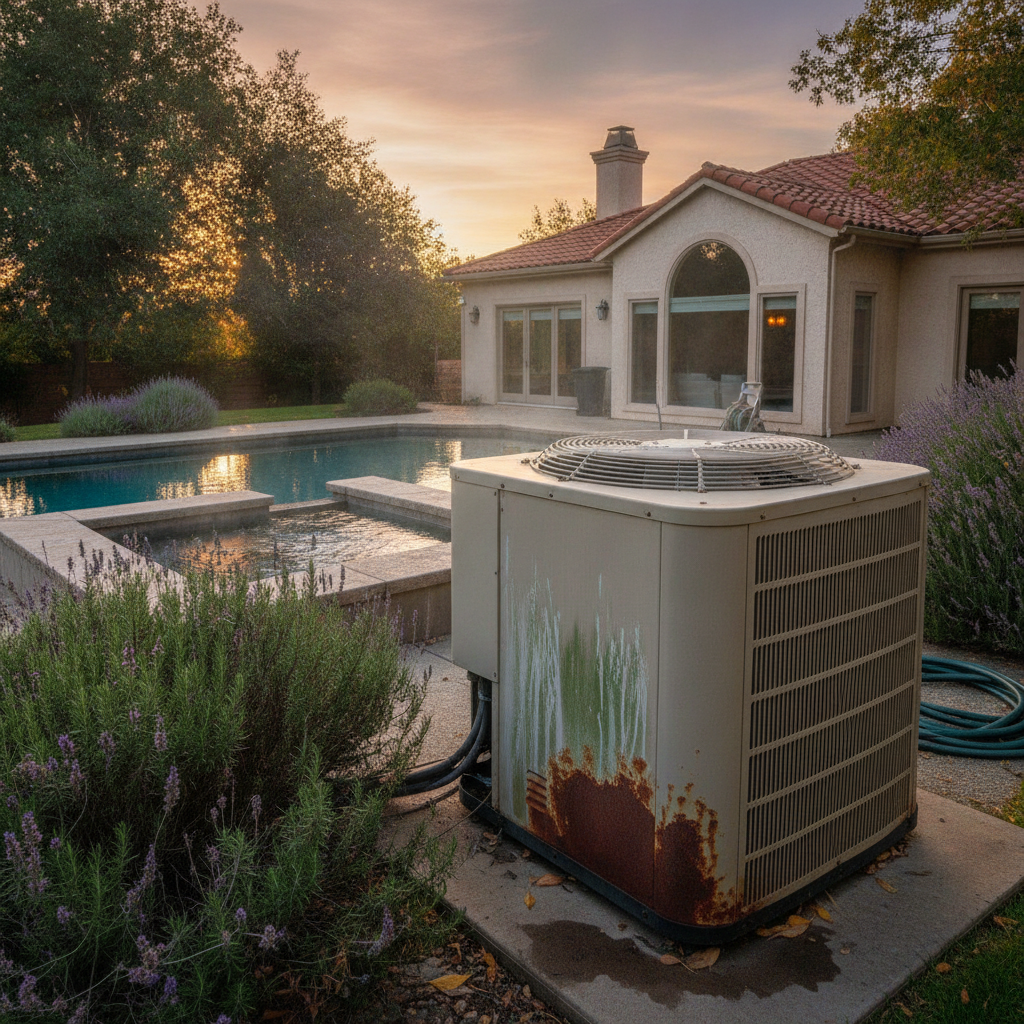
What Sonoma County Homeowners Should Know About HVAC and Pool or Spa Equipment — How Nearby Water Features Affect Your System and What to Watch For
If you have a pool, spa, or hot tub on your property in Sonoma County, your HVAC system may be aging faster than you realize — and not because anything is technically wrong with it. The combination of airborne pool chemicals, elevated moisture, and poor equipment placement can quietly degrade your condenser coils, corrode electrical connections, and cut years off the life of an otherwise healthy system. It’s a topic most HVAC contractors don’t bring up, and one that almost none of the local competitors address at all. Here’s what you actually need to know.
Why Pool and Spa Environments Are Hard on HVAC Equipment
The main culprit is chlorine — or more specifically, chloramines and other volatile compounds that off-gas from pool and spa water. When these compounds drift through the air and get pulled into your outdoor condenser unit, they start attacking the aluminum fins and copper tubing inside the coil. This process is called formicary corrosion, and it’s much more common near pools than most homeowners expect.
You won’t see it happening. The coil looks fine from the outside. But microscopic pitting develops in the copper tubing over time, eventually leading to refrigerant leaks that are expensive to diagnose and repair. In some cases, by the time a homeowner notices their AC isn’t cooling well, the damage is already advanced enough to warrant coil replacement — a cost that runs anywhere from several hundred to several thousand dollars depending on the system.
Salt water pools, which have become increasingly common in Sonoma County neighborhoods from Windsor down through Petaluma, add a different layer of risk. Salt air is aggressively corrosive to metal components. If your condenser is within 20 to 30 feet of a saltwater pool and there’s regular wind or splashing in that direction, you’re dealing with an accelerated corrosion environment that warrants specific protective measures.
Placement Matters More Than Most People Think
When a home is built or a pool is added after the fact, the relationship between the HVAC equipment and the pool area often isn’t considered at all. The condenser unit gets placed wherever it’s convenient — and sometimes that means it ends up directly downwind of the pool equipment pad, right next to the spa jets, or tucked into a corner where steam from a hot tub vents directly toward the unit during winter months.
If you’re adding a pool or spa to your property, or if you’re renovating an existing backyard, it’s worth having an HVAC contractor look at your outdoor equipment placement before construction begins. Relocating a condenser unit after the fact is possible but adds cost and complexity. Getting it right upfront is almost always cheaper.
General guidance: outdoor HVAC equipment should ideally be positioned at least 24 to 36 inches away from any obstruction, with good airflow clearance on all sides. Near a pool, add distance from the water’s edge and orient the unit so the exhaust fan blows away from the pool area, not toward it. For heat pump systems — which are increasingly popular across Sonoma County as homeowners look to offset PG&E costs — the same principles apply, and because heat pumps run year-round, the cumulative exposure risk is higher than with a cooling-only condenser.
The Moisture Problem That Goes Beyond Humidity
Sonoma County’s Mediterranean climate already creates meaningful seasonal moisture swings — dry summers followed by cool, wet winters. Homes with pools or spas add a layer of localized humidity that operates on a different schedule. A hot tub running on a cold January evening generates significant steam. An uncovered pool in the morning sun off-gases moisture constantly. And all of that water vapor has to go somewhere.
When it migrates toward your HVAC equipment — indoors or outdoors — it can cause problems beyond coil corrosion. Electrical connection points inside your air handler or furnace can oxidize more quickly in higher-humidity environments. Drain pans in air handlers can develop algae or scale buildup faster. And if your home’s return air pathway draws from an area near the pool — say, a sliding glass door that’s frequently open — you may be introducing more moisture-laden air into your system than you’d expect.
This is one of the reasons that homes with pools in areas like Kenwood, Healdsburg, or Sebastopol — where outdoor living spaces often blur into indoor spaces — benefit from a closer look at their whole-home ventilation strategy. Residential ventilation systems designed with that moisture balance in mind can make a meaningful difference in both comfort and equipment longevity.
What a Good Maintenance Inspection Should Cover for Pool Homes
Standard bi-annual HVAC tune-ups are a good baseline for any home. But if you have a pool or spa, there are a few additional things worth asking your technician to check specifically:
- Coil condition: Ask for a close inspection of the condenser coil fins and tubing for early signs of formicary or salt corrosion. Catching it early allows for coil coating treatments that can extend coil life significantly.
- Electrical connections: Chlorine and salt air accelerate oxidation at terminals, contactors, and wiring connections. These should be checked and cleaned as part of any inspection near a pool environment.
- Drain pan and drain line: Higher moisture environments mean faster biological growth in the condensate system. A clogged drain line can cause water damage inside the air handler that has nothing to do with the pool — but the pool environment speeds up the problem.
- Refrigerant levels: If you’re seeing gradual cooling performance decline, a slow refrigerant leak from corrosion-related coil damage may be the culprit rather than a mechanical failure.
- Unit placement and clearance: A technician should flag any vegetation, pool equipment, or structures that have grown into the condenser’s airflow path since installation.
At Stout’s, we’ve been servicing homes across Santa Rosa and Sonoma County since 1992. Pool homes are common in this area, and the specific wear patterns we see on HVAC equipment near water features are something our technicians check for as a matter of habit — not something you have to ask three times to get addressed.
Coil Coating: A Protective Option Worth Knowing About
If your condenser is already positioned near a pool and relocation isn’t practical, there’s a protective treatment worth discussing with your HVAC contractor: coil coating. Manufacturers and aftermarket suppliers produce epoxy or polymer coatings that can be applied to existing condenser coils to create a barrier against corrosive compounds in the air.
This isn’t a DIY project — improper coating can restrict airflow or interfere with heat transfer — but when applied correctly by a qualified technician, it can meaningfully extend coil life in challenging environments. Some newer systems also come factory-coated for coastal or chemically aggressive environments; if you’re replacing a condenser in a pool home, it’s worth asking specifically about factory-coated coil options from brands like Trane, Carrier, Daikin, or Lennox.
The cost of coil coating is modest compared to coil replacement. If you’ve already spent money on a system you want to protect, it’s one of the more straightforward investments available. Check our current offers if you’re looking at maintenance or equipment upgrades — financing options are available for larger projects.
Frequently Asked Questions
How far should my AC condenser be from a pool or spa?
As a general rule, at least 6 to 8 feet of clearance is a minimum, but further is better if your yard allows it. The goal is to minimize direct exposure to chemical off-gassing, steam, and splashing. Orientation matters too — the unit should exhaust away from the pool area, not toward it.
Can pool chemicals really damage my HVAC system?
Yes, and it’s more common than most homeowners realize. Chloramines and related compounds that evaporate off pool and spa surfaces are corrosive to the copper and aluminum components inside your condenser coil. The damage is gradual and typically invisible until you have a refrigerant leak or significant performance decline.
My pool is saltwater. Is that worse for my HVAC equipment?
Salt air is more aggressively corrosive than standard chlorine environments for metal components. If your condenser is within 20 to 30 feet of a saltwater pool, you should ask your HVAC technician about protective coil coatings and plan on more frequent inspections.
Would a ductless mini-split be better for a room that opens to a pool area?
It can be a good option for spaces like pool houses, covered patios, or bonus rooms adjacent to outdoor living areas. A mini-split keeps the main air handler indoors and limits what the outdoor unit is exposed to. It’s worth discussing based on your specific layout and how the room is used.
Does this affect my HVAC warranty?
Corrosion damage from environmental factors like pool chemicals is generally not covered under manufacturer warranties, which is one more reason to address placement and protection proactively rather than after a failure occurs.
Talk to Someone Who Knows the Area
Pool homes are part of the fabric of Sonoma County — from Rohnert Park neighborhoods to wine country estates near Kenwood and Healdsburg. If your HVAC system is anywhere near a pool, spa, or outdoor water feature, it’s worth having a technician take a look with that specific context in mind — not just a generic tune-up checklist.
Stout’s Heating & AC, Inc has been working in this area since 1992. We’re not a franchise, and we’re not going to recommend more than your system actually needs. If you want an honest assessment of how your outdoor HVAC equipment is holding up near your pool or spa, reach out to us directly or request a free estimate. We’ll give you a straight answer.