
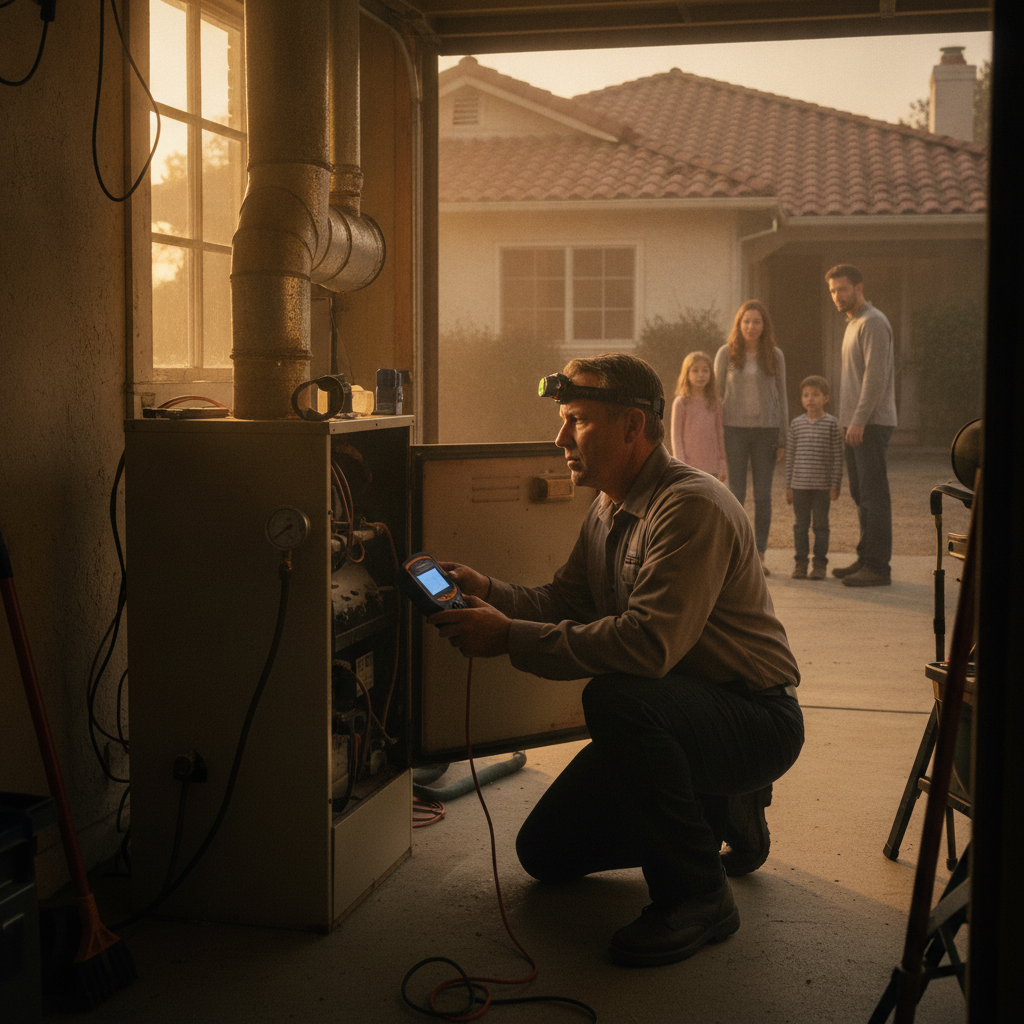
What Sonoma County Homeowners Should Know About HVAC and Indoor Carbon Monoxide Risk — Why Your Heating System Is the Threat Most People Underestimate
Carbon monoxide is invisible, odorless, and genuinely dangerous — and in Sonoma County, your gas furnace is almost certainly the biggest potential source of it in your home. If you have a gas heating system and you’ve never had a combustion safety inspection done by a qualified HVAC technician, that’s worth taking seriously. A CO detector is a backup warning system. It is not a substitute for making sure your heating equipment is actually in safe working condition before you switch it on for the season.
Why the HVAC Industry Doesn’t Talk About This Enough
Most HVAC content — including what you’ll find on many local competitor websites — focuses on comfort, efficiency, and cost. Carbon monoxide risk gets mentioned in passing, usually as a checkbox item in a tune-up list. What rarely gets explained in any useful detail is how a furnace produces carbon monoxide, which conditions create real risk versus theoretical risk, and what homeowners should actually do beyond buying a detector and hoping for the best.
That gap matters. We’ve been servicing heating systems in Santa Rosa and across Sonoma County since 1992, and the CO-related calls we get are almost always from homeowners who had no idea there was a problem until something went noticeably wrong. The equipment rarely announces itself. That’s the whole issue.
How a Gas Furnace Produces Carbon Monoxide — and How It Ends Up in Your Air
Gas furnaces produce CO as a normal byproduct of combustion. Under normal operating conditions, that combustion gas — including carbon monoxide — travels through your heat exchanger and exits through your flue or exhaust vent, completely separated from the air your family breathes. The air you breathe gets heated by passing over the outside of the heat exchanger, never mixing with the combustion gases inside it.
The problem happens when that separation fails. The most common cause is a cracked or deteriorated heat exchanger. Heat exchangers expand and contract thousands of times over the life of a furnace, and eventually — especially in systems that are 15 or more years old — they can develop cracks or holes. When that happens, combustion gases can leak into the airstream that flows through your home. Other causes include blocked or improperly installed flue venting, a furnace operating with insufficient combustion air, and backdrafting — where negative pressure inside your home actually pulls exhaust gases back through the venting system rather than pushing them out.
Older homes in neighborhoods like Coffey Park, Rincon Valley, and parts of Petaluma and Rohnert Park often have heating systems that are well past their design life, in some cases still running 20- or 25-year-old equipment. Those are the systems that carry the most risk, and they’re exactly the ones that tend to get a quick filter change and a pass rather than a real safety inspection.
What a CO Detector Does — and What It Doesn’t
CO detectors are required in California residential properties, and they’re worth having. But it’s important to understand what they’re actually designed to do. Most residential CO detectors are calibrated to alert at exposure levels and durations that represent an acute health threat — meaning they’re meant to wake you up before you’re incapacitated, not to detect low-level chronic exposure.
A furnace with a small heat exchanger crack may be leaking low concentrations of carbon monoxide into your home’s air for weeks without ever triggering a standard detector. You might feel tired or get headaches that seem unrelated to anything in particular. Or you might feel nothing at all. That’s not a reason to skip the detector — you absolutely need one — but it is a reason not to treat a quiet detector as proof that your furnace is safe.
Placement matters too. California law requires CO detectors outside each sleeping area. Many homeowners have one detector in a hallway and consider themselves covered. A detector nowhere near the furnace room or the return air pathway is going to be less responsive than it could be. This is worth thinking through.
The Combustion Safety Inspection — What It Actually Involves
A real combustion safety inspection goes beyond the standard tune-up checklist. It involves checking for heat exchanger integrity — usually through a combination of visual inspection, flame observation under operating conditions, and sometimes combustion gas analysis. It includes verifying that your flue and exhaust venting is correctly installed, free of obstructions, and that it’s actually moving combustion gases out of the building under real operating conditions. It also means checking that your furnace has adequate combustion air supply, which can become an issue in tightly sealed homes or after weatherization projects that reduce natural infiltration.
When we do residential heater repair and inspection work in Santa Rosa and the surrounding area, the heat exchanger check is not optional — it’s part of what a responsible heating service call looks like. A contractor who cleans a flame sensor, checks the blower, and calls it a safety inspection is leaving out the part that actually matters for CO risk.
When Heating System Age Becomes a Safety Issue
Most gas furnaces have a design life of 15 to 20 years. In practice, a well-maintained unit in a mild climate like Sonoma County’s can run longer — but the heat exchanger doesn’t last forever, and there’s no reliable way for a homeowner to inspect it themselves. If your furnace is more than 18 years old and has never had a proper heat exchanger inspection, that’s a real gap in your home’s safety picture, not just a maintenance inconvenience.
This is also a relevant consideration when you’re buying a home. A home inspection will note the age of the furnace and may flag obvious issues, but a general home inspector is not an HVAC technician and typically won’t perform a combustion safety analysis. If you’re purchasing an older home in Windsor, Healdsburg, or Sebastopol — particularly one with an older furnace — a standalone HVAC inspection before close of escrow is worth the cost.
Newer Systems Aren’t Immune — What Else Can Go Wrong
Even a relatively new furnace can create CO risk under the wrong conditions. The most common issue we see in newer systems is venting problems — either improper installation from the start or physical changes to the home that create negative pressure conditions. Newer high-efficiency furnaces use PVC exhaust pipes rather than traditional metal flues, and those plastic systems can fail or become obstructed in ways that are less obvious than a damaged metal flue.
If you’ve had significant weatherization work done — new windows, added insulation, whole-house sealing — your home may be tight enough to create combustion air problems for a gas furnace that was installed when the house was less airtight. This is a real issue and one that’s easy to miss unless someone specifically looks for it. All-electric heat pump systems eliminate combustion entirely, which is one reason they’ve become increasingly popular with Santa Rosa homeowners who are thinking seriously about indoor air quality and safety alongside efficiency and PG&E costs.
Frequently Asked Questions
How often should I have my gas furnace inspected for carbon monoxide safety?
At minimum, annually — ideally in the fall before heating season begins. If your system is older than 15 years, or if you’ve noticed any unusual symptoms (headaches, fatigue at home that clears up when you leave), don’t wait for the annual schedule. Call for an inspection now.
My CO detector has never gone off. Does that mean my furnace is safe?
Not necessarily. Residential CO detectors are designed to alert at concentrations and durations associated with acute poisoning risk, not low-level chronic exposure. A furnace with a small heat exchanger leak may produce CO levels your detector won’t alarm on while still degrading your indoor air quality over time. A detector is a safety backup, not a diagnostic tool.
Can a technician tell me on the spot if my heat exchanger is cracked?
In many cases, yes — though the inspection method matters. A visual inspection alone is sometimes insufficient for small cracks. A qualified technician will observe burner flame behavior under operating conditions and may use combustion gas analysis equipment. Be cautious of any contractor who claims to check the heat exchanger without actually running the system through a proper evaluation process.
What should I do if my CO detector goes off?
Get everyone — including pets — out of the house immediately. Don’t stop to open windows or investigate the source. Call 911 from outside. Once the fire department has cleared the property, call an HVAC technician before you run the heating system again. Do not assume the alarm was a false positive without having the system properly inspected.
Is a heat pump a safer option from a CO standpoint?
Yes. Heat pumps don’t burn fuel, so they produce no combustion gases and no carbon monoxide risk from the heating system itself. If eliminating CO risk is a priority for your household — especially if you have young children, elderly family members, or anyone with respiratory conditions — a heat pump upgrade is worth discussing. Sonoma County’s mild winters make heat pumps particularly effective here, and current PG&E rebates and federal tax credits can offset a meaningful portion of the installation cost.
Don’t Wait Until Something Smells Wrong — Because You Won’t Smell Anything
That’s the thing about carbon monoxide. There’s no warning sign you can see or smell. The only reliable protection is a properly functioning, recently inspected heating system — and a CO detector as a backup, not as your first line of defense.
If your furnace hasn’t been inspected this season, or if it’s been running for years without a real combustion safety evaluation, we’d encourage you to get that taken care of before the cold weather sets in. Stout’s Heating & AC, Inc has been doing this work in Santa Rosa and across Sonoma County since 1992. We’re not here to sell you a new system you don’t need — we’re here to make sure your existing equipment is running safely and give you an honest assessment of what, if anything, needs attention.
Contact us to schedule a heating system inspection or request a free estimate if your system is due for evaluation or replacement. You can also check our current offers and financing options if you’re considering an upgrade to a high-efficiency or heat pump system. We’re here when you need us.