
What Sonoma County Homeowners Should Know About HVAC and Pets — How Animals in the House Affect Your System and What to Do About It
If you have a dog, a cat, or a few of both, your HVAC system is working harder than it would in a pet-free home — often significantly harder. In Santa Rosa and across Sonoma County, we’ve been in thousands of homes over the years, and pet households have some of the most consistently overworked and undermaintained heating and cooling systems we see. That’s not a criticism; most pet owners just don’t realize how much fur, dander, and airborne debris their animals are putting into circulation every single day. This article explains exactly what’s happening, what the real risks are, and what you can do to protect your system without spending a fortune.
Why Pets Are Genuinely Hard on HVAC Systems
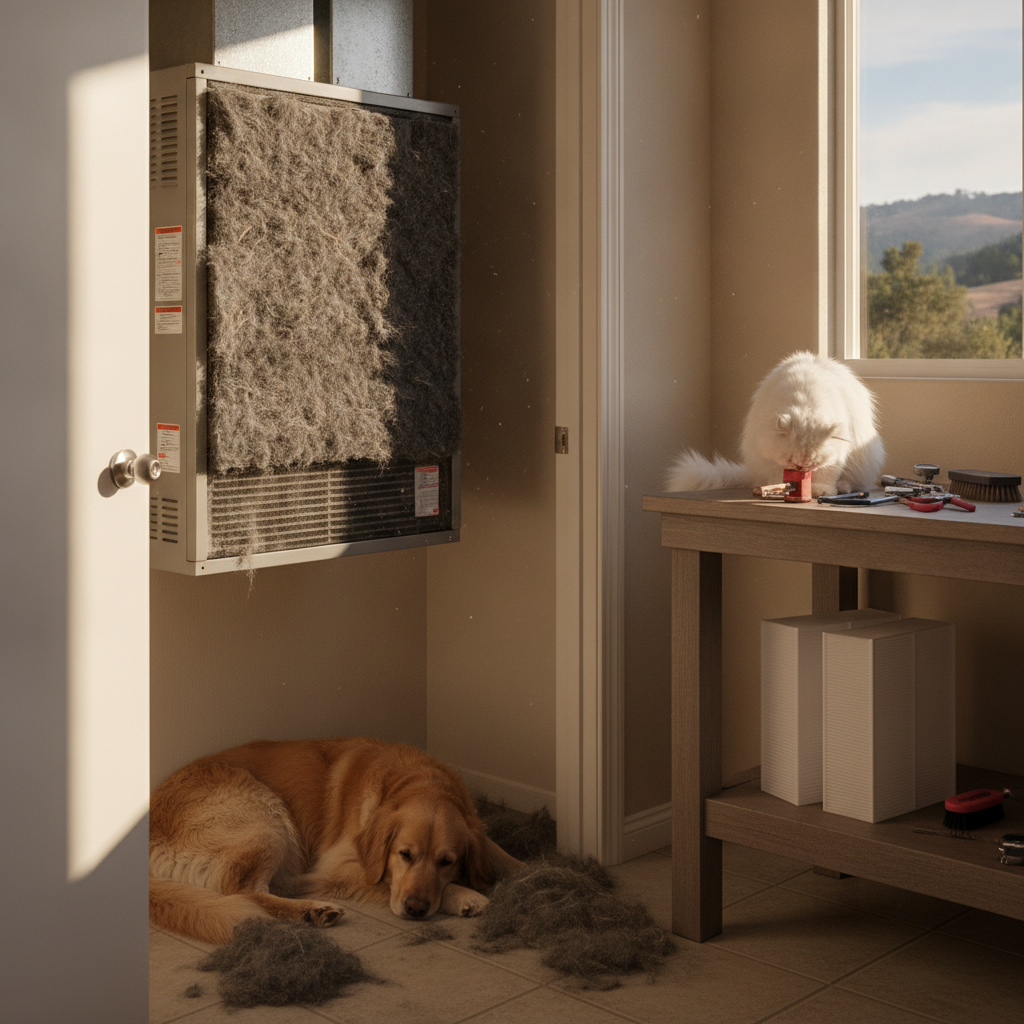
Your HVAC system circulates the air in your home continuously. Every particle floating around in that air — dust, dander, fur, skin cells, litter dust — gets pulled into your return vents and through your filter. In a home with one or two shedding pets, that volume of airborne debris is dramatically higher than most homeowners assume.
The most immediate effect is filter clogging. A standard 1-inch pleated filter in a pet-free home might last 60 to 90 days before needing replacement. In a home with two dogs or a couple of cats, that same filter can be fully saturated in three to four weeks. When a filter clogs, your system doesn’t just run less efficiently — it strains. The blower motor works harder to pull air through a restricted filter, which increases energy consumption, raises wear on the motor, and in some cases triggers safety shutoffs. Over time, this kind of chronic strain shortens the lifespan of your equipment.
The second issue is what gets past the filter. No filter catches everything, and fine pet dander — particularly from cats — is small enough to pass through even moderately rated filters. That dander accumulates on your evaporator coil, inside your ductwork, and on blower fan blades. A coated evaporator coil loses heat-transfer efficiency quickly. A coil that’s insulated by a thin layer of dander and debris is essentially a coil working against itself, which means your system runs longer cycles to hit the same temperature setpoint.
The Air Quality Dimension — Especially During Wildfire Season
Sonoma County homeowners already deal with wildfire smoke every summer and fall. During poor air quality days, most people close their windows and rely on their HVAC system to recirculate and filter indoor air. In a pet household, that indoor air is already carrying a significant baseline load of allergens and particulates. Combine that with smoke infiltration and you have an indoor air quality situation that a standard 1-inch filter simply isn’t equipped to handle.
If anyone in your household has asthma, pet allergies, or respiratory sensitivities, this combination is worth taking seriously. Upgrading to a higher-efficiency filtration solution — whether that’s a 4-inch media filter, a whole-house air purifier, or an in-duct UV system — makes a meaningful difference in what you’re actually breathing. This is one of those cases where the HVAC system isn’t just about comfort; it’s a direct health issue. Our residential ventilation services include indoor air quality assessments that can help you figure out what’s actually worth the investment for your specific home and situation.
What Pet Owners Should Actually Be Doing Differently
Most HVAC maintenance advice is written for average conditions. If you have pets, you’re not operating under average conditions. Here’s what changes:
- Change your filter every 3 to 4 weeks if you have multiple shedding pets, or at minimum monthly. This single habit eliminates most of the performance problems we see in pet households.
- Move up to a MERV 11 or MERV 13 filter if your system can handle it. These catch significantly more dander and fine particulates than a standard MERV 8. Important caveat: not every system is designed to push air through a denser filter without strain. Check with a technician before upgrading filter ratings, because a filter that’s too restrictive for your equipment can cause the same problems as a clogged filter.
- Keep return vent areas clear and clean. Pet hair accumulates at return grilles faster than anywhere else. Pull the grille off and vacuum it out every month. It takes five minutes and it matters.
- Schedule a professional coil cleaning annually. The evaporator coil is something most homeowners never think about, but in a pet household it’s one of the first things a technician should look at. A dirty coil dramatically reduces system efficiency and can eventually cause the coil to ice over.
- Have your ductwork inspected every few years. If your pets shed heavily and you’ve owned the home for a long time without professional duct cleaning, there’s likely a meaningful accumulation inside the system that no filter change will address.
Outdoor Unit Concerns Pet Owners Often Miss
If you have dogs that spend time in the yard, your outdoor condenser unit may be at risk in ways that surprise homeowners. Dogs — especially males — will frequently urinate on or near the condenser coil fins. Urine is highly corrosive to aluminum coil fins and copper refrigerant lines. Repeated exposure leads to fin deterioration, pinhole refrigerant leaks, and eventually compressor failure. This is a legitimate equipment damage issue, not just a hygiene concern.
Protecting the condenser is straightforward: install a low fence or barrier around the unit that keeps dogs at least two feet away on all sides while maintaining adequate airflow. Don’t enclose it tightly — the unit needs to breathe — but a simple barrier does real protective work. We see corroded condenser coils in pet households throughout Petaluma, Rohnert Park, and Windsor fairly regularly, and in most cases a simple barrier would have prevented the damage.
Heat Pumps and Pet Households — A Good Combination
If you’re considering a system upgrade, heat pumps are worth thinking about from a pet owner’s perspective. Because they handle both heating and cooling from a single system, you’re maintaining one set of components rather than two separate systems. They also tend to run in longer, more consistent cycles compared to gas furnaces cycling on and off, which means more continuous air filtration through your filter media. For pet households concerned about air quality, that steady circulation is a practical advantage. Santa Rosa’s moderate climate — warm dry summers, cool wet winters — is also well-suited to heat pump performance, so you’re not compromising on comfort to get there.
Frequently Asked Questions About HVAC and Pets in Sonoma County
How often should I really change my air filter if I have pets?
For a single pet, once a month is a reasonable target. For two or more shedding animals, every three weeks is more realistic. If you hold your filter up to light and can’t see through it, it needed to come out last week.
Can pet dander damage my HVAC system long-term?
Yes, indirectly. Dander buildup on the evaporator coil reduces efficiency and can lead to coil icing. A chronically clogged filter puts extra strain on the blower motor. These issues shorten system lifespan if they’re not addressed through consistent maintenance.
Is professional duct cleaning worth it for pet owners?
It depends on how long you’ve been in the home and how diligent you’ve been with filter changes. If you’ve had heavy-shedding pets for several years with inconsistent filter maintenance, a professional duct inspection and cleaning is probably overdue. It’s not something we’d say every pet household needs on a fixed schedule — but it’s worth having someone take a look.
My cat likes to sleep on the outdoor unit. Is that a problem?
Mostly harmless when the unit is off, but a habit worth discouraging. Cats scratching around the condenser fins can bend or damage them over time. More practically, when the unit kicks on it’s loud and surprising — not great for the cat, and the startled scrambling across fins isn’t good for the coil either.
Does Stout’s Heating & AC service homes in Sebastopol and Windsor, not just Santa Rosa?
Yes. We serve all of Sonoma County, including Sebastopol, Windsor, Petaluma, Rohnert Park, and everywhere in between. If you’re in Sonoma County, we can get to you — including same-day service for urgent repair situations.
Ready to Get Your System in Better Shape?
If you have pets and you haven’t had your HVAC system professionally serviced in the last year, it’s worth scheduling a tune-up before the next season hits. We’ll check your coil, inspect your filter and airflow, and give you an honest assessment of what’s going on — no upselling, no scare tactics. We’ve been doing this in Santa Rosa since 1992, and we’re not in the business of creating problems that don’t exist. Contact Stout’s Heating & AC, Inc. to schedule service or ask a question. We’re local, we’re straightforward, and we’re happy to help.