
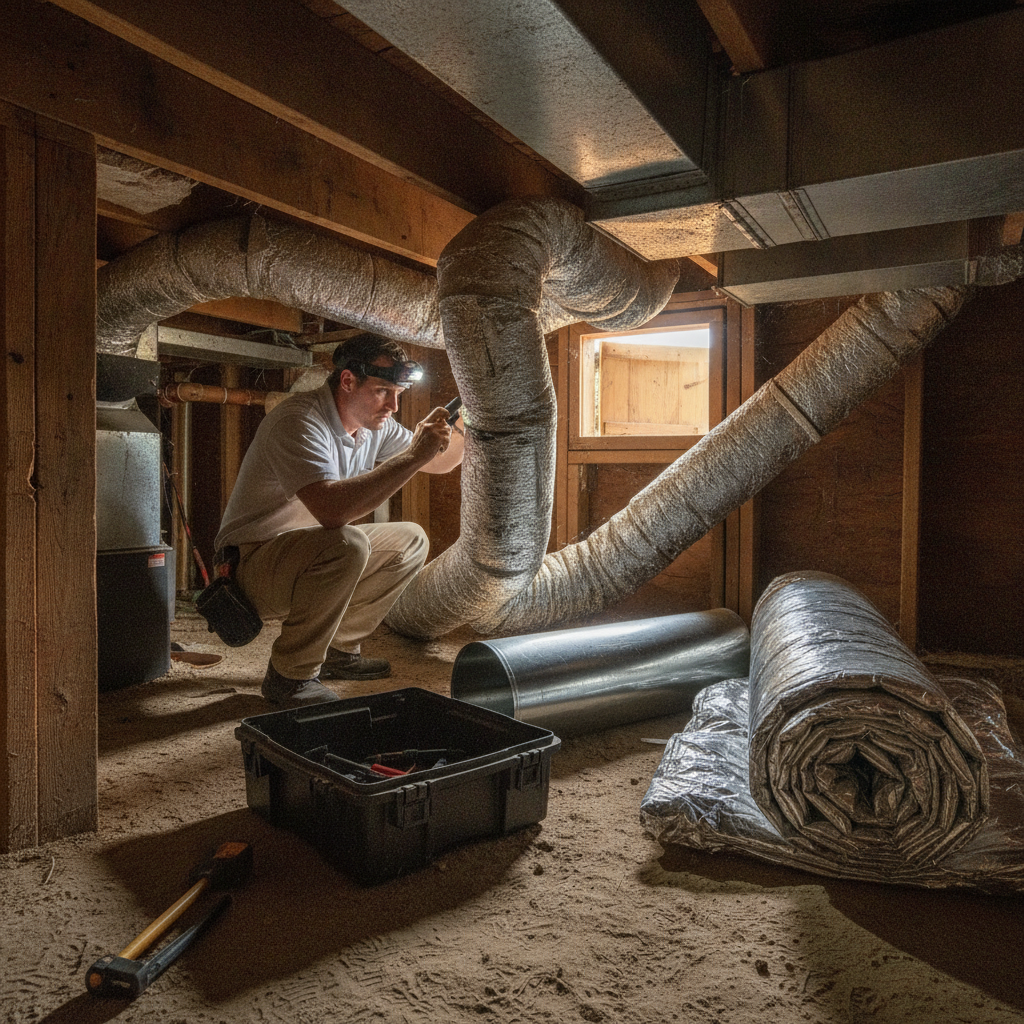
What Sonoma County Homeowners Should Know About HVAC and Aging Ductwork — When to Repair, When to Replace, and What Leaky Ducts Are Actually Costing You
If your heating and cooling system runs fine but certain rooms in your Santa Rosa home are always too warm, too cold, or just feel stuffy — there’s a good chance the problem isn’t your furnace or air conditioner at all. It’s what’s hidden in your walls, attic, or crawl space: the ductwork. Leaky, deteriorating, or poorly designed duct systems are one of the most common and least talked-about sources of energy waste and comfort problems in Sonoma County homes, and they’re easy to overlook because most of the damage is invisible.
Why Ductwork Is So Often Overlooked — And Why That’s a Problem
Most homeowners think about their HVAC system as the equipment they can see: the furnace in the garage, the air handler in the utility closet, the condenser sitting outside. Ductwork is out of sight, so it tends to stay out of mind — until the PG&E bill spikes or one room of the house refuses to stay comfortable no matter how long the system runs.
According to the U.S. Department of Energy, the average ducted HVAC system loses roughly 20 to 30 percent of conditioned air through leaks, holes, and poorly connected joints. In practical terms, that means your system may be doing a third more work than it needs to — and you’re paying for all of it. In Sonoma County, where PG&E energy rates have climbed steadily over the past several years, that waste adds up quickly across a heating season or a summer of air conditioning.
How Old Are the Ducts in Sonoma County Homes, Really?
This is where local context matters. A meaningful portion of the housing stock in Santa Rosa’s older neighborhoods — Railroad Square, the West End, South Park, and parts of Bennett Valley — dates to the 1950s through 1980s. Many of those homes have duct systems that have never been replaced, even when the furnace or AC has been swapped out one or two times over the decades.
Flexible duct installed before the 1990s is frequently made with materials that have since degraded — plastic liners that crack, insulation that compresses and loses R-value, foil tape that dries out and pulls away from joints. In attic spaces that hit 130°F or more during a Sonoma County summer, that deterioration accelerates. Older rigid sheet metal ducts hold up better structurally, but they develop leaks at seams and connections over time, especially if they were never properly sealed to begin with.
In Rincon Valley and parts of Windsor and Healdsburg where newer construction is more common, ductwork is generally in better shape — but even homes built in the late 1990s and early 2000s are now 25 or more years old, and their duct systems deserve a closer look.
What Leaky Ducts Actually Do to Your Home
The comfort and energy cost issues are significant, but there’s another dimension that often goes unmentioned: air quality. When ducts run through unconditioned attic or crawl space areas — which is common in Sonoma County homes — leaks don’t just let conditioned air escape. They also pull in whatever is in those spaces: dust, insulation particles, rodent debris, mold spores, and during wildfire season, fine particulate matter that has infiltrated your attic or sub-floor.
If you’ve ever noticed that your home gets noticeably dustier during heating season, or that you smell something musty when the system kicks on, aging ductwork is frequently the culprit. That air is being pulled through gaps and distributed through your living space — bypassing whatever filtration your system has in place.
Duct Repair vs. Full Replacement — How to Think Through the Decision
This is the question we hear most often once a homeowner understands their duct system has a problem. The honest answer is that it depends on what you find when you actually inspect the system — which is why a proper duct assessment is the right first step, not a guess.
When Repair Makes Sense
If your duct system is fundamentally sound — reasonably well-designed, made of rigid metal or higher-quality flex, and mostly intact — targeted repairs and sealing can solve the problem for a fraction of the cost of full replacement. This typically involves:
- Sealing joints and connections with mastic sealant or metal-backed tape (not standard duct tape, which fails quickly)
- Repairing or replacing damaged sections of flexible duct
- Adding insulation to ducts running through unconditioned attic or crawl space areas
- Reconnecting ducts that have separated at joints — which happens more often than most homeowners realize
Duct sealing is one of the highest-return improvements you can make to an existing HVAC system. If your duct leakage rate is high, sealing it can noticeably reduce your energy bills without touching the equipment itself.
When Replacement Is the Right Call
Full duct replacement is worth considering when the system is old enough and degraded enough that repairs are chasing a losing battle. Specific situations that point toward replacement include:
- Flex duct that is severely kinked, crushed, or has a liner that is cracking throughout
- A duct layout that was poorly designed from the start — undersized trunks, too many bends, registers in the wrong locations — causing uneven airflow that repair won’t fix
- Duct runs in locations that make ongoing maintenance or repair impractical
- A new HVAC system installation, particularly if you’re upgrading to higher-efficiency equipment that requires proper airflow to perform as rated
That last point is important and frequently missed. Installing a new, high-efficiency furnace or heat pump into a duct system that’s leaking 25 percent of its air means your new equipment will never reach its rated efficiency. You’ll have paid for performance you’re not getting.
What a Proper Duct Assessment Involves
A meaningful duct assessment isn’t just someone walking through your attic with a flashlight. Done properly, it includes a duct blaster test or blower door test with zone pressure diagnostics — tools that measure how much air your duct system is actually losing and where. This gives you a real number to work from, rather than a guess.
We’ve been doing this work in Santa Rosa and across Sonoma County since 1992, and in that time we’ve seen the full range — ducts that looked rough but were mostly sealed, and ducts that looked intact from the outside with gaping leaks at every connection. You don’t know until you test.
If you’re also thinking about furnace repair or replacement, a duct assessment at the same time is particularly valuable — it tells you whether your existing duct system is ready to handle new equipment, or whether addressing the ducts is part of what needs to happen.
Rebates and Incentives Worth Knowing About
Duct sealing and replacement work can qualify for rebates through PG&E’s energy efficiency programs, and if duct work is part of a larger HVAC upgrade — particularly one involving a heat pump system — federal tax credits may also apply. California’s climate incentive programs have expanded in recent years, and the combination of rebates and reduced energy costs makes the financial case for addressing aging ductwork stronger than it’s been in a long time. Ask us about current offers when you call — these programs change, and we stay current on what’s available for Sonoma County homeowners.
You can also check our current HVAC offers and financing options if upfront cost is a consideration. We offer 0% financing on qualifying work, and duct system projects are often eligible.
Frequently Asked Questions
How do I know if my ducts are leaking if I can’t see them?
Common signs include uneven temperatures between rooms, higher-than-expected energy bills, excessive dust, and a system that runs longer than it should to reach your thermostat setting. The only way to confirm and quantify leakage is a pressure test — visual inspection alone isn’t reliable.
Can I seal my own ducts with duct tape?
Standard duct tape — the silver adhesive cloth tape most people think of — fails quickly in the temperature extremes of an attic or crawl space. Proper duct sealing uses mastic sealant (a paste-like compound) or UL-listed metal-backed tape. This is one of those situations where DIY materials and professional materials aren’t the same thing, and the difference shows up a few years later.
How long does a duct system typically last?
Well-installed rigid sheet metal ductwork can last the life of the house when properly maintained. Flexible duct has a practical lifespan of roughly 15 to 25 years, depending on installation quality and attic conditions. Older flex duct — especially anything installed before the mid-1990s — is worth assessing sooner rather than later.
Does duct condition affect indoor air quality during wildfire season?
Yes, meaningfully so. When ducts run through attic or crawl spaces that are not well-sealed from the outside, leaks in the duct system can draw fine particulate matter from those spaces into your living area. During wildfire smoke events — which Sonoma County residents know well — a leaky duct system can undermine even a good filtration setup on your HVAC equipment.
Does replacing ducts make sense in an older Kenwood or Sebastopol home where I might also add solar?
Absolutely. Tightening up your duct system reduces how hard your HVAC equipment has to work, which directly reduces your electricity consumption. If you’re sizing a solar array for your home’s energy needs, a more efficient duct system means you may need fewer panels to cover your HVAC load. It’s one of those improvements that pays dividends across multiple systems.
Talk to Someone Who Knows Sonoma County’s Housing Stock
Ductwork is unglamorous, hidden, and rarely the first thing anyone wants to talk about — but it has a direct impact on how comfortable your home is, how much you spend on energy, and what you’re breathing every day. If your system has been giving you trouble and the equipment checks out fine, there’s a real chance the ducts are where the problem lives.
We’ve been helping homeowners across Santa Rosa, Petaluma, Rohnert Park, Sebastopol, Windsor, Healdsburg, and the surrounding area figure out exactly these kinds of problems since 1992. We’ll give you a straight assessment — not a sales pitch — and tell you honestly whether repair or replacement makes sense for your specific situation.
Reach out to us at Stout’s Heating & AC, Inc to schedule an assessment or ask a question. We’re a local, family-owned contractor and we’re here when you need us.