
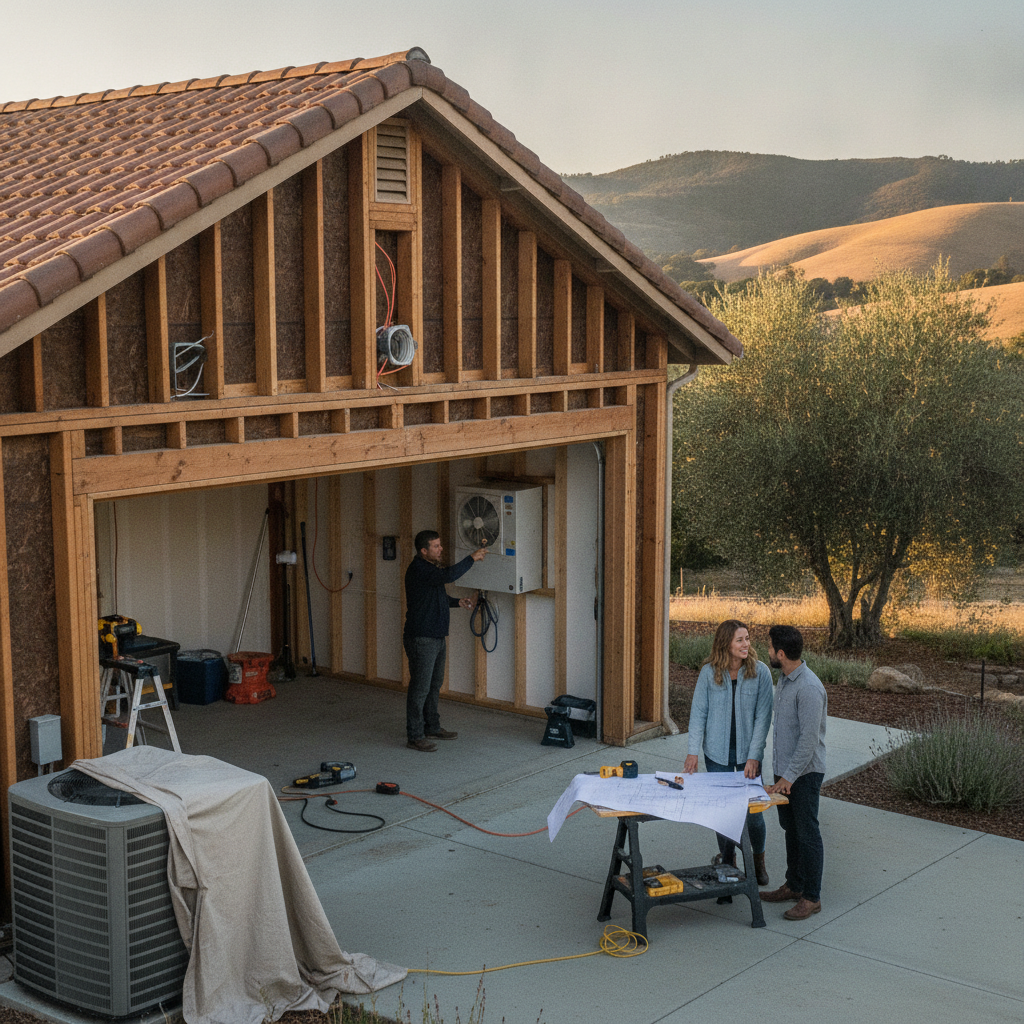
What Sonoma County Homeowners Should Know About Choosing the Right HVAC System for a New ADU or Garage Conversion
If you’re finishing a garage, building a backyard cottage, or converting a bonus room into a rentable ADU in Santa Rosa or anywhere in Sonoma County, you’ve likely spent a lot of time thinking about insulation, permits, and finishes. But the heating and cooling question often gets answered too late — sometimes after walls are already closed up. The HVAC choice you make for an ADU or converted space is different from what you’d do for a whole house, and getting it wrong means either an uncomfortable tenant, a surprised utility bill, or a costly retrofit down the road.
Here’s a straightforward breakdown of what actually works, what doesn’t, and what to think through before you call a contractor.
Why ADU Heating and Cooling Is Its Own Category
A 400- or 600-square-foot ADU has completely different heating and cooling needs than the main house on the same property. It’s a small, often well-insulated space — but it can still overheat in July or get cold on a January morning in Sonoma County. The mistake a lot of homeowners make is assuming they can just extend the existing HVAC system from the main house. In most cases, that’s either impractical, inefficient, or both.
Extending ductwork from an existing central system to a detached or semi-detached ADU usually requires significant structural work, and it ties the tenant’s comfort to whatever the main house is doing — which isn’t workable if someone else is living there. Even attached garage conversions often sit outside the envelope of the main system, meaning the existing furnace or AC is already sized for a certain square footage and can’t reliably serve additional space without being oversized, which creates its own problems.
For most ADUs in Santa Rosa, Rohnert Park, Windsor, and across Sonoma County, a standalone system is the right answer. And for standalone systems in small spaces, one solution consistently outperforms the rest.
Why a Ductless Mini-Split Is Usually the Right Call
A single-zone ductless mini-split — one outdoor compressor connected to one indoor air handler — is purpose-built for exactly this situation. It heats and cools the space from a single unit, requires no ductwork, installs with a small penetration through an exterior wall, and runs on electricity. In Sonoma County’s Mediterranean climate, where summers are hot and dry but winters are mild enough that you rarely need serious heating output, a mini-split handles both seasons efficiently from one system.
Modern mini-splits from manufacturers like Mitsubishi Electric, Daikin, Fujitsu, and LG are heat pumps at their core — meaning they move heat rather than generate it, which makes them roughly two to three times more efficient than electric resistance heating. That matters more than ever with PG&E rates where they are. For a well-insulated 500-square-foot ADU, a properly sized mini-split will handle both summer cooling and winter heating without strain, and it gives the occupant independent control of their space.
There are also practical permitting advantages. California’s Title 24 energy compliance requirements for new ADU construction increasingly favor all-electric systems, and a heat pump mini-split satisfies those requirements cleanly. Some Sonoma County jurisdictions also have specific requirements around new gas appliance installations in ADUs — worth confirming with your contractor and permit office before you design around a gas furnace.
You can learn more about heat pump options we install across Sonoma County, including mini-split systems for smaller spaces.
What About Window Units, Portable ACs, or Space Heaters?
If you’re renting out an ADU or garage conversion, this is worth addressing directly: plug-in solutions aren’t a real answer. Window air conditioners are loud, inefficient, and block natural light. Portable AC units exhaust warm air right back into the space unless properly ducted. Space heaters are a fire risk, a significant energy draw, and not permitted as a primary heat source in a habitable rental unit in California.
Beyond comfort, there are liability considerations for landlords. California habitability standards require that rental units maintain adequate heating, and local code in Santa Rosa and Petaluma is increasingly strict about what counts. A permitted, permanently installed system protects you as a property owner — a plug-in workaround does not.
Sizing Matters More Than People Think
One of the most common mistakes in ADU HVAC installs is oversizing. A contractor who doesn’t do a proper load calculation may default to a larger unit because it seems safer. In reality, an oversized mini-split in a small space will short-cycle — turning on and off frequently without running long enough to properly dehumidify the air. In the cooler, occasionally foggy mornings that roll through Sebastopol and coastal parts of Sonoma County, that means a clammy, uncomfortable space even when the temperature technically feels right.
A proper Manual J load calculation accounts for square footage, ceiling height, insulation values, window orientation, and local climate data. For an ADU in Santa Rosa’s Bennett Valley or a converted garage in Windsor, the right sizing calculation will likely land you on a smaller unit than you’d expect — and that’s the right answer.
What If the ADU Already Has a Gas Connection?
Some homeowners have an existing garage with gas already run to it — maybe for a workshop heater or a gas dryer. In that case, a gas furnace with a small standalone AC might seem straightforward. It’s a valid option, and we install and service those systems too. But before going that route, it’s worth comparing the long-term operating costs against a heat pump mini-split given current PG&E electricity rates versus gas prices, and factoring in any available rebates.
California and PG&E currently offer rebates on qualifying heat pump installations, and federal tax credits under the Inflation Reduction Act can offset a significant portion of the upfront cost of a high-efficiency heat pump system. Those incentives don’t apply to conventional gas furnace installs. Check our current offers and financing options to see what’s available right now — the numbers often make the heat pump the better financial choice even before you factor in efficiency savings.
What to Ask Your HVAC Contractor Before They Start
Whether you’re working with us or getting multiple bids, ask these questions before anyone pulls permits or orders equipment:
- Will you do a load calculation for this specific space? If the answer is no or vague, that’s a red flag.
- What’s the plan for electrical service? Mini-splits require a dedicated circuit, and older garages often need a subpanel upgrade. That cost should be part of the quote.
- Does this system qualify for PG&E or California rebates? A good contractor will know the answer or find out before you commit.
- What brand equipment are you proposing? Verify the equipment is a recognized brand with local parts availability — not a generic import with no local service network.
- Will this be permitted? In Sonoma County, permitted work protects your resale value and your rental compliance. Unpermitted HVAC in an ADU can create problems when you sell.
Frequently Asked Questions
Can I run an ADU off the same HVAC system as my main house?
In most cases, no — at least not reliably. A detached ADU almost always needs its own system. An attached conversion might be possible to tie in, but only if the existing equipment was oversized to begin with and the ductwork runs are reasonable. This requires an honest load calculation, not a guess.
How much does it cost to install a mini-split in a garage conversion in Sonoma County?
Costs vary based on system size, electrical work needed, and access conditions, but a single-zone mini-split installation in a typical ADU or garage conversion generally falls in a range that most homeowners find reasonable relative to the value it adds. We offer free estimates — contact us and we’ll give you an honest number for your specific situation.
Do I need a permit to install HVAC in my ADU in Santa Rosa?
Yes. Any new HVAC installation in a habitable space requires a mechanical permit in Santa Rosa and throughout Sonoma County. If you’re converting a garage to an ADU, the HVAC install is part of the broader building permit process. Working with a licensed contractor who pulls permits is the right way to do this.
What’s the most energy-efficient option for heating and cooling a small ADU?
A high-efficiency heat pump mini-split is generally the most efficient option available for a small detached space in Sonoma County’s climate. Look for systems with a SEER2 rating of 18 or higher and an HSPF2 rating that meets current California standards. Brands like Mitsubishi Electric, Daikin, and Fujitsu offer units specifically designed for small-space, high-efficiency applications.
Can Stout’s Heating & AC install HVAC in an ADU in Healdsburg or Petaluma — not just Santa Rosa?
Yes. We serve homeowners and property owners throughout Sonoma County, including Healdsburg, Petaluma, Windsor, Sebastopol, Rohnert Park, and the surrounding area. If you’re building or finishing an ADU anywhere in the county, we’re happy to come out and take a look.
Ready to Talk Through Your ADU HVAC Options?
At Stout’s Heating & AC, Inc., we’ve been helping Santa Rosa and Sonoma County homeowners make smart HVAC decisions since 1992. We don’t push the most expensive system — we figure out what actually fits your space, your budget, and your situation. If you’re in the middle of an ADU project or just starting to plan one, reach out and we’ll walk you through your options without any pressure. Contact us here or call us directly at (707) 527-1504 to schedule a free estimate.