
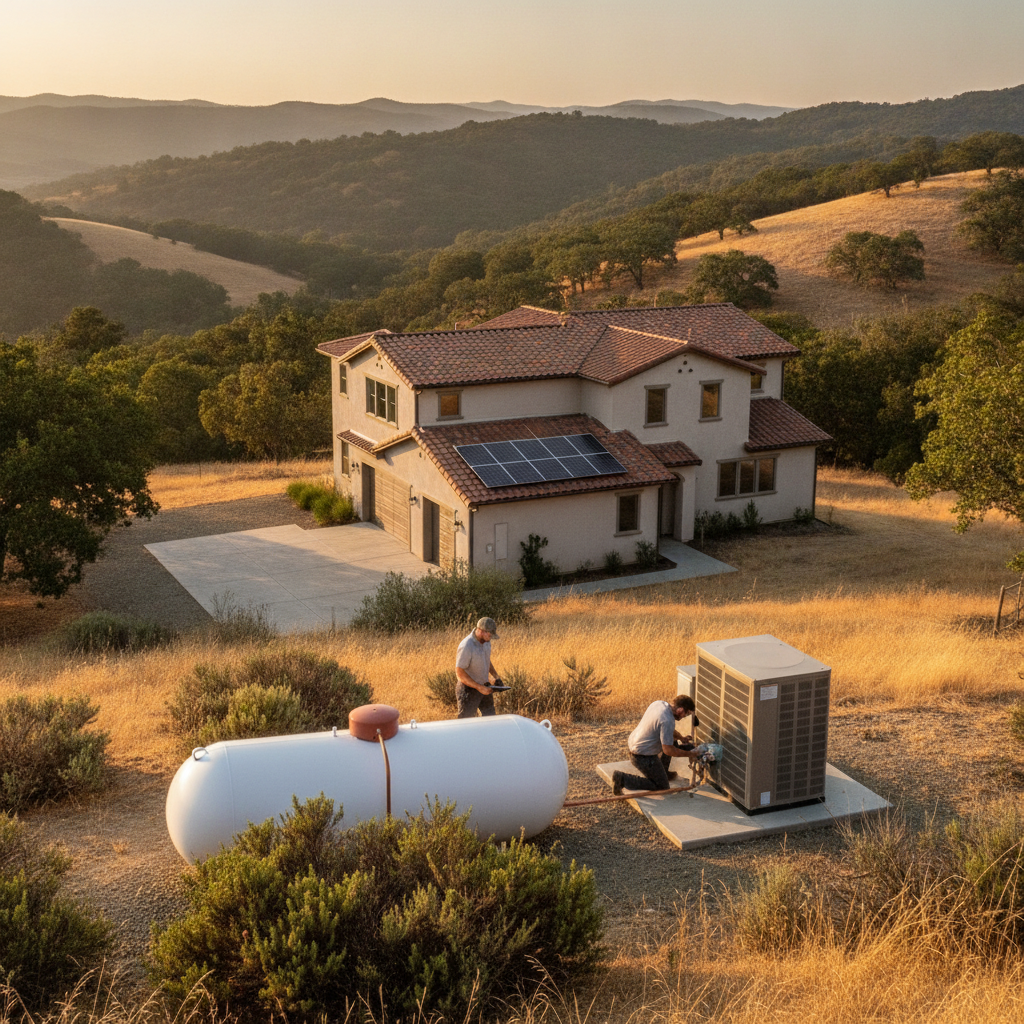
What Sebastopol and West Sonoma County Homeowners Should Know About HVAC and Propane Systems — Heating Options When You’re Off the Natural Gas Grid
If your home sits west of Santa Rosa — out in Sebastopol, Occidental, Forestville, or along the Sonoma Coast toward Bodega Bay — there’s a good chance you’re heating with propane. Natural gas lines don’t reach much of west Sonoma County, which means your heating system works differently, costs more to operate, and needs service from a technician who actually understands propane-fired equipment. Most HVAC content online treats natural gas as the default and either ignores propane entirely or waves it off with a sentence. That doesn’t help you much when your furnace quits on a cold, foggy January morning and you need real answers.
At Stout’s Heating & AC, Inc., we’ve been servicing propane systems throughout Sonoma County since 1992. Here’s what you should understand about maintaining, repairing, and potentially upgrading your propane-based heating setup — and why the calculus for rural homeowners looks meaningfully different from what your neighbors in central Santa Rosa are dealing with.
How Propane Heating Systems Actually Work — and Where They Differ From Natural Gas
Propane and natural gas furnaces are similar in design, but they’re not interchangeable. Propane burns hotter and at a higher pressure than natural gas, so the burner orifices, gas valves, and pressure regulators are sized differently. A furnace configured for natural gas cannot safely or efficiently burn propane without a conversion kit — and vice versa. This is worth knowing because it affects both repair parts and technician competency. Not every HVAC company that services natural gas equipment is equally comfortable working on propane systems, and you don’t want someone guessing at your fuel pressure settings.
Propane furnaces otherwise follow the same maintenance schedule as their natural gas counterparts: annual or bi-annual tune-ups, filter changes, heat exchanger inspections, and flue checks. The main practical difference is operating cost. Propane prices fluctuate significantly and have historically run higher per BTU than natural gas. That cost gap is a big part of why many west Sonoma County homeowners are now asking whether it makes more financial sense to move toward electric heat pump technology rather than staying on propane long-term.
What Can Go Wrong With a Propane Furnace — and What to Watch For
Propane furnaces share most of the same failure points as any forced-air heating system: igniter failures, cracked heat exchangers, failing draft inducer motors, clogged burners, and control board issues. But there are a few propane-specific things to stay alert to:
- Regulator problems: The pressure regulator between your tank and the furnace can fail or ice up during cold snaps. If your furnace is running weakly or cycling off unexpectedly, low gas pressure from a failing regulator is worth checking before assuming the furnace itself is the problem.
- Burner orifice clogging: Propane burns cleaner than some fuels, but debris and spider webs can still clog the small orifices in a propane burner assembly — especially if the furnace sits idle over summer. Yellow or orange flames instead of blue are a warning sign.
- Running out of fuel mid-season: This sounds obvious, but propane homeowners sometimes let their tanks run low and then wonder why the furnace isn’t performing right. Low tank pressure causes combustion problems and can trip safety lockouts.
- Carbon monoxide risk: Any combustion appliance carries CO risk, and propane furnaces are no exception. If your system hasn’t had a heat exchanger inspection recently, that’s not a check you want to skip.
If you’re not sure when your propane furnace last had a full service, our residential heater repair and maintenance service is a good starting point. A thorough inspection can catch problems before they become emergency calls.
The Case for Heat Pumps in West Sonoma County — Especially for Propane Homes
Here’s the angle most HVAC companies serving this area aren’t discussing clearly enough: for homes currently running on propane, switching to a heat pump often makes stronger economic sense than it does for homes already on the natural gas grid.
Why? Because propane costs significantly more per unit of heat than natural gas — sometimes two to three times more, depending on market conditions. Heat pumps, meanwhile, deliver two to four units of heat for every unit of electricity they consume. That math can look very favorable if you’re currently burning propane at current prices, particularly in Sonoma County’s moderate coastal climate where heat pumps operate efficiently even on cold winter nights.
Sebastopol, Forestville, and Occidental don’t see the kind of sustained hard freezes that make heat pumps struggle. You’re not in Minnesota. Even on a cold, damp January night, modern cold-climate heat pumps perform well in this region’s conditions. Pair that with the ongoing PG&E rebates, California utility incentives, and federal tax credits currently available for high-efficiency heat pump installations, and the payback window shrinks considerably.
That said, propane isn’t necessarily going away from your property entirely. If you have a propane water heater, range, or backup generator, the tank stays. The furnace is just one piece of that.
When a Dual Fuel System Makes Sense — Propane + Heat Pump
One option that works particularly well for rural propane homeowners is a dual fuel system — a heat pump paired with a gas (or propane) furnace as a backup. The system runs on the heat pump during mild weather when electricity is cheapest and most efficient, then automatically switches to the propane furnace when temperatures drop below the heat pump’s efficient operating range or when propane fuel costs become more economical at the margin.
This setup lets you keep your existing propane infrastructure while dramatically reducing how often you’re burning fuel. For homes in Occidental or the hills above Forestville where winter nights can get legitimately cold, having that propane backup can be reassuring — both for comfort and for resilience during power outages if you have a generator.
It’s worth having a conversation about your specific usage patterns, tank size, and existing equipment before deciding whether a straight heat pump replacement or a dual fuel configuration is the better move for your situation.
Ductless Mini-Splits for Older West County Homes
Many of the homes in Sebastopol and the surrounding area are older, with quirky layouts, additions, converted spaces, or no existing ductwork at all. If your home doesn’t have ducts — or has ducts that are deteriorating or inadequate — adding a central heat pump system means adding ductwork too, which is expensive and disruptive.
Ductless mini-split heat pumps sidestep that entirely. You get heating and cooling through wall-mounted air handlers connected to an outdoor unit, with no ductwork required. Brands like Mitsubishi Electric, Daikin, and Fujitsu make systems well-suited to Sonoma County’s climate, and they can be installed in a matter of days without tearing into your walls or ceilings. For a farmhouse, converted barn, or cottage in the west county, a mini-split is often the most practical upgrade available.
Frequently Asked Questions
Can any HVAC technician work on a propane furnace, or do I need someone specifically trained for it?
Most licensed HVAC technicians can work on propane furnaces, but you want to confirm they have hands-on experience with propane-fired equipment specifically. The burner configuration, gas pressure settings, and orifice sizing are different from natural gas, and a tech unfamiliar with propane systems may misdiagnose or improperly adjust your equipment. At Stout’s, we service propane systems regularly throughout the west county.
How often should a propane furnace be serviced?
Annually is the standard recommendation, ideally in the fall before heating season. Because propane burns at higher pressure than natural gas, burner condition and pressure regulation deserve close attention. A bi-annual schedule — spring and fall — is worth considering if your system is older or if the furnace runs hard through winter.
Would switching from propane to a heat pump actually save me money in Sebastopol?
It often does, particularly because propane costs per BTU are significantly higher than electricity-based heat pump operation in moderate climates like west Sonoma County. The specific numbers depend on your current propane usage, PG&E rate tier, and system efficiency. We can walk you through a rough cost comparison during a consultation.
Are there rebates available for replacing a propane furnace with a heat pump?
Yes. California’s TECH Clean California program, PG&E rebates, and the federal Inflation Reduction Act tax credits all currently apply to qualifying heat pump installations. The available incentives change periodically, so it’s worth checking current offers before making a decision. You can see what Stout’s currently has available on our HVAC offers and financing page.
What if my propane furnace breaks down and I can’t get a repair part quickly?
Propane-specific parts — particularly burner assemblies and orifice kits — can sometimes take longer to source than standard natural gas components. This is one practical reason to stay ahead of maintenance rather than waiting for a failure. We carry common parts for the brands we service most frequently, and we offer same-day service when our schedule allows.
Get Honest Advice for Your Off-Grid Heating Situation
Propane systems have quirks, and rural west Sonoma County homes have their own set of challenges that generic HVAC content doesn’t address. Whether you need repair work on an existing propane furnace, want an honest assessment of whether a heat pump upgrade makes financial sense for your property, or are trying to figure out the right approach for a home that’s never had central air, we’re happy to come out, look at what you have, and give you a straight answer.
Stout’s Heating & AC, Inc. has been serving Sebastopol, Occidental, Forestville, Bodega Bay, and the surrounding area for over 30 years. We’re not going to sell you something you don’t need, and we won’t send someone out who doesn’t know what they’re looking at. Contact us to schedule a visit or ask a question — no obligation, no pressure.