
What Santa Rosa Multi-Zone Homeowners Should Know About Zoned HVAC Systems — Whether They’re Worth It, How They Work, and What Can Go Wrong
A zoned HVAC system can be a genuinely useful upgrade for the right Santa Rosa home — but it’s also one of the most oversold ideas in the heating and cooling business. If you’ve been told that adding zoning to your existing system will solve your comfort problems and slash your energy bills, it’s worth slowing down and getting a clearer picture before you spend a few thousand dollars finding out otherwise. The honest answer is: zoning works well in some situations and creates new headaches in others. Here’s what we’ve seen after more than 30 years of working on homes across Sonoma County.
What a Zoned HVAC System Actually Is
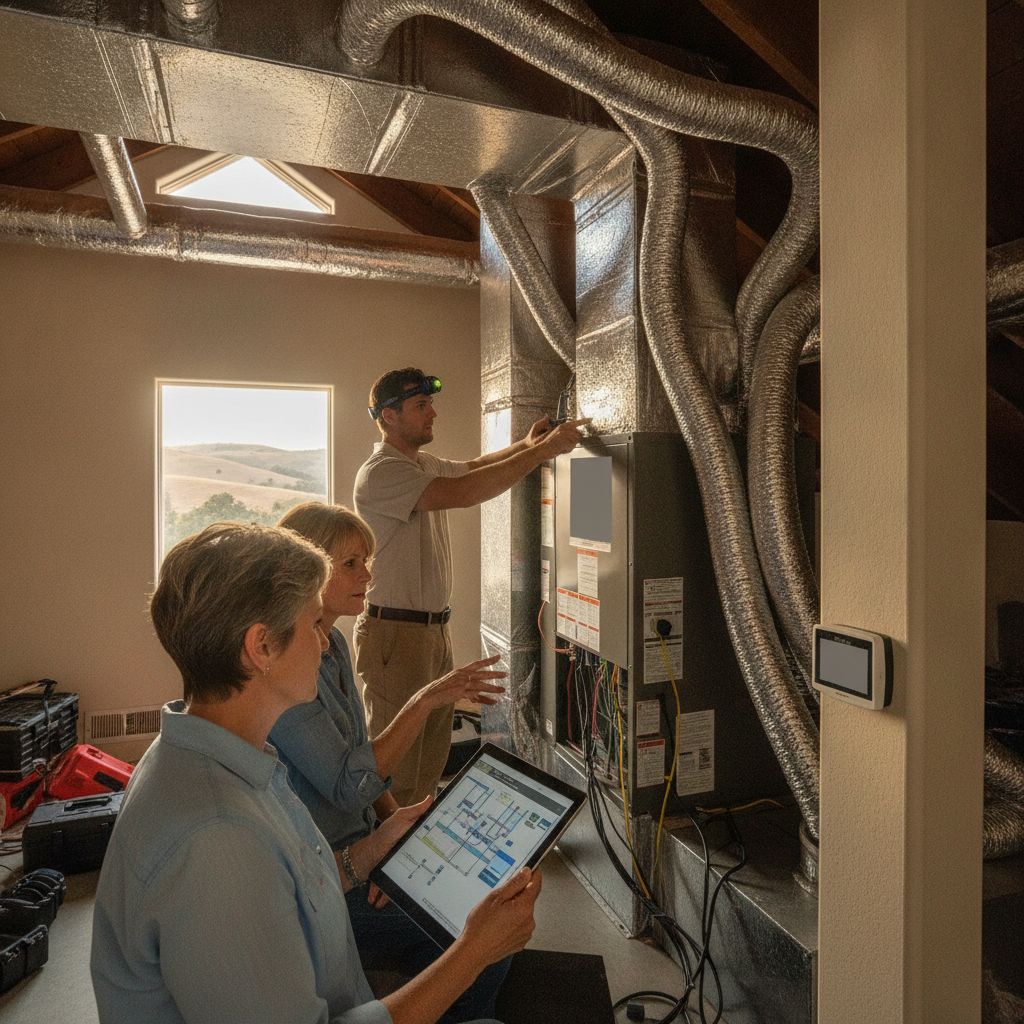
In plain terms, a zoned system divides your home into separate areas — zones — each with its own thermostat and independent temperature control. Instead of your furnace or air conditioner conditioning the entire house at once, motorized dampers inside your ductwork open and close to direct airflow only where it’s needed at a given time.
Sounds great in theory. Bedroom wing too hot while the living room is comfortable? With zoning, you’d only cool the bedrooms. Guest room sitting empty all week? Close off that zone and stop spending money conditioning it. The potential for comfort and energy savings is real — but the execution is where things get complicated.
The Problem Most Contractors Don’t Mention: Static Pressure
Here’s the thing that rarely comes up in sales conversations about zoning: your HVAC equipment — the furnace, the air handler, the AC unit — was sized to move a specific volume of air. When you close off zones with dampers, that total airflow gets restricted. The system is still trying to push the same amount of air, but now it has fewer places for it to go.
This creates what’s called excess static pressure. Over time, high static pressure stresses your blower motor, shortens the life of your heat exchanger, and can cause the system to short-cycle — running in short bursts instead of full, efficient cycles. In the worst cases, it accelerates equipment failure in ways that are expensive to diagnose and even more expensive to fix.
A properly designed zoned system accounts for this with a bypass damper — a pressure relief pathway that redirects excess air back to the return when zones close off. But bypass dampers are often undersized, poorly positioned, or skipped entirely by contractors who are more interested in selling the zoning controller than engineering the system correctly. We’ve walked into homes in Rincon Valley and Fountaingrove where zoning was added to an existing system without any bypass provisions at all, and the equipment was running hot and struggling as a result.
When Zoning Actually Makes Sense in Sonoma County Homes
That said, there are real situations where zoning is the right answer. Santa Rosa’s Mediterranean climate creates some genuinely uneven comfort challenges. Hot dry summers mean the south- and west-facing rooms in your home can be significantly warmer than north-facing rooms during an afternoon heat wave. Two-story homes in neighborhoods like Bennett Valley often have the classic problem of a sweltering upstairs and a comfortable downstairs — a single-zone system can’t address both at once without overcooling one area.
Zoning makes the most sense when:
- Your home has distinct areas with different sun exposure, occupancy patterns, or thermal characteristics (e.g., a finished bonus room over a garage, a master suite addition, a sunroom)
- You’re installing a new, properly sized variable-speed system that can modulate its output — not retrofitting onto an older single-speed unit
- The duct system is in good condition and large enough to support the added complexity without creating airflow problems
- The zoning design includes a correctly sized bypass damper or, better yet, uses a variable-capacity system that doesn’t depend on bypass at all
Variable-speed systems — heat pumps and air handlers with ECM blower motors — are much friendlier to zoning because they can actually reduce their output when fewer zones are calling. That’s a fundamentally different situation from bolting a zoning controller onto an older single-speed furnace and crossing your fingers. Modern heat pumps in particular are well-suited to zoning because they’re designed to ramp up and down in response to demand rather than just running flat-out until the thermostat is satisfied.
When a Ductless Mini-Split Is the Better Answer
A lot of what people are trying to accomplish with a zoned ducted system can actually be done more cleanly — and more reliably — with ductless mini-splits. If the core of your problem is that one room or one area of your home runs hot or cold regardless of what the rest of the system is doing, a dedicated mini-split head for that space is often a simpler, more effective solution than restructuring your entire duct system.
This is especially true in older Santa Rosa homes — the kind of 1950s and 1960s construction you find in the West End and South Park neighborhoods — where the ductwork was designed for a different era’s equipment and retrofitting a zoning system would require significant modifications to the duct layout anyway. Adding a Mitsubishi Electric, Daikin, or Fujitsu ductless unit to a problem room is often cleaner, faster, and less disruptive than a full zoning retrofit.
If you’re weighing your options and aren’t sure which approach makes more sense for your home, that’s exactly the kind of conversation worth having with a contractor who doesn’t have a financial stake in selling you one solution over the other. We’ll give you a straight answer.
What a Zoning Retrofit Actually Costs — and What to Watch Out For
For a typical Santa Rosa home, adding zoning to an existing ducted system generally runs somewhere in the range of $2,500 to $5,000 or more depending on the number of zones, the condition of your existing ductwork, and whether bypass damper work is required. That’s before any equipment upgrades if your current system isn’t compatible with the added complexity.
Be cautious of quotes that seem low. A zoning job that skips the bypass damper engineering or uses undersized damper controllers is cheaper upfront and more expensive in the long run. Ask the contractor specifically how they’re handling static pressure management — if they look at you blankly, that’s a useful data point.
Also ask whether your current equipment is variable-speed or single-stage. That answer changes the calculus considerably. If you’re due for a system replacement anyway, pairing new variable-speed equipment with zoning from the start is a much better outcome than retrofitting onto aging hardware.
If you’re also thinking about financing the upgrade, we do offer 0% financing options on qualifying installations, and depending on the equipment you choose, there may be California and federal rebates that offset part of the cost.
Frequently Asked Questions About Zoned HVAC in Santa Rosa
Can I add zoning to my existing furnace and AC without replacing the equipment?
Sometimes, but it depends on your equipment’s age, type, and condition. Single-stage systems are more problematic than variable-speed systems when it comes to zoning. We’ll assess your existing setup before recommending anything — there’s no point spending money on a zoning retrofit if the underlying equipment is on its last legs or isn’t compatible.
How many zones does a typical Sonoma County home need?
Most single-family homes do well with two to three zones — commonly upstairs vs. downstairs, or a sleeping area vs. living spaces. More zones add more complexity and more potential failure points. Bigger isn’t always better here.
What happens when a zone damper fails?
Dampers can stick open or closed, which either leaves a zone uncontrolled or cuts it off entirely. It’s a real maintenance consideration. Motorized dampers have a finite lifespan, and the control boards that manage them can fail too. This is worth factoring into your long-term cost of ownership when comparing zoning to other solutions.
Is zoning the same as a ductless mini-split system?
No — they’re two different approaches to the same goal. A zoned ducted system uses your existing ductwork with motorized dampers and multiple thermostats. A ductless mini-split system has dedicated indoor heads connected by refrigerant lines to an outdoor unit, with no shared ductwork at all. Both can deliver zone-by-zone control, but the right fit depends on your home’s layout and existing infrastructure.
Do zoned systems qualify for energy rebates in California?
Zoning hardware alone typically doesn’t qualify, but if zoning is part of a qualifying high-efficiency system installation — particularly a heat pump — the equipment itself may be eligible for PG&E rebates or federal tax credits. We can walk you through what applies to your specific project.
Talk to Someone Who Will Give You a Straight Answer
Zoned HVAC systems are genuinely useful in the right homes with the right equipment and the right installation. They’re also one of the more commonly oversold upgrades in this industry — and the fallout from a poorly designed zoning retrofit tends to show up months or years later, not the day the contractor packs up and leaves.
At Stout’s Heating & AC, we’ve been working on homes across Santa Rosa, Rohnert Park, Sebastopol, and the rest of Sonoma County since 1992. We’re not going to sell you zoning if it’s not the right answer for your home — and we’ll tell you plainly if a ductless unit or a different approach would serve you better.
Request a free estimate and let’s take a look at your home, your existing system, and your comfort goals before you make any decisions. No pressure, no upsell — just honest advice from a local contractor who’ll still be here if something needs attention down the road.