
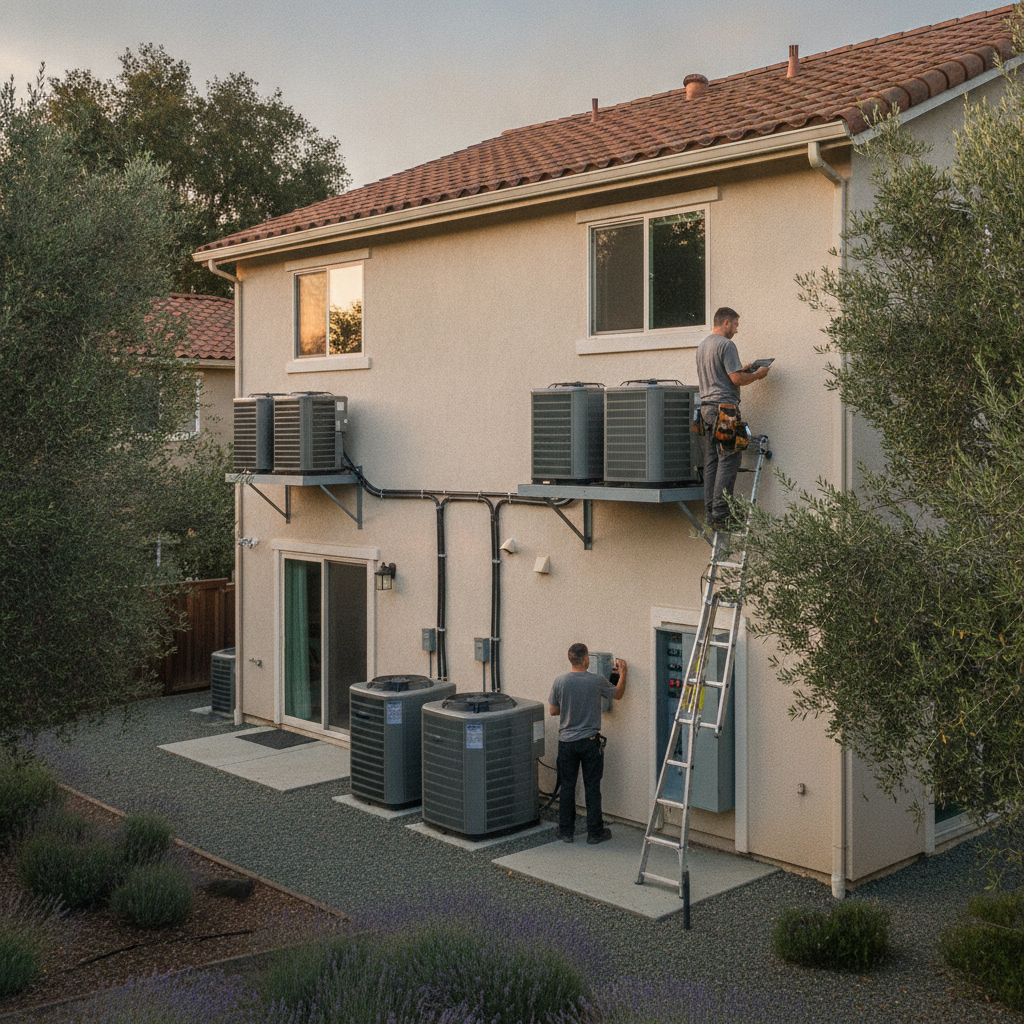
If you own a duplex, triplex, or small apartment building in Santa Rosa, managing HVAC isn’t just about keeping tenants comfortable — it’s about protecting a significant asset, controlling unpredictable repair costs, and staying compliant with California’s habitability standards. Whether your building has one shared central system or individual units in each apartment, the decisions you make about heating and cooling will affect tenant retention, your maintenance budget, and the long-term value of the property. Here’s what you actually need to know — the practical stuff that most HVAC companies don’t bother putting in one place.
Shared vs. Individual Systems: Which Setup Are You Actually Dealing With?
The first thing to get clear on is how your building is configured, because the maintenance strategy, the cost exposure, and the upgrade path are completely different depending on the answer.
Shared central systems — where one furnace or air handler serves the whole building through a common duct network — are common in older Sonoma County multi-family properties built before the 1980s. You’ll find them frequently in Roseland, parts of Rohnert Park, and older apartment stock throughout Santa Rosa. The advantage is that you control one system. The disadvantage is that when it fails, everyone loses heat or AC at once, and the repair bill is yours alone. There’s also no way for tenants to independently manage their comfort, which can lead to friction and complaints.
Individual systems per unit — whether that’s a separate furnace and AC, a ductless mini-split, or a heat pump in each apartment — give tenants more control and spread your risk. If Unit 3’s system goes down, Units 1, 2, and 4 are unaffected. But you’re responsible for maintaining multiple systems, and if those systems are aging at roughly the same rate, you could face a wave of replacements in a short window.
Many property owners in Santa Rosa are inheriting aging systems in older buildings and haven’t had a clear picture of what they’re working with. If you haven’t had a licensed HVAC contractor walk through and assess every unit, that’s the right place to start — before something breaks in August.
The Real Cost Problem: Deferred Maintenance Across Multiple Units
The most common mistake multi-family owners make is treating HVAC reactively. One unit breaks, you call someone, you fix it. Repeat. The problem is that systems in the same building that were installed around the same time tend to fail around the same time. If you’ve got six apartments and the furnaces are all 18 years old, you’re not looking at one replacement — you’re looking at a potential cluster of them over a two- or three-year period.
A structured bi-annual maintenance plan — inspecting and tuning up each system every spring and fall — catches problems early, extends equipment life, and gives you a documented service history for each unit. That documentation matters when a tenant files a habitability complaint or when you’re selling the building. We offer maintenance tune-ups starting at $90 per system, and for multi-unit buildings, we can schedule everything in one visit to minimize disruption. Details on our current maintenance offers are available on our HVAC offers page.
Why Ductless Mini-Splits Are Becoming the Go-To for Multi-Family Upgrades in Sonoma County
If you’re replacing aging systems in a multi-family building — or retrofitting units that never had central HVAC — ductless mini-splits have become the practical default for a reason. They don’t require ductwork, which makes installation far less invasive in occupied units. Each system is self-contained, so you’re not running new refrigerant lines through walls shared between apartments. And because they function as both heaters and air conditioners using heat pump technology, they handle Santa Rosa’s climate well: the moderate winters are well within heat pump operating range, and they keep tenants cool during summer heat waves without the noise and inefficiency of window units.
For older buildings in neighborhoods like Coffey Park or the West End that were rebuilt or remodeled without central duct systems, mini-splits are often the only realistic path to adding real heating and cooling without tearing into walls. Brands like Mitsubishi Electric, Daikin, and Fujitsu make systems specifically designed for multi-zone residential applications, and the installation footprint is minimal compared to a traditional forced-air setup.
You can learn more about the heat pump options we install and service on our heat pumps page.
What the Competitor Websites Miss: HVAC and California’s Habitability Law
This is the piece that most local HVAC company websites don’t cover for landlords, and it’s genuinely important. Under California Civil Code, landlords are required to provide heating capable of maintaining a minimum indoor temperature of 70°F in habitable rooms. If a heating system fails and you don’t respond in a reasonable timeframe, tenants have legal remedies — including rent withholding and repair-and-deduct options.
What that means practically: a heating failure in a rental unit isn’t just an inconvenience, it’s a potential legal exposure. Same-day and emergency service availability matters when you’re a property owner, not just a homeowner. At Stout’s, we’ve been serving Santa Rosa landlords and property managers since 1992, and we understand that when you call with a tenant’s heat down, you’re not just looking for a technician — you’re looking for someone who shows up the same day and gets it fixed without a runaround.
If you’re managing properties across Santa Rosa, Petaluma, Windsor, or elsewhere in Sonoma County, it’s worth having a local contractor you can actually reach in an emergency — not a national dispatch center that’s routing calls through a call center in another state.
Energy Costs and Why High-Efficiency Upgrades Make Financial Sense for Landlords
PG&E rates in Sonoma County have climbed significantly in recent years, and if you’re paying any portion of your tenants’ utilities — or if you’re trying to attract and retain tenants who are watching their own bills — energy efficiency matters. High-efficiency heat pumps and variable-speed systems cost more upfront, but the operating cost difference over a 15-year lifespan is real. For multi-unit properties, that math compounds across every unit.
California and PG&E both offer rebates on qualifying high-efficiency heat pump systems. Federal tax credits are also available through the Inflation Reduction Act for certain energy-efficient upgrades, including heat pumps. These incentives don’t last forever, and they’re not always straightforward to navigate — but we can walk you through what’s available and what your property would qualify for before you commit to anything.
Frequently Asked Questions
As a landlord, am I responsible for HVAC repairs in every unit?
Yes. Under California law, you’re required to maintain heating systems in working order in all habitable units. This includes furnaces, heat pumps, and any permanently installed heating equipment. Air conditioning is not legally required, but if an AC system is present and listed as an amenity, failure to maintain it can be a lease violation issue.
Can I put all my rental units on one maintenance plan?
Absolutely, and it’s the most cost-effective way to manage multi-family HVAC. We schedule all units in a single visit when possible, keep records for each system, and flag anything that’s approaching end of life so you can plan replacements before they become emergencies.
What’s the best HVAC setup for a duplex or triplex in Santa Rosa?
For most Sonoma County properties, individual ductless mini-split systems per unit are the most practical and efficient option — especially in buildings without existing ductwork. They give tenants independent control, limit your repair exposure to one unit at a time, and qualify for rebates and tax credits.
How do I know if my building’s shared HVAC system is worth repairing or replacing?
If the system is over 15 years old and you’re seeing repeat repairs, the math usually favors replacement — especially if a failure means the whole building loses heat or AC. We can assess the system and give you an honest recommendation. We’re not going to push a replacement if a repair makes more sense.
Do you service multi-family properties in Petaluma and Sebastopol, or just Santa Rosa?
We serve property owners throughout Sonoma County, including Petaluma, Sebastopol, Rohnert Park, Windsor, and surrounding areas. Multi-family properties are a regular part of what we do, not a side job.
Talk to a Local Contractor Who Knows Multi-Family Properties
If you own or manage rental units in Santa Rosa or anywhere in Sonoma County and you’re not sure where your HVAC systems stand, the best move is a straightforward assessment from someone who’ll tell you the truth — not upsell you on something you don’t need. We’ve been doing this since 1992, and we work with property owners of all sizes, from single duplexes to larger apartment buildings.
Reach out through our contact page to schedule a visit or ask a question. We’ll give you a clear picture of what you’re working with and what your options are — no pressure, no corporate runaround.