
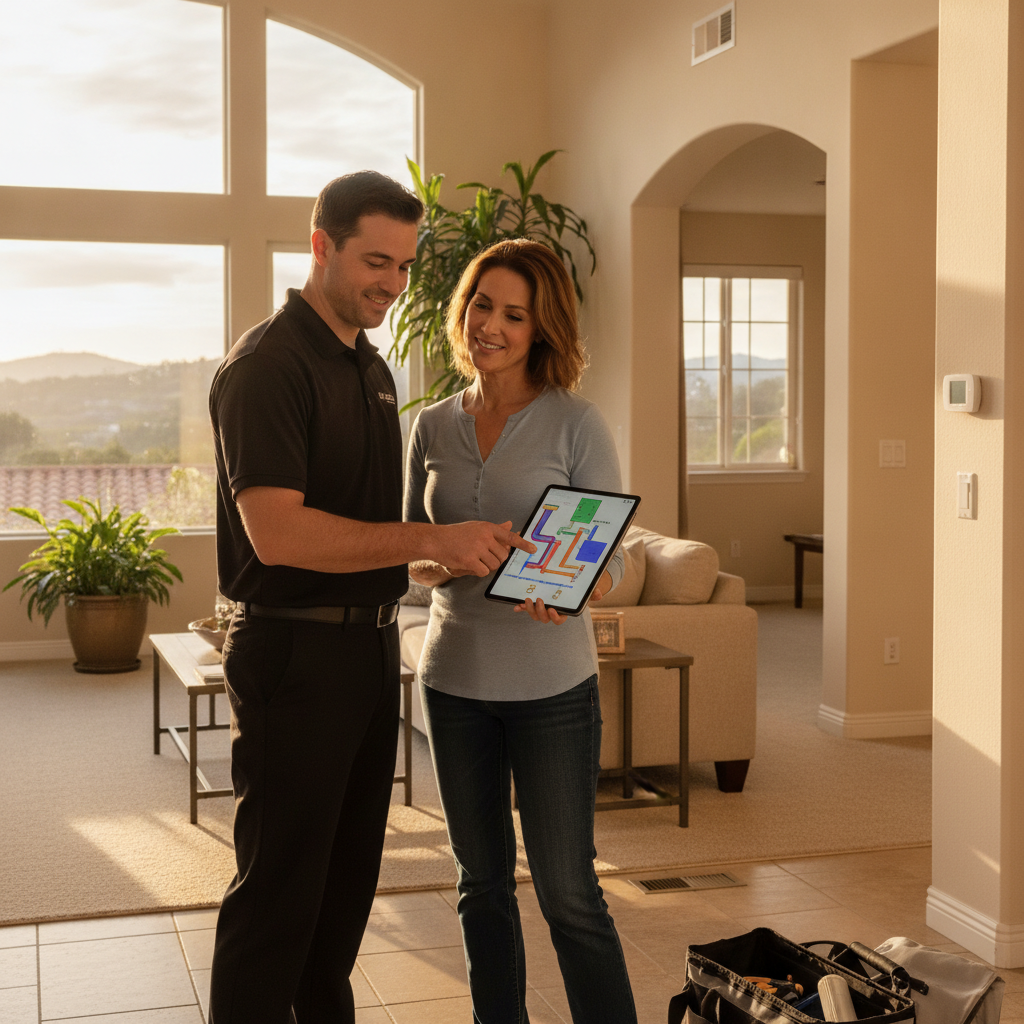
If some rooms in your Santa Rosa home are always too hot or too cold, a zoning system might be the fix — not a bigger HVAC unit. Zoning lets you heat and cool different parts of your home independently, so you’re not blasting cold air into an empty guest room just to keep the upstairs bedroom comfortable. It’s a practical solution for a lot of homes here in Sonoma County, and it’s one of the more underexplained topics in the local HVAC world. Here’s what you actually need to know before you decide whether it’s worth pursuing.
Why Temperature Imbalances Are So Common in Santa Rosa Homes
Santa Rosa has a pretty wide range of home styles — two-story craftsman homes in older neighborhoods like Bennett Valley and Rincon Valley, sprawling ranch-style houses on larger lots, newer construction up in Fountaingrove, and everything in between. A single thermostat controlling all of it doesn’t always work well, and that’s not a design flaw you can fix by tweaking the thermostat setting.
The physics are straightforward: heat rises. So if you have a two-story home, your upstairs bedrooms are often 5 to 10 degrees warmer in summer than your downstairs living area — even with a central system running. Add in south-facing windows, a finished basement, or a room above the garage, and you’ve got multiple zones that want completely different things at the same time.
Sonoma County’s Mediterranean climate doesn’t make this easier. Our summers bring stretches of 95°F-plus days, and the evening marine layer that cools things down in coastal areas like Sebastopol doesn’t always reach inland neighborhoods the same way. A home in Windsor might bake on the second floor all afternoon while the downstairs stays tolerable, and a single-zone system splitting the difference satisfies nobody.
What HVAC Zoning Actually Is — and the Two Main Ways to Do It
Zoning doesn’t mean you need multiple HVAC systems. It means you’re dividing your home into separate temperature-controlled areas, each with its own thermostat or sensor, so you can set different comfort levels in different parts of the house.
There are two primary approaches, and the right one depends on your home’s existing setup.
Damper-Based Zoning for Ducted Systems
If your home already has ductwork and a central forced-air system, you can add motorized dampers inside the ducts. These are essentially valves that open and close based on what each zone needs. A central control panel coordinates everything — when Zone 1 (say, the upstairs bedrooms) calls for cooling, the dampers direct airflow there. When Zone 2 (the main living area) is already at temperature, its dampers close.
This approach works well when the existing duct layout can support it. The catch is that damper-based zoning requires careful system sizing. Closing off sections of ductwork increases static pressure in the system, and if your HVAC unit isn’t designed to handle that, you can end up with airflow problems, increased wear on the blower motor, and premature equipment failure. A qualified technician needs to evaluate your system before you commit to this approach — this is one area where cutting corners leads to expensive problems down the road.
Ductless Mini-Splits for True Zone-by-Zone Control
For homes without ductwork, homes with poorly laid out ducts, or anyone adding a new room or addition, ductless mini-split heat pumps are often the better answer. Each indoor unit handles its own zone independently, with no shared ductwork involved. You can have one outdoor compressor serving two, three, or four indoor units — each with its own remote or app control.
The upside is precise control and very high efficiency. You’re only conditioning the space you’re using. The downside is upfront cost — multi-zone mini-split systems are a meaningful investment, though California and PG&E rebates can take a significant bite out of that number depending on the equipment you choose.
Which Homes Benefit Most from Zoning in Sonoma County
Zoning isn’t the right answer for every home. Here’s where it tends to make the most sense locally:
- Two-story homes where upstairs bedrooms consistently overheat in summer
- Homes with additions or converted spaces — a converted garage, a bonus room above the main structure, or a sunroom that gets direct afternoon sun
- Larger single-story homes where the master bedroom wing runs warmer or cooler than the common areas
- Homes with a basement or lower level that stays naturally cool and doesn’t need as much conditioning
- Households with different schedules — if someone works from home in a dedicated office while the rest of the house sits empty, you shouldn’t be paying to condition all of it equally
If your home is a compact single-story with a well-designed duct system and reasonable insulation, zoning probably won’t move the needle much. But for multi-level homes with persistent hot and cold spots, it’s often the most cost-effective long-term solution compared to running a whole-house system harder than it needs to run.
What Zoning Won’t Fix — and What It Might Be Masking
This is the section most local HVAC websites skip, so it’s worth saying clearly: zoning doesn’t solve insulation problems, duct leaks, or an undersized or oversized HVAC system.
If your upstairs is unbearably hot because you have almost no attic insulation and single-pane windows facing west, a zoning system will just make your upstairs unit work harder to compensate. You’ll spend more on the system and more on energy, and you still won’t be fully comfortable. Before anyone recommends a zoning solution, they should be asking about your insulation, your duct condition, and whether your current equipment is actually sized correctly for your home.
Older homes in Rohnert Park, Petaluma, and some of the established Santa Rosa neighborhoods frequently have duct systems that have developed leaks over 20 or 30 years. Leaky ducts lose conditioned air before it reaches the room — and adding dampers to a leaky duct system just adds complexity without fixing the root cause. A proper duct inspection and pressure test should happen before any zoning conversation goes further.
What to Expect From a Zoning Installation: Cost, Timeline, and Process
Every home is different, so we’re not going to throw out a number and call it typical. What we can tell you is what the process looks like.
For a damper-based system on an existing ducted setup, the work generally involves installing motorized dampers at strategic points in the duct system, running control wiring to a zone controller, and setting up individual thermostats for each zone. Depending on the number of zones and how accessible your ductwork is, this is usually a one- to two-day installation.
For a multi-zone ductless mini-split, the work involves mounting indoor air handlers in each zone, running refrigerant lines and electrical to the outdoor unit, and commissioning the system. Timeline varies by the number of zones and any electrical panel work needed.
On the financing side, California’s Title 24 energy efficiency standards and current PG&E rebate programs can apply to qualifying high-efficiency zoned systems, particularly mini-split heat pumps meeting certain SEER thresholds. Federal tax credits for qualifying heat pump equipment are also worth factoring in. We can walk you through what’s currently available when you come in for an estimate — the incentive landscape changes often enough that a conversation is more useful than a static number. You can also check our current offers and financing options here.
Frequently Asked Questions About HVAC Zoning in Santa Rosa
Can I add zoning to my existing furnace and AC without replacing them?
Sometimes, yes — but it depends on your equipment’s age, condition, and capacity. Damper-based zoning works best with variable-speed or two-stage systems that can modulate output as airflow demand changes. Single-stage systems can still be zoned, but it requires a bypass damper or other pressure-relief strategy to protect the equipment. A technician should evaluate your system before anything is installed.
How many zones does my home need?
Most residential zoning projects in our area involve two to four zones. A common setup for a two-story home is one zone for the upstairs bedrooms and one for the main living area. You can get more granular than that, but more zones mean more equipment, more control wiring, and a higher upfront cost. Start with the problem areas first.
Will zoning actually lower my energy bills?
It can, particularly if you’re currently conditioning unused spaces or running a whole-house system on full blast to satisfy one difficult room. But the savings depend heavily on your habits, your home’s insulation, and the efficiency of the equipment involved. Zoning is as much about comfort as it is about energy — for most homeowners, both improve together.
Is a smart thermostat the same as zoning?
No. A smart thermostat is still a single thermostat controlling a single zone. It can learn your schedule and adjust setpoints automatically, which is useful — but it can’t independently heat one room while cooling another. Zoning requires either separate equipment (mini-splits) or dampers with multiple thermostats tied to a zone controller.
Do zoned systems require more maintenance?
Damper motors and zone controllers do add components that can eventually need service, but they’re generally reliable when installed correctly. We recommend including a zoned system in your regular annual maintenance visits so any damper or controller issues get caught early before they cause comfort or equipment problems.
Talk to Someone Who Knows Santa Rosa Homes
We’ve been working on homes throughout Santa Rosa and Sonoma County since 1992. We know the older split-levels in Rincon Valley, the newer builds up in Fountaingrove, and everything in between. When you call us about a zoning problem, we’re going to look at the whole picture — your ductwork, your current equipment, your home’s layout, and your budget — before we recommend anything.
If you’re tired of playing thermostat wars and want a real conversation about whether zoning makes sense for your home, we’re happy to take a look. Reach out to Stout’s Heating & AC, Inc. to schedule a visit or request a free estimate. No pressure, no upsell — just a straight answer about what will actually work.