
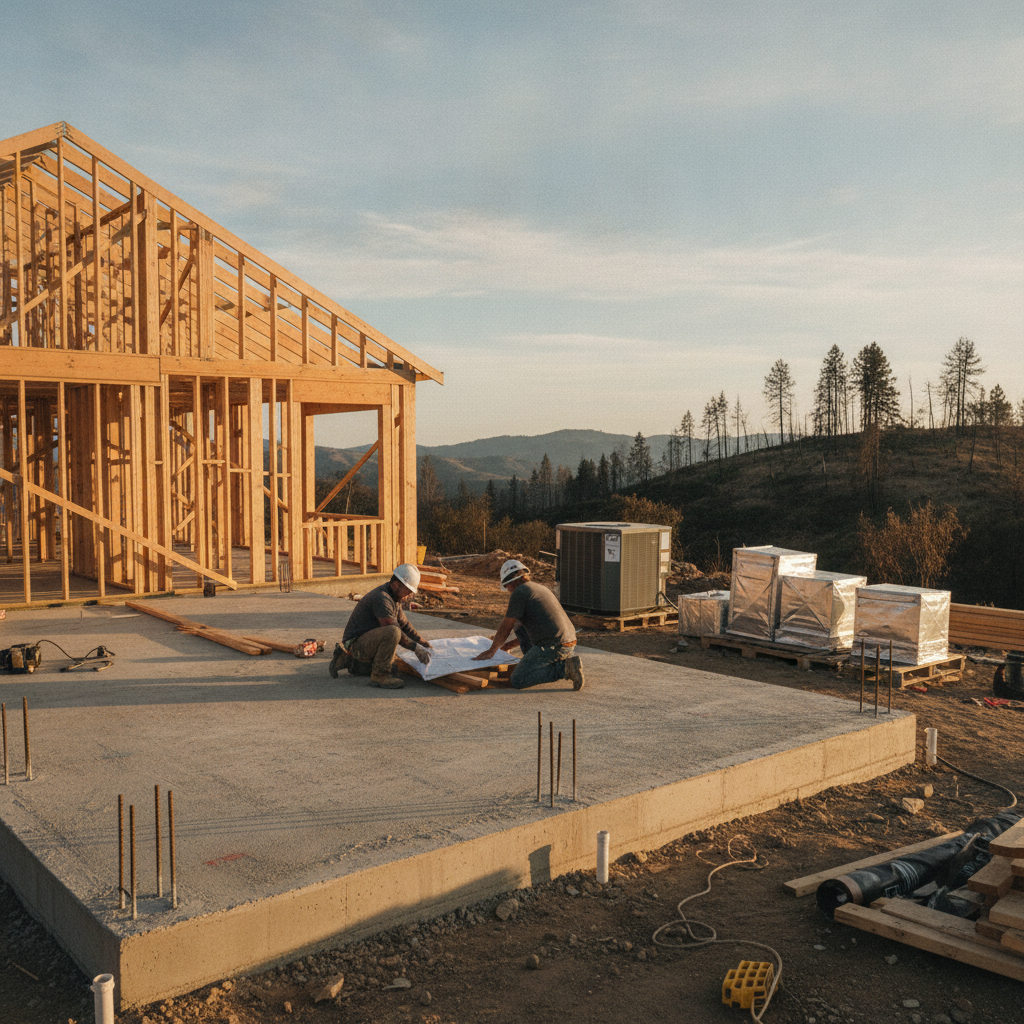
What Santa Rosa Homeowners Should Know About HVAC and Wildfire Rebuilds — Choosing the Right System When You’re Starting From Scratch
If you’re rebuilding a home in Santa Rosa after a wildfire — whether in Coffey Park, Fountaingrove, or another neighborhood that was hit hard — your HVAC decisions during construction matter far more than most people realize. When you’re coordinating with a general contractor, juggling permits, and making hundreds of decisions about finishes and floor plans, heating and cooling often gets treated as an afterthought. It shouldn’t be. The choices you make before the walls close up will shape your comfort, your energy bills, and your indoor air quality for decades. Here’s what you actually need to know.
Why a Rebuild Is a Rare Opportunity — and a Common Trap
Most homeowners never get to design their HVAC system from scratch. They inherit whatever was already in the house and work around it. When you’re rebuilding, you don’t have that constraint — and that’s genuinely valuable. You can right-size the system for your new floor plan, route ductwork efficiently through planned chases rather than improvised crawl spaces, and choose equipment that matches how you actually live rather than what was cheapest in 1998.
The trap is letting your general contractor or framing crew make decisions that should involve an HVAC professional. Duct chases get framed in the wrong place. Mechanical rooms end up too small. Electrical panels get spec’d without accounting for a heat pump’s load. These mistakes are fixable after the fact, but fixing them costs real money — sometimes more than the original equipment itself.
If you’re rebuilding in Santa Rosa, get an HVAC contractor involved early. Not at rough-in. Early — ideally before framing is complete.
Should You Go All-Electric? The Heat Pump Case in Santa Rosa’s Climate
This is the question most rebuild homeowners are wrestling with right now, and the honest answer is: for most homes in Sonoma County, an all-electric heat pump system makes a lot of sense — especially when you’re starting fresh.
Santa Rosa’s Mediterranean climate is almost ideal for heat pump performance. Summers are hot and dry, winters are cool but rarely brutal. Heat pumps work most efficiently when outdoor temperatures stay above freezing, which describes most of our winter nights. You get heating and cooling from a single system, which simplifies your mechanical setup and eliminates the need to run a gas line if you’re going all-electric.
There are also financial incentives worth taking seriously. The federal Inflation Reduction Act offers tax credits for qualifying heat pump installations. PG&E has rebate programs for high-efficiency systems. If you’re rebuilding from the ground up and your contractor is already budgeting for a gas furnace and separate AC unit, run the numbers on a heat pump instead — the gap in upfront cost is often smaller than people expect, and the long-term savings on two separate systems can be significant.
That said, some larger homes or homes with very high heating loads may benefit from a dual fuel setup — a heat pump paired with a gas furnace backup — especially if you already have a gas service to the property. It’s not one-size-fits-all, and anyone who tells you it is isn’t thinking carefully about your specific home.
Ductwork: The Part Nobody Wants to Think About (But Really Should)
New construction is your best chance to build a duct system that actually works. Most existing homes in Santa Rosa have ductwork that was designed for a different era — undersized returns, leaky joints, supply runs that are too long or poorly balanced. In a rebuild, you can do it right the first time.
A proper duct design starts with a Manual J load calculation for your specific floor plan, orientation, window placement, and insulation spec. This tells you how much heating and cooling each room actually needs. Manual D then tells you how to size and route the ducts to deliver that conditioning. These calculations take time and cost money, but they’re the difference between a system that works quietly and efficiently and one that leaves certain rooms too hot, too cold, or too loud.
A few things to insist on in new construction:
- Sealed duct connections — mastic sealant, not just tape, at every joint
- Insulated ducts in unconditioned spaces — even a short run through a hot attic loses significant efficiency
- Adequate return air — undersized returns are one of the most common causes of comfort complaints in new builds
- Mechanical room sizing — your air handler, water heater, and any other mechanical equipment need enough clearance for service access
If your rebuild involves an open floor plan or vaulted ceilings — common in newer construction — duct routing gets more complex. This is worth a conversation with your HVAC contractor before framing, not after.
Indoor Air Quality: Don’t Skip This in a Post-Wildfire Rebuild
Homes rebuilt after wildfires in Santa Rosa exist in a region that sees significant smoke events every year. The new home you’re building will need to deal with that air quality reality indefinitely. This is a good time to build in filtration that actually handles wildfire smoke — not just standard fiberglass filters.
At minimum, your new system should be designed to accommodate MERV-13 filters or higher. If your HVAC contractor doesn’t mention filter compatibility when speccing the system, ask about it directly. Higher-efficiency filters require adequate airflow to function without straining the blower, which means the system has to be sized with that in mind from the start.
Some rebuild homeowners are also adding energy recovery ventilators (ERVs) to their new construction, which allow fresh outdoor air into the home without losing the conditioned air already inside. An ERV pairs well with a well-sealed new home and helps with both air quality and humidity management. It’s worth asking about during the design phase — retrofitting one later is possible but more disruptive.
What Most Contractors Get Wrong on Rebuilds (And What to Ask Instead)
The most common mistake we see on rebuild projects — and this is something competitor companies rarely address directly — is that homeowners let general contractors select and install HVAC systems as a line item, rather than bringing in a dedicated HVAC contractor during the design phase. General contractors work with whoever is available and cheapest, not necessarily whoever is best suited to your home’s specific layout and your long-term comfort goals.
Here are the questions to ask any HVAC contractor before they touch your rebuild:
- Will you perform a Manual J load calculation, or are you sizing the system based on square footage alone?
- Are you familiar with the local permit requirements for new construction HVAC in Sonoma County?
- Do you have experience with the specific equipment you’re recommending — Daikin, Mitsubishi Electric, Trane, or whichever brand is being proposed?
- Can you walk me through the rebate and tax credit options available for this system?
- What’s your commissioning process after installation — how do you verify the system is balanced and operating correctly?
If you’re rebuilding in Windsor, the same principles apply — we serve the Windsor area and surrounding communities and can be involved at the design stage, not just rough-in.
Frequently Asked Questions: HVAC and Wildfire Rebuilds in Santa Rosa
When should I bring an HVAC contractor into a new build or rebuild?
Before framing is complete if possible — ideally during the design phase. This ensures duct chases, mechanical room sizing, and electrical loads are accounted for in the original plans, which is far less expensive than making changes after the fact.
Is a heat pump a good choice for a Santa Rosa rebuild?
For most homes, yes. Santa Rosa’s climate is well-suited to heat pump performance, and starting fresh in new construction makes the installation cleaner and less expensive than retrofitting. Factor in current federal tax credits and PG&E rebates when comparing costs.
What air filtration should a rebuilt home have given wildfire smoke in the area?
At minimum, a system designed to accept MERV-13 or higher filters. An energy recovery ventilator (ERV) is worth considering in a well-sealed new construction home. Your HVAC contractor should address filtration compatibility during the system design phase, not as an add-on after the fact.
Can I use the same HVAC equipment the previous home had?
Probably not — and you shouldn’t want to. A rebuild is the right time to right-size for your new floor plan. The old home’s equipment was sized for a different layout, may be outdated in terms of efficiency, and almost certainly wouldn’t meet current code for new construction installation.
Are there rebates available for high-efficiency HVAC in new construction?
Yes. Federal tax credits under the Inflation Reduction Act apply to qualifying heat pump systems. PG&E offers rebates for qualifying high-efficiency equipment. The specifics change periodically, so it’s worth confirming current eligibility with your HVAC contractor before finalizing your equipment selection. See our current offers and financing page for what’s available now.
Talk to Someone Who Knows This Area
Stout’s Heating & AC has been working with Santa Rosa homeowners since 1992 — through growth, through losses, and through rebuilds. We’re not a franchise. We’re a local company that understands what it means to build something back up from scratch and wants to help you get it right this time. If you’re in the planning stages of a wildfire rebuild and haven’t yet locked in your HVAC approach, it costs you nothing to have a conversation before decisions get made for you.
Request a free estimate or consultation and let’s talk through what makes sense for your home, your floor plan, and your budget. We’re reachable at (707) 527-1504 or by email at help@stoutshvac.com.