
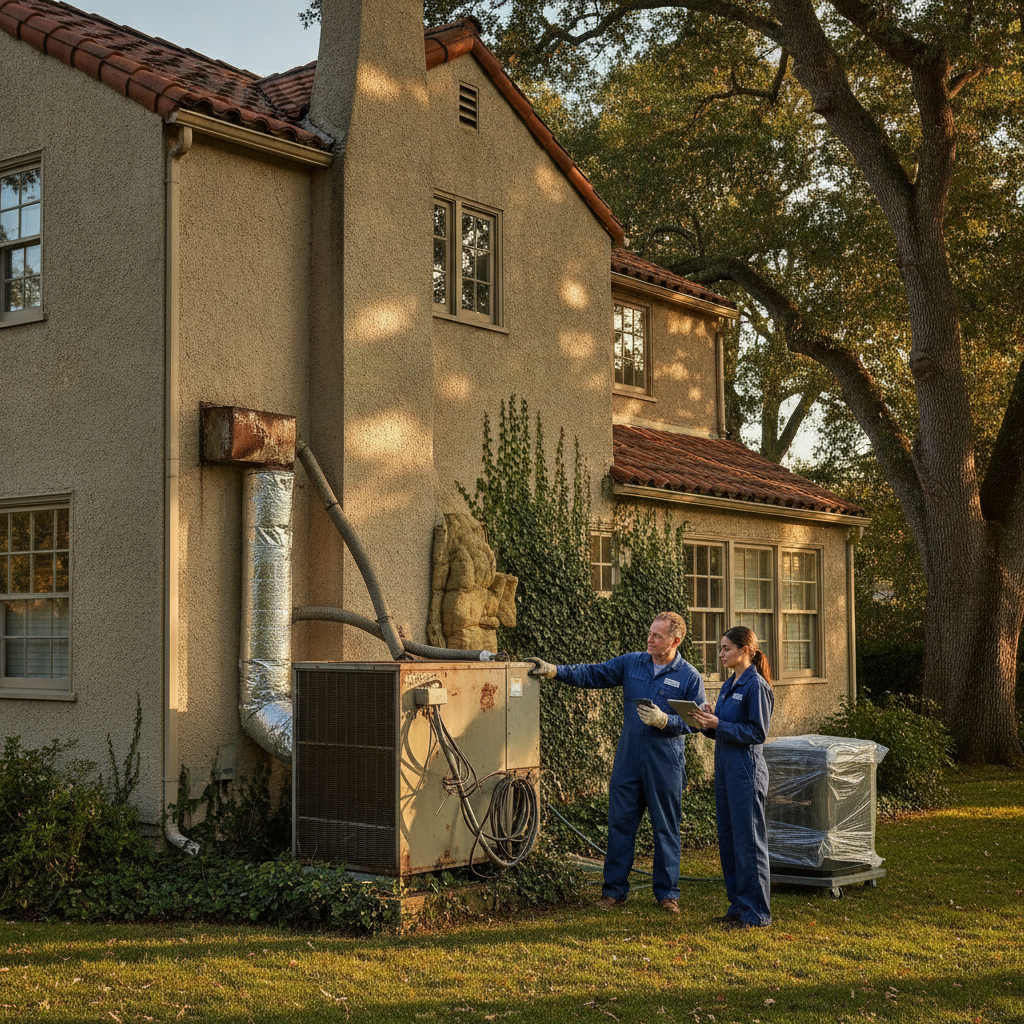
What Santa Rosa Homeowners Should Know About HVAC and Home Aging — How an Older House Fights Your Heating and Cooling System at Every Turn
If your Santa Rosa home was built before 1990, there’s a good chance it was never designed to work with the kind of heating and cooling system sitting in it today. That disconnect — between older construction and modern HVAC — is one of the most common reasons homeowners call us frustrated, wondering why their system runs constantly, why some rooms never get comfortable, or why their energy bills keep climbing even after a new unit was installed. The equipment often isn’t the problem. The house is.
This isn’t a knock on older homes. Some of the best-built houses in Sonoma County are the older ones — the craftsman bungalows near Railroad Square, the mid-century ranch homes in the West End and South Park neighborhoods, and the post-war houses that fill older Sebastopol streets. But those homes were built in an era when “heating the house” meant a floor furnace or a wall heater, and “cooling” meant opening a window. Installing a full central HVAC system into that kind of structure creates challenges that a lot of contractors gloss over — and that most competitor websites barely mention.
The Core Problem: Old Houses Were Built to Breathe Differently
Modern HVAC systems — especially high-efficiency central air and heat pump systems — are designed around the assumption that a house has a relatively consistent, sealed envelope. They move conditioned air through a duct network sized for the home’s layout and expect that air to stay where it’s put.
Older homes don’t work that way. They tend to have:
- Thinner wall cavities with little or no insulation
- Single-pane windows or older dual-pane units past their service life
- Gaps around plumbing and electrical penetrations that were never sealed
- Attic spaces with inadequate insulation or none at all
- Underfloor areas — crawl spaces or pier-and-beam foundations — that act as a cold air reservoir in winter
All of that means your HVAC system is working against the house itself. It conditions air, pushes it into the living space, and then watches it leak back out through every gap and thin wall section. The result is a system that runs longer, uses more energy, and still can’t keep the bedroom at the end of the hallway comfortable on a hot July afternoon.
What This Looks Like in Real Santa Rosa Homes
We’ve been servicing homes across this area since 1992, and certain patterns come up over and over in older neighborhoods. In Coffey Park, where a lot of homes were rebuilt after the 2017 fires, you have a mix of brand-new construction and original homes on adjacent blocks — the contrast in HVAC performance between them is striking. In Bennett Valley, we regularly work in 1960s and 1970s ranch-style homes where the original ductwork — if it exists at all — was never properly sized and runs through unconditioned spaces like uninsulated attics and exterior wall cavities.
In the historic neighborhoods closer to downtown Santa Rosa, the situation is often even more complicated. Victorian-era and early 20th-century homes have unusual floor plans, finished walls that make duct installation difficult or impossible, and architectural details worth preserving that you can’t just route sheet metal through. For these homes, retrofitting a traditional ducted system often isn’t the right answer.
When a New System Alone Won’t Solve the Problem
This is the conversation we have regularly with homeowners who’ve already spent money on a new furnace or AC unit and are still unhappy. If the ductwork is leaky, undersized, or routed badly, a new system won’t fix the comfort problems — it’ll just be a newer system running inefficiently through the same compromised infrastructure.
Before recommending any equipment, we look at the whole picture:
- Duct condition and sizing. Ducts that are 30 or 40 years old may have disconnected joints, collapsed flex sections, or were never sized correctly to begin with. A new system pushing air through bad ducts is like putting new tires on a car with a bent frame.
- Return air configuration. Older homes often have undersized or poorly located return air grilles, which chokes airflow and creates pressure imbalances throughout the house.
- Thermal envelope reality. We’ll be direct with you about what the house is and isn’t doing. Sometimes a little targeted weatherstripping and attic insulation makes more difference than any HVAC upgrade.
Ductless Mini-Splits: Often the Right Answer for Older Santa Rosa Homes
For a lot of older homes in this area — especially those with no existing ductwork or ductwork that would cost more to fix than it’s worth — a ductless mini-split heat pump is genuinely the best solution. We’re not pushing this as a one-size-fits-all answer, but it makes sense for many situations:
- No ducts to run means no tearing into walls or ceilings
- Individual room units give you zone control without a full zoning systemModern mini-splits from Mitsubishi Electric, Daikin, Fujitsu, and LG are extremely efficient — better SEER ratings than most central systems
- They function as heat pumps, so they both heat and cool from one system
- Installation in a historic or architecturally sensitive home can be done cleanly with minimal visual impact
Multi-zone mini-split systems let you condition different parts of the house independently. That’s a real advantage in older homes where the bedroom wing is always too warm while the living room is cold — a problem that’s nearly impossible to solve with a single-zone central system in a house with an imperfect duct layout.
What About Older Gas Furnaces in Existing Systems?
If your older Santa Rosa home does have a central furnace and duct system that’s holding up reasonably well, the question becomes whether to repair or replace. A furnace that’s 20-plus years old but still functioning may not need immediate replacement — but it’s worth knowing what you have. Older atmospheric-vented furnaces, in particular, can develop heat exchanger cracks over time, which is a carbon monoxide risk that shouldn’t be ignored.
We service all major brands — Trane, Carrier, Lennox, Amana, American Standard, York — and we’re straightforward about whether a repair makes sense or whether the money is better put toward a replacement. In many cases, upgrading to a high-efficiency furnace or a heat pump hybrid system pays for itself over a few years through lower PG&E bills, especially with available California rebates and federal tax credits.
Wildfire Smoke and Older Homes: A Compounding Problem
One issue that’s specific to Sonoma County and rarely comes up in generic HVAC content: older homes have more air leakage pathways, which means wildfire smoke has more ways in. During the increasingly common smoke events in our area, a newer well-sealed home with a good filtration system can maintain decent indoor air quality. An older home with gaps around windows, unsealed attic penetrations, and an aging HVAC filter is going to let a lot of that smoke in regardless of what you’re running through your thermostat.
If you’re in an older home and air quality during fire season is a concern, the filtration conversation needs to happen alongside the HVAC conversation. We can help you understand what your current system can support in terms of filter upgrades and whether additional ventilation or air purification makes sense for your home’s specific situation.
Frequently Asked Questions
My house is from the 1950s and has no ductwork at all. What are my heating and cooling options?
Ductless mini-split systems are usually the most practical solution. They require only a small hole through an exterior wall for the refrigerant line and can heat and cool individual rooms or the whole house depending on how many indoor units you install. Installation is significantly less invasive than running new ductwork through finished walls and ceilings.
How do I know if my existing ductwork is the problem and not my HVAC equipment?
Signs that point to ductwork include uneven temperatures between rooms, weak airflow at certain vents, a system that runs longer than expected, and higher-than-normal energy bills despite a relatively new unit. A proper duct inspection — not just a visual check — can identify leaks and airflow restrictions. We can walk you through what we find before recommending anything.
Are there rebates available for upgrading HVAC in an older Santa Rosa home?
Yes. PG&E offers rebates on qualifying high-efficiency heat pumps and ductless systems, and federal tax credits under the Inflation Reduction Act can cover a meaningful portion of a heat pump installation. The specifics depend on the equipment and your household situation. Check our current offers and financing page for what we’re currently able to offer, and ask us about rebate eligibility when you call.
Can I keep my older home’s character and still get a modern HVAC system?
Yes, and this is something we take seriously. In Railroad Square and other historic neighborhoods, we regularly work in homes where the goal is minimal visual impact. Mini-split indoor units can be positioned discreetly, and line sets can usually be run in ways that don’t require opening up historic trim or plasterwork. It takes more planning, but it’s very doable.
Is it worth installing central AC in an older Santa Rosa home that only has a furnace?
It depends on the ductwork. If the existing furnace duct system is in reasonable shape and sized appropriately, adding central AC is often straightforward. If the ducts are problematic, you may be better served by a ductless system rather than putting AC on a flawed duct infrastructure. We’ll give you an honest assessment either way.
Ready to Get a Real Answer for Your Older Home?
We’ve been working on older Santa Rosa homes — the quirky floor plans, the undersized returns, the original wall heaters still hanging in the hallway alongside a newer furnace nobody trusted — since 1992. We’re not going to sell you a system without first understanding what the house actually needs.
If you’re dealing with comfort problems in an older home, or you’re trying to figure out whether to repair, replace, or rethink your heating and cooling setup entirely, give us a call at (707) 527-1504 or request a free estimate online. We’ll come out, look at what you have, and tell you straight what makes sense.