
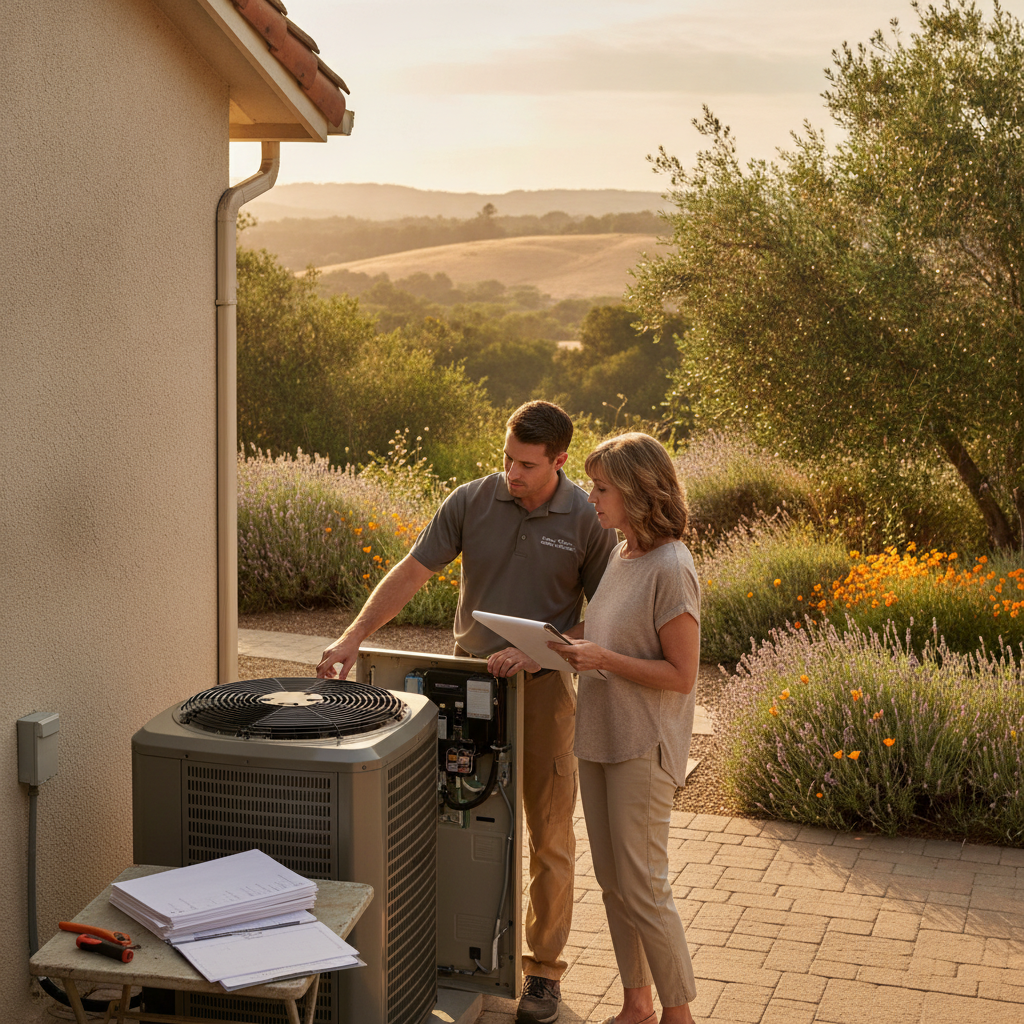
What Santa Rosa Homeowners Should Know About HVAC Maintenance Plans — What You’re Actually Paying For and Whether It’s Worth It
Yes, a good HVAC maintenance plan is usually worth it for Santa Rosa homeowners — but the key word is good. The honest truth is that maintenance plans vary wildly between HVAC companies, and a lot of what gets sold as a “comprehensive service agreement” is really just a glorified reminder that you exist as a customer. Before you sign anything, it helps to understand exactly what these plans cover, what they don’t, and what separates a plan that actually protects your system from one that’s mostly a profit center for the contractor.
Why Maintenance Plans Exist — and Why They’re Worth Having the Conversation
Your heating and cooling system is one of the most expensive pieces of equipment in your home. In Santa Rosa’s climate — hot, dry summers with stretches of triple-digit heat, and cool wet winters that can turn cold fast — your system works in both directions. That kind of year-round demand accelerates wear on components like capacitors, contactors, belts, and heat exchangers in ways that most homeowners don’t notice until something stops working entirely.
Preventive maintenance is how you catch those problems before they become emergencies. A failing capacitor found during a spring tune-up costs a fraction of what you’d pay for a midnight emergency call in July when your AC stops working during a heat wave. That’s the core value proposition — and it’s a real one.
The problem is that not all maintenance plans are structured to deliver on that promise.
What a Real HVAC Maintenance Plan Should Include
A legitimate bi-annual maintenance plan — one visit in the spring before cooling season and one in the fall before heating season — should cover a thorough inspection and tune-up of both your AC system and your furnace or heat pump. Here’s what that actually means in practice:
For your cooling system (spring visit):
- Checking refrigerant levels and inspecting for leaks
- Cleaning or inspecting the evaporator and condenser coils
- Testing the compressor, capacitors, and contactors
- Inspecting and cleaning the condensate drain line
- Checking electrical connections and measuring voltage and amperage draws
- Verifying thermostat calibration and system operation
For your heating system (fall visit):
- Inspecting the heat exchanger for cracks (a critical carbon monoxide safety check)
- Cleaning the burners and checking ignition and flame sensors
- Testing safety controls and limit switches
- Checking flue and venting for blockages or corrosion
- Lubricating moving parts and inspecting belts if applicable
- Verifying airflow through filters and duct connections
If a plan doesn’t include most of these items — or if the technician is in and out of your house in 20 minutes — you’re not getting a real tune-up. You’re getting a visual inspection dressed up as maintenance.
What Most Competitor Plans Don’t Tell You Upfront
This is where a lot of homeowners across Sonoma County get surprised. Some HVAC companies in the area sell maintenance plans that look good on paper but exclude the most common repairs. The plan covers the visit, but anything the technician finds — a dirty coil that needs chemical cleaning, a worn capacitor, a failing contactor — is billed separately at full price with no discount. You’re essentially paying an annual fee for someone to discover problems that will then cost you full rate to fix.
A better plan structure gives plan members priority scheduling, discounted or waived diagnostic fees, and a percentage off parts and labor when repairs are needed. Ask about this before you sign. If the plan doesn’t offer any repair benefits, the math may not work in your favor — especially if your system is newer and unlikely to need major service in the short term.
Does It Make More Sense to Just Pay Per Visit?
For some homeowners, paying for individual tune-ups each year is the right call — particularly if your system is relatively new, recently installed, and under manufacturer warranty. Many manufacturers actually require documented annual maintenance to keep warranties valid, so skipping service entirely isn’t a great idea regardless of whether you’re on a plan.
That said, if your system is more than eight to ten years old, is a model that sees hard use (a home in Rohnert Park with a south-facing roof in full sun, for example, or an older house in Sebastopol with suboptimal duct layout), or if you’ve had recurring repair calls in the last few years, a maintenance plan starts to pay for itself pretty quickly. The priority scheduling benefit alone is meaningful — when a heat wave hits and every HVAC company in Sonoma County is booked out, plan members get moved to the front of the line.
What About Plans From National HVAC Chains?
A number of national HVAC franchise operations have been expanding their footprint in Sonoma County in recent years, and they often lead with maintenance plan marketing. The pitch is polished, the branding is professional, and the pricing is competitive. But there are real tradeoffs.
National chains frequently use a revolving door of technicians — you rarely see the same face twice, and the person servicing your furnace may have driven in from outside the county that morning. They don’t know that your older Healdsburg home has a tricky duct configuration, or that your Windsor neighborhood still runs on aging equipment that requires a specific familiarity to service correctly. When something goes sideways, you’re navigating a call center, not calling someone who knows your system.
Local contractors who have been in the area for decades have institutional knowledge about the equipment common in this region, the quirks of Sonoma County housing stock, and the seasonal patterns that affect HVAC performance here. That familiarity has real value, particularly when a repair call turns into a diagnostic puzzle. Stout’s Heating & AC has been serving Santa Rosa and the surrounding area since 1992 — that kind of continuity matters when you’re trusting someone with your home’s primary comfort systems.
A Note on Air Quality and Wildfire Season
One thing that doesn’t get mentioned often enough in maintenance plan conversations is filter condition and indoor air quality — which in Sonoma County is a bigger issue than it is in most of California. During wildfire smoke events, filters get loaded faster than normal. A maintenance visit that includes filter inspection and replacement guidance (or a filter upgrade recommendation) has added value here that you simply don’t get in a lot of other markets. If your technician isn’t talking to you about filtration as part of your fall tune-up, that’s a gap worth flagging.
Frequently Asked Questions
How much does a typical HVAC tune-up cost in Santa Rosa without a plan?
Individual tune-up pricing varies, but a proper bi-annual tune-up from a reputable local contractor is typically in the range of $80–$120 per visit. Stout’s offers a $90 tune-up special — worth checking before you commit to an annual plan anywhere.
Do I still need maintenance if my system is under warranty?
Yes. Most HVAC manufacturers require documented annual professional maintenance to keep warranties valid. Skipping it — even once — can void your coverage if something fails and you need to make a warranty claim.
What’s the difference between a maintenance plan and a service contract?
A maintenance plan typically covers scheduled tune-ups and may include some repair discounts. A service contract (sometimes called an extended warranty) goes further and may cover repair costs up to a certain dollar amount. Read both carefully — the terms vary significantly between companies.
Can I get a maintenance plan if I have a heat pump instead of a furnace and separate AC?
Yes. Heat pumps still need bi-annual service — the mechanical demands are real, even though a heat pump is doing both heating and cooling from one system. Make sure any plan you sign up for explicitly includes heat pump maintenance, since some older plan templates were written around traditional split systems and may not cover your equipment properly.
What if I have an older system — is it worth maintaining or should I just replace it?
That depends on the specific system and its condition. A technician can give you an honest assessment. As a general rule, if a system is over 15 years old and repair costs are approaching 50% of replacement cost, replacement often makes more financial sense — especially when you factor in rebates and the efficiency gains from a modern system.
The Bottom Line
A maintenance plan with a contractor you trust is one of the better low-cost investments you can make in your home’s comfort and reliability. But the plan is only as good as the company behind it. Ask what’s included, what’s not, whether repairs come with member discounts, and whether you’ll see consistent technicians who actually know your system.
If you’re in Santa Rosa, Petaluma, Windsor, or anywhere else in Sonoma County and want an honest conversation about whether a maintenance plan makes sense for your home, reach out to Stout’s Heating & AC, Inc. We’ve been doing this work locally since 1992 and we’ll give you a straight answer — not a sales pitch.