
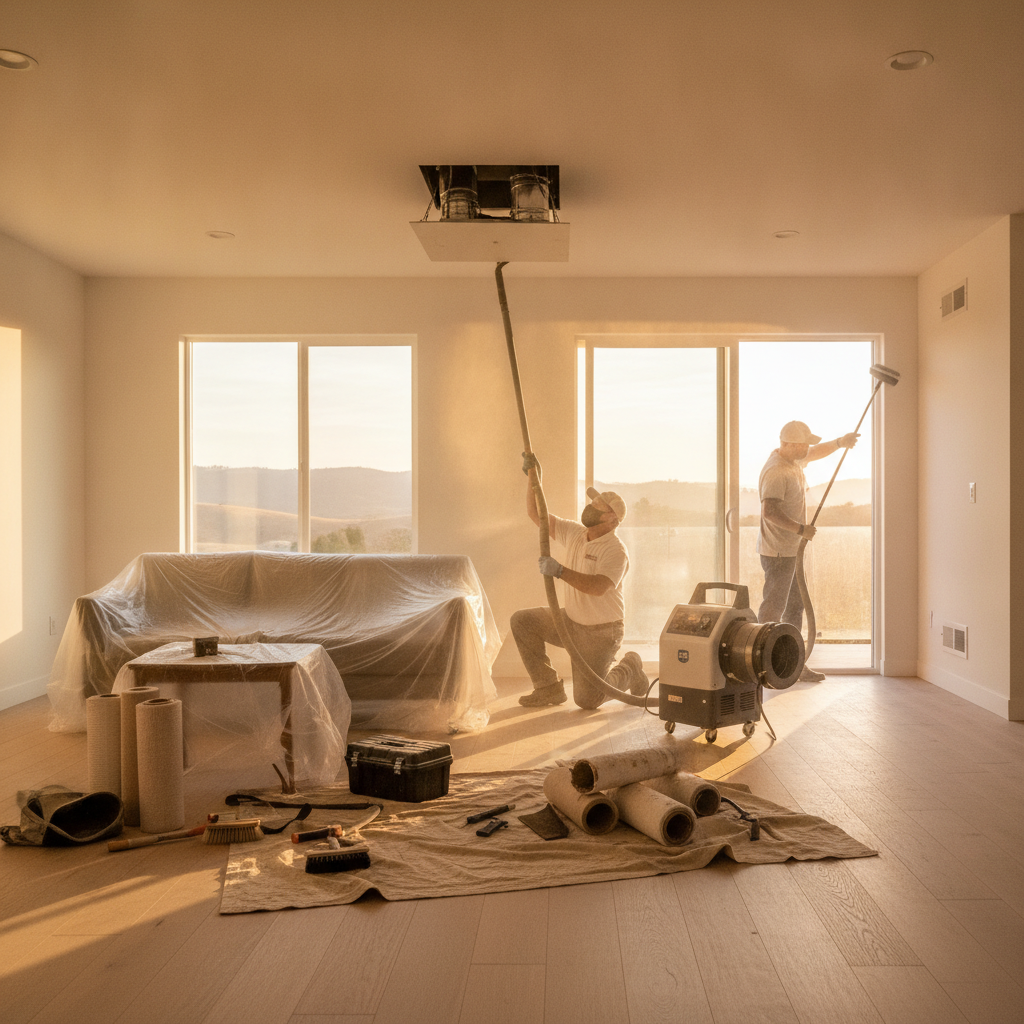
What Santa Rosa Homeowners Should Know About HVAC and Indoor Air Quality After a Home Renovation
If you’ve just wrapped up a kitchen remodel, bathroom upgrade, or whole-room addition in Santa Rosa, the last thing you’re probably thinking about is your HVAC system. But it should be near the top of your post-renovation checklist. Construction work — even a modest one-room project — sends drywall dust, insulation fibers, sawdust, adhesive fumes, and volatile organic compounds (VOCs) straight into your ductwork and air handler. Once that happens, your system becomes the thing spreading those contaminants to every other room in your home every time it kicks on.
This is a topic most local HVAC companies don’t address head-on, and it’s one we hear about regularly from homeowners in Santa Rosa who notice their home still smells like a job site weeks after the crew has packed up. The good news is that with the right steps — in the right order — you can clear the air and protect your system at the same time.
Why Construction Work Is Harder on Your HVAC Than You Might Expect
Your HVAC system is essentially a giant air-moving machine. During a renovation, it doesn’t know the difference between clean indoor air and a cloud of drywall compound. If the system was running during the remodel — or if supply and return vents weren’t sealed off during construction — that particulate matter has almost certainly made its way into your ductwork.
Here’s what typically ends up in your system after a remodel:
- Fine drywall and plaster dust — these particles are tiny enough to pass right through a standard 1-inch air filter and coat the inside of your ducts and blower wheel
- Wood particles and sawdust — from framing, trim work, or flooring installation
- Insulation fibers — especially if walls or ceilings were opened during the project
- VOCs from paints, sealants, adhesives, and new flooring — these off-gas for days or weeks after application and can accumulate inside a home without adequate ventilation
- Mold spores — if any water damage was uncovered during the renovation or if humidity wasn’t controlled during the project
In older Santa Rosa neighborhoods like Coffey Park, Rincon Valley, and the West End, many homes have ductwork that’s already accumulated years of dust and debris before a single nail is driven. A renovation can push that system past its limits quickly.
The Steps to Take Before You Start Running Your System Again
If you had construction happening in your home and your HVAC was running — or you’re not sure whether the vents were properly sealed — don’t just flip the thermostat back on and hope for the best. Here’s a practical sequence to follow:
1. Replace the Air Filter Immediately — But Don’t Stop There
Your air filter is the first thing to check after any renovation. It’s almost certainly clogged. But swapping the filter is the beginning of the process, not the end. A heavily loaded filter during construction can collapse and allow debris to bypass it entirely, meaning contamination is already downstream. Replace the filter with a fresh one rated MERV-8 or higher, and plan to check it again in two to three weeks — post-renovation particle loads can clog a new filter much faster than normal.
2. Have Your Ducts Inspected — and Cleaned if Necessary
Professional duct inspection after a major renovation is worth the investment. A technician can actually look inside your ductwork with a camera or inspection light and tell you what’s there. If there’s visible accumulation, a proper duct cleaning removes it at the source rather than just cycling it through the system repeatedly. This isn’t something a standard filter change addresses — and it’s something most homeowners don’t think to ask about until they’re noticing reduced airflow or persistent odors.
3. Check Your Air Handler and Blower Wheel
Fine construction dust — especially drywall — has a way of coating the blower wheel inside your air handler. A coated blower wheel reduces airflow, strains the motor, and can shorten system life. If your renovation was significant, having a technician pull and clean the blower is often worth doing at the same time as a post-renovation inspection. We catch this regularly on service calls for Santa Rosa homes where a remodel was done but the HVAC wasn’t part of the cleanup plan.
4. Address VOCs With Proper Ventilation
Paint, flooring adhesives, new cabinetry, and sealants off-gas VOCs that your standard HVAC filter does very little to address. Particulate filters — even high-MERV filters — are not designed to capture gases. Addressing VOCs properly means ventilation: bringing in fresh outdoor air and exhausting the contaminated indoor air. In Santa Rosa’s Mediterranean climate, post-renovation ventilation is often straightforward in the spring and fall when outdoor air quality is good. During wildfire season, however, opening windows may not be an option — which is where a whole-house ventilation system with appropriate filtration becomes genuinely useful.
If you’re dealing with persistent chemical odors after a remodel, it’s worth talking to an HVAC professional about whole-house ventilation solutions that can exchange indoor and outdoor air in a controlled way without relying on open windows.
What About Activated Carbon Filtration and Air Purifiers?
This is a gap that most local HVAC content doesn’t address honestly: standard MERV-rated filters remove particulates, but they don’t do much for VOCs, odors, or gaseous contaminants. Activated carbon filtration — either as a standalone media cabinet installed in your air handler or as part of a whole-home air purification system — is specifically designed to adsorb VOCs and odors. If your renovation involved significant paint or chemical work, or if you installed new engineered flooring, a carbon filtration component is worth discussing with your technician.
Homes in Rohnert Park, Windsor, Sebastopol, and throughout Sonoma County that have also dealt with wildfire smoke in recent years may already have some air quality infrastructure in place — but post-renovation VOC loads are a different category of problem than smoke particles, and it’s worth making sure your system is set up to handle both.
When to Schedule a Professional Post-Renovation HVAC Inspection
You don’t need to wait until something goes wrong to call. The best time to schedule a post-renovation HVAC inspection is right after the work is complete — before you’ve been running the system heavily through the newly finished space. A professional inspection at that stage lets you:
- Identify duct contamination before it spreads throughout the home
- Catch filter bypass or damaged ductwork that may have occurred during construction
- Verify that new construction didn’t block or pinch any supply or return vents
- Confirm that the system is sized appropriately if the renovation changed the square footage or insulation profile of the home
- Clean the blower and evaporator coil if contamination is present
At Stout’s Heating & AC, we’ve been doing this work in Santa Rosa and Sonoma County since 1992. A post-renovation inspection is something we’re glad to walk you through — we’ll tell you honestly what we find, what needs attention, and what can wait.
If you’re also due for a regular seasonal tune-up, our $90 tune-up special is a good time to bundle a post-renovation check with your standard bi-annual maintenance visit.
Frequently Asked Questions
Do I need to clean my ducts after every renovation?
Not necessarily after every small project, but any renovation involving drywall work, insulation, or significant demolition warrants at least a duct inspection. Whether cleaning is needed depends on what the inspection finds. Small cosmetic updates — like painting a single room with vents sealed — may not require it.
Should I turn my HVAC off during a remodel?
Ideally, yes — or at minimum, have all supply and return vents in the work area sealed tightly with plastic sheeting and tape before any demolition or dusty work begins. Running the system during active construction is one of the fastest ways to distribute debris through the entire home. If the system must run for comfort, use temporary filters over vents as an extra precaution.
How long do VOCs off-gas after a renovation?
It varies by material. Many paints and adhesives off-gas most heavily in the first 24 to 72 hours, but some flooring products and composite materials can continue off-gassing for weeks or even months. Good ventilation during and immediately after the renovation makes a significant difference in how quickly levels normalize.
My home smells fine but I’m still concerned about air quality. Is there a way to test it?
Yes. Indoor air quality monitors can measure particulate levels (PM2.5), VOC concentrations, and CO2. Some are consumer-grade and available at hardware stores; others are professional-grade instruments. If you have specific health concerns, an HVAC technician can also recommend professional air quality testing services. For many homeowners, installing a whole-home air purification system provides ongoing peace of mind without requiring constant manual monitoring.
Will my existing HVAC handle a room addition without any changes?
Possibly not. If your renovation added conditioned square footage — a room addition, converted garage, or finished attic — your existing system may be undersized for the new load. Signs include rooms that don’t reach setpoint temperature, longer run cycles, and elevated energy bills. A load calculation can confirm whether your system is still appropriately sized. This is something we can evaluate during a service visit.
Ready to Get Your Air Right After Your Remodel?
If you’ve recently finished a renovation in Santa Rosa, Petaluma, Windsor, or anywhere in Sonoma County and you’re not sure what shape your HVAC system is in, we’re happy to take a look. Stout’s Heating & AC has been serving this area since 1992 — we know the homes, the climate, and the air quality challenges that come with living here. We’ll give you a straight answer about what your system needs and what it doesn’t.
Contact us today to schedule a post-renovation HVAC inspection or request a free estimate. You can also reach us directly at (707) 527-1504 or email help@stoutshvac.com.