
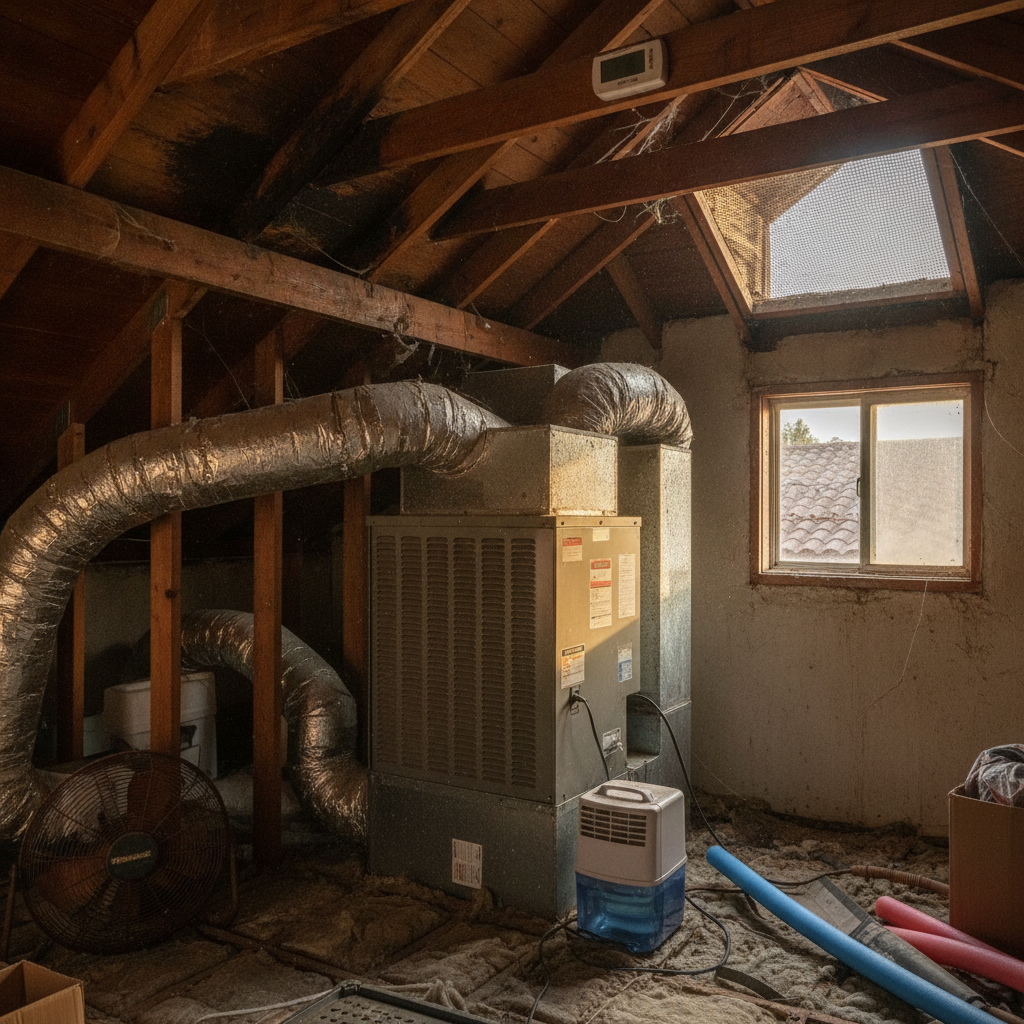
What Santa Rosa Homeowners Should Know About HVAC and Attic Ventilation — How a Poorly Ventilated Attic Is Quietly Destroying Your Comfort and Your System
If your AC runs constantly during a hot Santa Rosa summer but your upstairs rooms still feel stuffy and warm, there’s a good chance the problem isn’t your air conditioner at all — it’s your attic. During the peak of our Mediterranean summers, an unventilated attic can reach temperatures of 140°F or higher. That heat radiates down through your ceiling, overwhelms your insulation, and forces your HVAC system to work twice as hard to keep up. The system doesn’t fail because it’s broken. It fails because it’s fighting conditions it was never designed to overcome.
This is one of the most commonly overlooked comfort and efficiency issues in Sonoma County homes, and it’s rarely discussed in enough depth — even by HVAC contractors. Here’s what’s actually going on, and what you can realistically do about it.
Why Attic Heat Is an HVAC Problem, Not Just an Insulation Problem
Most homeowners think of attic heat as something insulation handles. And insulation does help — to a point. But insulation slows heat transfer; it doesn’t eliminate it. When your attic is sitting at 130 or 140 degrees for hours at a time, that heat will eventually work its way down into your living space, no matter how much R-30 batts you have up there.
The bigger issue for your HVAC system, though, is what happens to the equipment and ductwork sitting in that hot space. In many Santa Rosa homes — particularly in neighborhoods like Rincon Valley, Bennett Valley, and Coffey Park — the air ducts run through unconditioned attic space. When those ducts are surrounded by 130-degree air, the cool air inside them absorbs heat before it ever reaches your vents. You’re paying to cool air that gets warm again on its way to you.
Beyond duct losses, if your air handler or any part of your HVAC equipment lives in the attic, it’s operating in extreme conditions that accelerate wear on motors, capacitors, and electrical components. We’ve seen systems in Fountaingrove and other hillside neighborhoods age far faster than their rated lifespan for exactly this reason.
The Specific Problem With Santa Rosa’s Climate
Our local climate creates a particular challenge. Sonoma County’s Mediterranean pattern means cool, wet winters and hot, dry summers — with significant temperature swings between morning and afternoon during July and August. Inland neighborhoods can see afternoon highs in the upper 90s and occasionally over 100°F, while coastal areas like Sebastopol stay much cooler. That range matters because the attics of homes sitting in hotter inland microclimates are under far more thermal stress than homes closer to the coast.
On top of that, wildfire season has added another layer of complexity. During smoke events, homeowners — understandably — keep windows shut tight. That means no passive airflow through the house, and any heat that builds up during the day has nowhere to go at night. A well-ventilated attic becomes even more important in that context, because you’re relying entirely on your HVAC and your building envelope to manage temperature.
What Good Attic Ventilation Actually Looks Like
Proper attic ventilation works on a simple principle: hot air rises and needs a path to escape, while cooler replacement air needs a path to enter. The standard approach is a combination of soffit vents (at the eaves) and ridge vents or gable vents (at or near the peak). This creates passive airflow that flushes heat out continuously without any mechanical assistance.
The problem is that many older Santa Rosa homes — especially those built before the 1980s — weren’t ventilated to current standards. Soffit vents get blocked by insulation that was blown in improperly. Ridge vents get clogged with debris. Gable vents are undersized for the attic volume. In homes rebuilt after the 2017 Tubbs Fire, this was sometimes done right during reconstruction, but not always.
When passive ventilation isn’t enough, powered attic fans or whole-house fans can help. Whole-house fans are particularly effective in our climate because Santa Rosa evenings cool down significantly — often 30 to 40 degrees from the afternoon high. A whole-house fan can flush hot air out of your living space and attic in minutes once the outside temperature drops, reducing how hard your AC has to work the following day.
If you’re curious how whole-house ventilation fits into your overall comfort strategy, our residential ventilation services page gives a good overview of what we offer and how we approach these assessments.
Signs Your Attic Ventilation May Be Affecting Your HVAC System
You don’t need to climb into your attic to suspect a problem. Here are some common signs we see in homes across Santa Rosa and the surrounding area:
- Upper floors are noticeably warmer than lower floors even when the AC is running, especially in the late afternoon
- Your AC runs almost continuously on hot days but can’t get the house below a certain temperature
- High energy bills in summer that don’t match the size or age of your system
- The HVAC system short-cycles — turning on and off frequently without completing a full cooling cycle
- Premature equipment failures, particularly capacitors or fan motors, that your technician can’t otherwise explain
- Duct connections that have softened, sagged, or separated — excessive heat degrades flex duct over time
Any one of these by itself could have multiple causes. But if you’re seeing two or three together, attic conditions are worth investigating before you spend money on HVAC repairs that won’t actually fix the comfort problem.
What a Proper Attic and HVAC Assessment Covers — and What to Ask For
This is where a lot of homeowners get shortchanged. A technician who only looks at the mechanical equipment — refrigerant charge, airflow, thermostat calibration — may give your system a clean bill of health while missing the environmental conditions that are degrading it. A thorough assessment should include:
- Visual inspection of attic ventilation: soffit vent clearance, ridge vent condition, gable vent sizing
- Inspection of all duct runs in the attic: insulation wrap condition, connection integrity, signs of heat damage
- Assessment of insulation depth and whether it’s blocking intake vents at the eaves
- Temperature differential check between attic and outside air on a warm day
- Evaluation of whether a whole-house fan or powered attic ventilator would provide meaningful relief
When you’re calling a contractor, ask specifically whether they’ll look at the attic as part of a system evaluation, not just the equipment. If they say they’ll only assess the mechanical components, that’s useful information — but it’s not the full picture.
For homes in Windsor or Rohnert Park with newer construction and better-insulated attics, this is sometimes less of an issue. But in older neighborhoods and homes with aging flex duct, it’s almost always worth a look.
If your system is due for a tune-up anyway, that’s a good time to ask. We offer a $90 tune-up special that gives us a chance to evaluate the full system in context — not just swap filters and check refrigerant.
What the Fix Usually Involves — and What It Costs
The good news is that attic ventilation improvements are usually far less expensive than HVAC repairs or replacements. Adding or clearing soffit vents, installing a ridge vent, or adding a powered attic ventilator is typically a straightforward job. Duct insulation repair or replacement in the attic is more involved but still a fraction of the cost of replacing a system that burned out prematurely.
Whole-house fans are a bigger investment but often pay back quickly in energy savings during our long spring and fall shoulder seasons, when the house can be cooled at night without running the AC at all.
We don’t quote specific prices here because the right solution depends on your home’s layout, attic size, existing ventilation, and duct configuration. But we’re always happy to walk through what we find and explain the options clearly, without pressure.
Frequently Asked Questions
Can a hot attic actually damage my AC unit?
Yes — if your air handler or any part of your HVAC equipment is located in the attic, sustained high temperatures accelerate wear on electrical components, reduce refrigerant efficiency, and can cause the system to overheat and trip safety shutoffs. Even if your equipment is elsewhere, duct runs through a hot attic lose significant cooling capacity before the air reaches your living space.
Is attic insulation the same as attic ventilation?
No — they do different jobs and you need both. Insulation slows heat transfer from the attic into your living space. Ventilation removes that heat from the attic entirely. Adding insulation without addressing ventilation helps, but it doesn’t solve the underlying problem of heat accumulating in the attic space.
Will a whole-house fan work in Santa Rosa’s climate?
It’s actually an ideal climate for them. Our evenings cool down substantially — often dramatically — after hot days. A whole-house fan takes advantage of that by flushing out accumulated heat in minutes once the outside air drops. You do need to keep windows closed during smoke events, so it’s a seasonal tool rather than a year-round solution, but for spring and fall it’s very effective.
My home was rebuilt after the 2017 fires — should I still check my attic ventilation?
Possibly. Many homes rebuilt in Coffey Park, Fountaingrove, and other affected areas were built to better standards than the original structures, but construction quality varied. If you haven’t had an inspection since the rebuild, it’s worth confirming that soffit vents are clear and that duct insulation is intact — especially if you’re noticing comfort or efficiency issues.
How do I know if my ducts are losing efficiency in the attic?
A good indicator is the temperature difference between what your thermostat reads and how comfortable the rooms actually feel on a hot day. An HVAC technician can also measure supply air temperature at the register versus at the air handler — a significant difference suggests heat gain in the duct run. We can check this as part of a system evaluation.
Get a Real Assessment From a Contractor Who Looks at the Whole Picture
At Stout’s Heating & AC, Inc., we’ve been working in Santa Rosa and Sonoma County homes since 1992. We know these houses — the older ones with undersized gable vents and compressed attic insulation, the rebuilds with modern construction but variable duct installation, and everything in between. When you call us about a comfort problem, we’re not going to hand you a quote for a new system before we understand what’s actually causing it.
If you’re dealing with rooms that won’t cool down, an AC that runs constantly, or energy bills that seem high for what you’re getting, let’s start with a proper look at the full system — including what’s happening in your attic. Contact us to schedule an evaluation, and we’ll tell you honestly what we find and what your real options are.