
What Santa Rosa Homeowners Should Know About HVAC and Attic Heat — Why Your Upstairs Rooms Are Always Hotter
If you have a two-story home in Santa Rosa and your upstairs bedrooms feel unbearably hot every summer while the ground floor stays relatively cool, you’re not alone — and the fix usually isn’t just cranking down the thermostat. The real culprit in most cases is your attic. During Sonoma County’s hot, dry summers, an unventilated or poorly ventilated attic can reach temperatures well above 140°F. That heat radiates directly through your ceiling into the living space below, overwhelming your AC system no matter how new or efficient it is.
Why Attic Heat Is a Bigger Problem in Sonoma County Than Most Homeowners Realize
Santa Rosa’s Mediterranean climate means long stretches of intense summer heat with very little cloud cover or coastal fog relief — especially in inland neighborhoods like Rincon Valley, Fountaingrove, and Bennett Valley. When the sun beats down on a dark roof for eight to ten hours a day, that energy transfers directly into your attic space. If that heat has nowhere to go, it bakes everything it touches — including your ductwork.
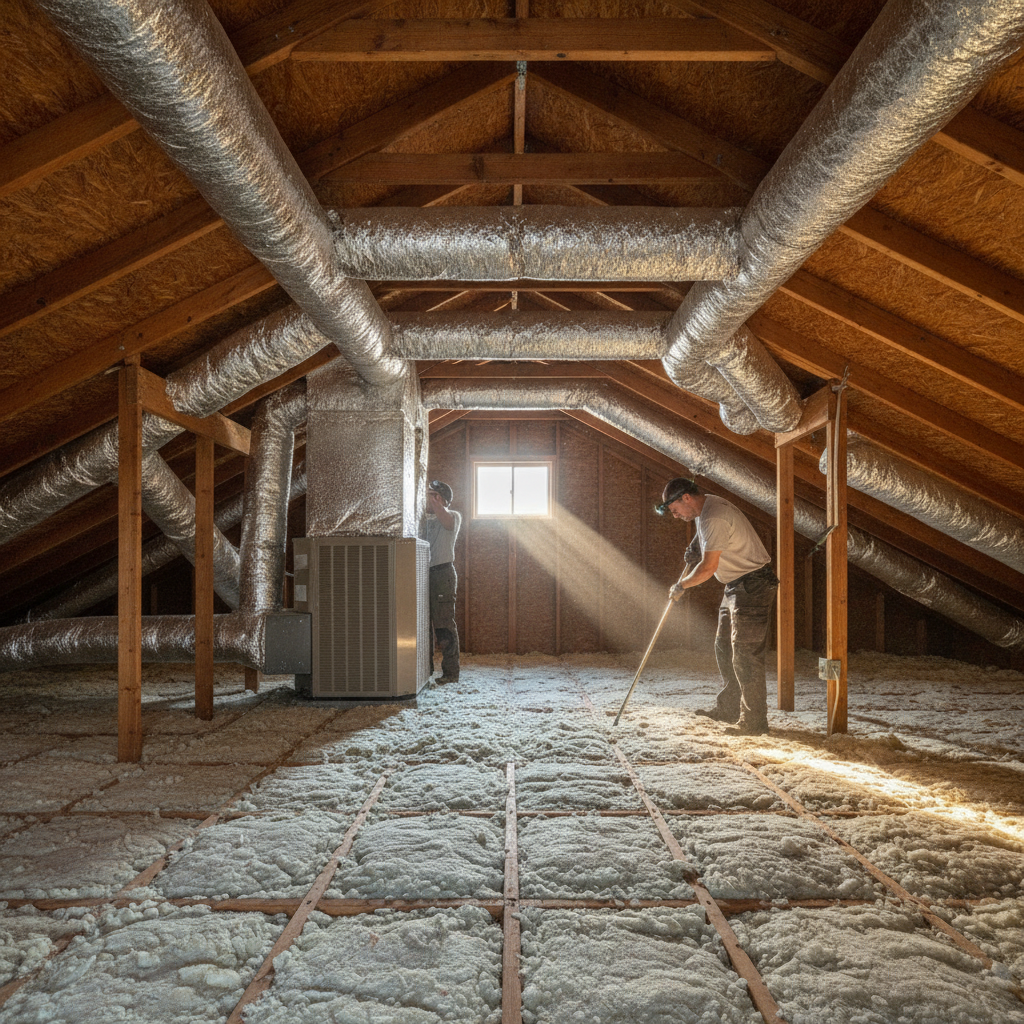
This is the piece most people miss. A significant number of Santa Rosa homes have their ductwork running through unconditioned attic space. When attic temperatures hit 130°F to 150°F and your ducts aren’t properly insulated, the cool air your system works so hard to produce gets partially reheated before it ever reaches the upstairs registers. Your air conditioner isn’t failing — it’s fighting a losing battle against a superheated attic.
Older homes in neighborhoods like Coffey Park, the West End, and parts of south Santa Rosa often have aging duct systems with deteriorating insulation and loose connections — problems that compound the attic heat issue considerably.
The Three Main Causes of Hot Upstairs Rooms
When we evaluate a home with this problem, it almost always comes down to one or more of these three factors:
- Inadequate attic ventilation: Hot air builds up in the attic because there’s not enough intake or exhaust airflow to flush it out. This is often a combination of too few soffit vents and an undersized or absent ridge vent or attic fan.
- Duct problems in the attic: Leaky, uninsulated, or poorly insulated ducts lose a substantial portion of their conditioned air before it reaches the rooms you’re trying to cool.
- Insufficient insulation at the attic floor: Without enough insulation between the attic and the ceiling below, radiant heat moves freely into your living space regardless of how hard your AC runs.
In many cases it’s all three working together — and that’s why simply replacing your AC unit doesn’t solve the problem. We’ve seen homeowners install brand-new systems and still struggle with hot upstairs rooms because no one addressed the attic conditions first.
What Good Attic Ventilation Actually Looks Like
Proper attic ventilation works on a simple principle: cool outside air enters low (typically through soffit vents), rises as it warms, and exits high (through ridge vents or a powered attic exhaust fan). When this airflow is working correctly, it dramatically reduces the peak temperature inside your attic.
A well-ventilated attic in Santa Rosa should stay within 10°F to 20°F of the outdoor air temperature rather than spiking 60 to 80 degrees above it. That difference is enormous when you’re trying to maintain 72°F inside your home on a 100°F July afternoon.
For homes where passive ventilation isn’t enough — common in larger homes and those with complex rooflines — a properly sized whole-house ventilation solution or attic fan can make a meaningful difference. If you’re curious about residential ventilation options for your home, we’re happy to walk you through what makes sense for your specific situation.
The Ductwork Problem No One Talks About Enough
This is the gap that most HVAC content — including what you’ll find on many competitor websites — simply doesn’t address in enough detail. Hot upstairs rooms are frequently a ductwork problem masquerading as an air conditioning problem. Before recommending any new equipment or system upgrade, a good local HVAC contractor should inspect what’s happening in your attic.
Here’s what we look for:
- Duct insulation rating: Ducts in an attic should be insulated to at least R-8. Many older Sonoma County homes have R-4 or lower — or bare metal ducts with no insulation at all.
- Duct leakage: Even small gaps at connections or joints allow conditioned air to escape into the attic rather than reaching your registers. Studies have found that the average home loses 20–30% of airflow through duct leaks.
- Duct routing: Ducts that travel a long distance through a hot attic — even well-insulated ones — lose more heat than ducts routed through conditioned space. Sometimes repositioning or re-routing makes a real difference.
In homes where ductwork issues are severe, or in older properties where running new ducts isn’t practical, a ductless mini-split system installed in the upstairs area is often the cleanest and most efficient solution. These systems deliver conditioned air directly to the room without any attic ductwork involved — and they work extremely well in Sonoma County’s climate year-round.
What About Radiant Barriers?
Radiant barriers — reflective foil material installed on the underside of your roof decking — can reduce the amount of radiant heat entering the attic in the first place. In a climate like Santa Rosa’s, where you’re dealing with intense sun but not extreme humidity, a radiant barrier can be a cost-effective addition alongside proper insulation and ventilation. It won’t solve a duct problem or replace adequate insulation, but it’s a useful layer in a well-designed attic system.
If you’re planning a roofing project or a major home improvement, it’s worth discussing with your contractor. And if you’ve already had the conversation about a new HVAC system, ask whether attic conditions were factored into the recommendation — because they should be.
How Stout’s Approaches This Problem Differently
We’ve been doing this in Santa Rosa since 1992, and we’ve learned that the homeowners who call us frustrated about hot upstairs rooms have usually already spent money trying to fix the wrong thing. A new thermostat, a bigger AC unit, or an extra window unit in the bedroom — none of it addresses what’s actually happening in the attic.
Our approach is straightforward: before we recommend anything, we want to understand the whole picture. That means looking at your current system’s condition, how your ducts are routed and insulated, what ventilation your attic has, and whether your insulation is doing its job. From there, we give you an honest assessment — whether the solution is a duct repair, an attic ventilation upgrade, a mini-split addition, or simply better insulation. We’re not going to sell you a new system if the real fix costs a fraction of that.
If you’re in Windsor, Petaluma, Rohnert Park, or Sebastopol and dealing with the same issue, the same principles apply — and we serve all of those areas as well.
You can also check our current offers and financing options if you’re looking at a larger project like adding a mini-split system or upgrading ductwork — there are often rebates and 0% financing available that make these improvements more accessible than homeowners expect.
Frequently Asked Questions
Can a bigger air conditioner fix my hot upstairs problem?
Usually not on its own. If your attic is superheating your upstairs space and your ducts are leaking or poorly insulated, a larger system will still struggle — and it may short-cycle, which reduces efficiency and wears the equipment out faster. Fixing the root cause first almost always delivers better results than upsizing the equipment.
How do I know if my attic ductwork is leaking?
Common signs include rooms that never reach the set temperature, unusually high energy bills in summer, visible dust buildup around registers, and a noticeable difference in airflow between upstairs and downstairs vents. A proper duct inspection — ideally with a pressure test — is the most reliable way to confirm it.
Would a whole-house fan help with my hot upstairs rooms?
A whole-house fan can help significantly during Santa Rosa’s cooler evenings and mornings by drawing in outside air and flushing hot indoor air into the attic. However, it works best when outdoor temperatures drop below indoor temperatures — typically evening and early morning. It’s not a replacement for proper attic ventilation or insulation, but it’s a useful tool in the right home.
Is a ductless mini-split a realistic fix for just the upstairs rooms?
Yes, and it’s one of the more practical solutions we recommend for two-story homes with difficult attic ductwork situations. A single mini-split head in a master bedroom or hallway can condition the entire upstairs zone independently from your central system — and because there are no ducts involved, attic heat isn’t a factor at all.
How much does it cost to fix attic ductwork in Santa Rosa?
Costs vary widely depending on the size of the home, the number of ducts affected, and how much access there is in the attic. We don’t publish set prices because every attic is different — but a free estimate takes the guesswork out of it. We’ll give you a clear picture of what’s needed and what it will cost before any work begins.
Ready to Stop Fighting Your Upstairs Temperature Problem?
If every summer in your Santa Rosa home means miserable upstairs bedrooms and an AC system that never quite keeps up, there’s likely a fixable reason — and it probably starts in your attic. Stout’s Heating & AC, Inc. has been diagnosing and solving exactly these kinds of problems for homeowners across Sonoma County since 1992. We’ll give you a straight answer about what’s going on and what it will take to fix it — no upselling, no runaround.
Request a free estimate today and let’s figure out what’s actually happening in your home.