
What Santa Rosa Homeowners Should Know About HVAC and ADUs — Heating and Cooling a Backyard Cottage or Garage Conversion the Right Way
If you’re adding an accessory dwelling unit to your Santa Rosa property — whether that’s a detached backyard cottage, a garage conversion, or a finished bonus room over a detached structure — one of the first things you’ll run into is the question of how to heat and cool it. It sounds simple enough on the surface, but the HVAC side of an ADU project trips up more homeowners than almost anything else. The wrong system choice can leave a tenant uncomfortable, drive up your PG&E bill, or create a headache when it comes time for final inspection. Here’s a straightforward look at what your real options are, how they differ, and how to make a decision you won’t regret.
Why ADUs Present a Unique HVAC Challenge
An ADU isn’t just a smaller version of your house. It’s usually detached or semi-detached, built in a space that wasn’t originally designed for year-round occupancy, and often needs to be permitted separately from the main structure. That combination creates a few specific complications that don’t come up with a typical home HVAC installation.
First, extending your existing central HVAC system to a detached ADU is almost always impractical. Running ductwork underground or through a covered walkway is expensive, loses significant efficiency over distance, and typically can’t be sized correctly without overworking your main system. In most cases, the right answer is a completely independent system for the ADU — one that’s sized and installed specifically for that space.
Second, many ADU projects in Santa Rosa and surrounding areas like Roseland, Coffey Park, and Rincon Valley are built on properties with older main homes that already have aging HVAC equipment. Adding a second load to a marginal system is a recipe for premature failure. Even if your contractor tells you it’s possible, it’s worth getting an honest second opinion on whether the capacity is actually there.
The Right System for Most ADUs: Ductless Mini-Splits
For the vast majority of ADUs and garage conversions in Sonoma County, a ductless mini-split heat pump is the right answer — and not because it’s the trendy choice. It’s because it genuinely fits the situation better than the alternatives.
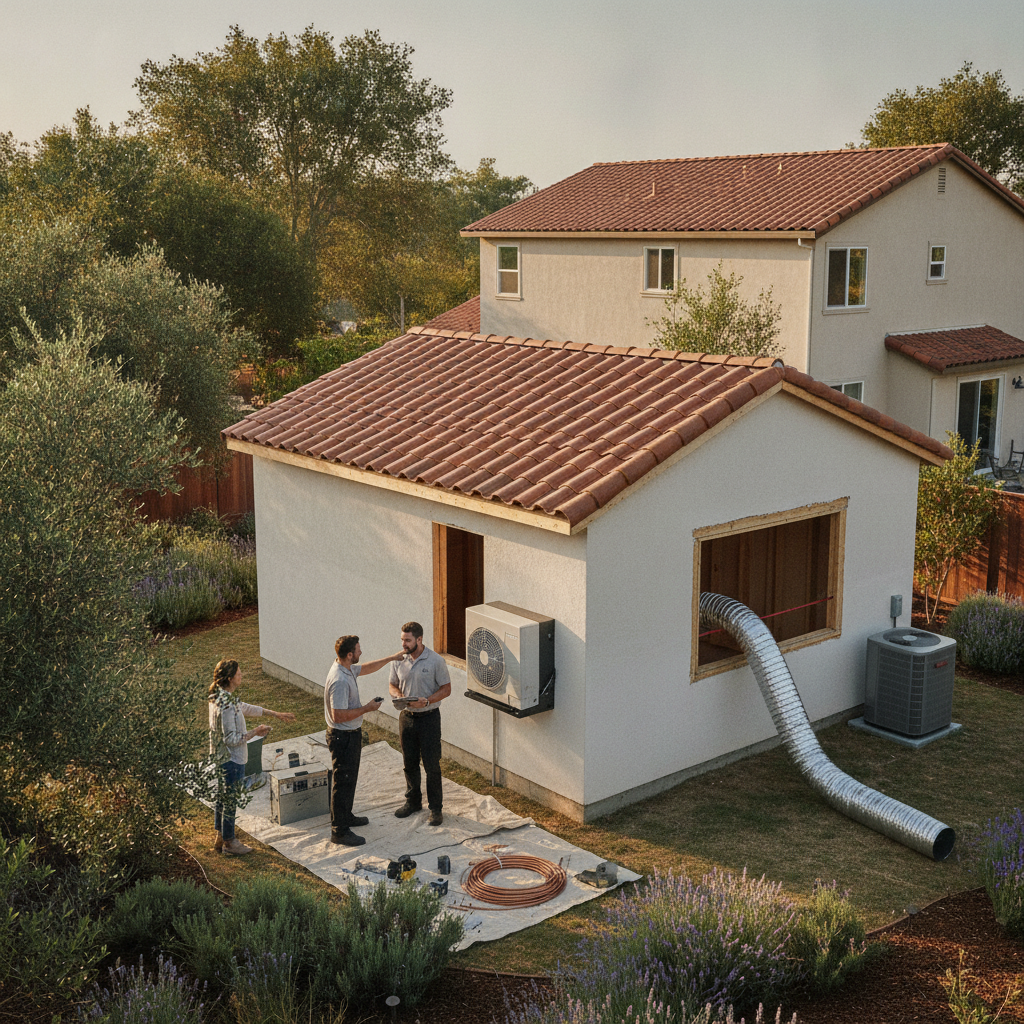
A mini-split consists of a wall-mounted indoor unit and a compact outdoor compressor. There’s no ductwork involved. Installation typically requires only a small hole through the wall for the refrigerant line, power conduit, and condensate drain — which means far less disruption to a newly finished space. The outdoor unit can be placed on a concrete pad or wall-mounted bracket near the ADU without affecting your main home’s equipment.
Because mini-splits are heat pumps, they handle both heating and cooling from a single system. That matters in Santa Rosa’s Mediterranean climate, where summers can push well past 90°F and winter nights regularly drop into the 30s. You’re not installing a heater and an AC — you’re installing one system that does both efficiently. Learn more about heat pump options for residential properties here.
Modern mini-splits from manufacturers like Mitsubishi Electric, Daikin, Fujitsu, and LG are also highly efficient — many carry SEER ratings well above what a conventional window or wall unit can achieve. That efficiency matters when you’re renting the space and trying to keep utility costs fair for a tenant.
What About Window Units or Wall Heaters — Can’t I Just Use Those?
This is where a lot of ADU projects go sideways. A window AC and a separate wall heater are cheap upfront, but they’re not an equivalent substitute for a proper HVAC system — and in many cases, they won’t pass a City of Santa Rosa permit inspection for a legally permitted ADU.
Wall furnaces and floor furnaces are gas-combustion units that require proper venting and are subject to California’s increasingly strict building codes. If you’re building a new ADU or doing a full conversion with permits pulled, you may be required to meet current energy codes — including Title 24 compliance — which favors all-electric systems like mini-splits over gas alternatives.
That said, the right answer depends on your specific project, your property’s gas service, and what your building permit actually requires. If you’re not sure what’s allowed for your ADU, a local HVAC contractor who’s familiar with Santa Rosa’s permitting environment can walk you through it before you spend money on equipment that won’t pass.
Single-Zone vs. Multi-Zone: What Do You Actually Need?
Most ADUs are small enough — typically 400 to 800 square feet — that a single-zone mini-split is all you need. One indoor head unit, one outdoor compressor. Straightforward installation, modest cost, and easy for a future tenant to operate.
If your ADU is larger, has multiple rooms with walls between them, or has a loft with a meaningful temperature difference from the main floor, you might consider a multi-zone setup — one outdoor unit connected to two indoor heads. This gives you independent temperature control in separate areas without running two full systems.
For most backyard cottages and garage conversions in Windsor, Petaluma, Rohnert Park, and across Sonoma County, single-zone is the right call. Don’t overbuild — you’ll spend more money than the project justifies and end up with more equipment than the space actually needs.
Permits, Inspections, and Why This Is Not a DIY Project
One thing that often catches homeowners off guard: HVAC work on a permitted ADU has to be done by a licensed contractor, and the installation typically needs to be inspected as part of the overall ADU permit process. This isn’t just a bureaucratic hurdle — it protects you as the property owner and protects your tenant.
If you’re going through the City of Santa Rosa’s ADU permitting process (or Sebastopol’s, or the county’s), make sure your HVAC contractor is licensed in California and is comfortable coordinating with your general contractor or permit expediter. That coordination matters more than most homeowners realize — HVAC rough-in has to happen at the right stage of construction, and the inspection sequence has to line up correctly or you’ll face delays.
At Stout’s Heating & AC, we’ve been doing this work in Santa Rosa since 1992. We’re familiar with local inspection requirements and can help you figure out the right system and the right timeline for your specific ADU project. Request a free estimate to get the conversation started.
Energy Efficiency, Rebates, and the PG&E Factor
With PG&E rates continuing to rise across Northern California, the operating cost of whatever system you install in your ADU matters — especially if you’re covering utilities for a tenant or including utilities in rent. A high-efficiency mini-split heat pump will outperform a baseboard electric heater or a window AC unit on every measure that matters: comfort, efficiency, and monthly cost.
Depending on the system you choose, you may also be eligible for California rebates through the Inflation Reduction Act’s federal tax credits or local utility incentives. These programs change regularly, and the eligibility rules can be specific about equipment type and efficiency ratings — so it’s worth asking your HVAC contractor directly what’s available at the time of your project rather than assuming based on something you read six months ago.
Frequently Asked Questions About HVAC and ADUs in Santa Rosa
Can I just extend my existing home’s HVAC to my ADU?
In most cases, no — and even when it’s technically possible, it’s usually not a good idea. The distance involved, the duct sizing requirements, and the added load on your existing system make it impractical. A separate mini-split for the ADU is almost always the better path.
Do I need a permit for HVAC work in my ADU?
Yes. If your ADU is being built or converted with permits — which is strongly recommended for legal rental purposes — the HVAC installation is part of that permit process and must be inspected. Work done without permits can create problems when you sell the property or file an insurance claim.
What size mini-split do I need for a 500-square-foot ADU?
Sizing depends on more than just square footage — insulation quality, ceiling height, window area, and local climate all factor in. A proper Manual J load calculation will give you the right number. As a rough starting point, many 400–600 square foot ADUs in Santa Rosa’s climate are well-served by a 9,000–12,000 BTU single-zone system, but don’t finalize anything without a real assessment.
Is a mini-split good enough for cold Sonoma County winters?
Yes. Modern heat pumps are rated to operate efficiently at temperatures well below freezing — which is colder than Santa Rosa winters typically get. Even on the coldest nights in the Rincon Valley or up toward Windsor, a properly sized mini-split will keep an ADU comfortable without backup heating.
How long does a mini-split installation take for an ADU?
For a straightforward single-zone installation, most jobs can be completed in one day. More complex setups with multi-zone configurations or difficult line-set routing may take longer. Your contractor should be able to give you a realistic timeline after seeing the space.
Talk to a Local Contractor Who Knows Santa Rosa ADU Projects
Adding an ADU is one of the more significant investments you can make in a Sonoma County property — and the HVAC side of that project deserves the same care and planning as everything else. The wrong system choice or a cut-corner installation can mean an uncomfortable tenant, a failed inspection, or a callback six months after move-in that falls on you to sort out.
Stout’s Heating & AC has been serving Santa Rosa and the surrounding area since 1992. We’re a local, family-owned business — not a franchise — and we’ve worked on everything from historic homes in the West End to new construction in Windsor and garage conversions in Rohnert Park. We’ll give you a straight answer about what system makes sense for your project, what it will cost, and what the process looks like from start to finish.
Contact us today to schedule a consultation or ask a question about your ADU project. We’re happy to help you get it right the first time.