
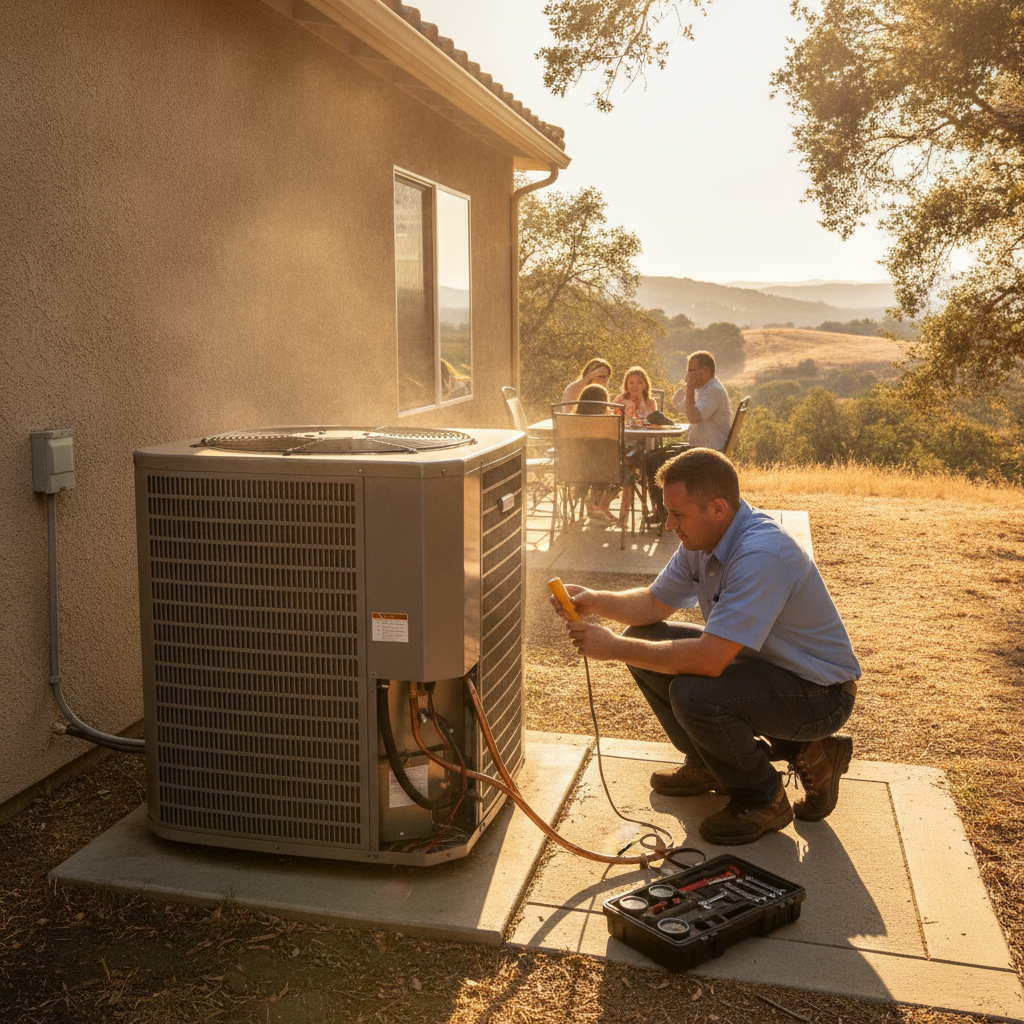
What Happens to Your HVAC System During a Santa Rosa Heat Wave — and How to Protect It
When a heat wave rolls through Santa Rosa and temperatures push past 100°F for three or four days in a row, your air conditioner is working in conditions that are genuinely hard on the equipment. Most AC systems are sized and designed for a typical summer afternoon — not an extended stretch of extreme heat that won’t let up even after sunset. Understanding what’s actually happening inside your system when it’s running flat-out for days on end can help you catch a small problem before it turns into a compressor replacement or a full breakdown during the hottest week of the year.
Why Extended Heat Events Are Different from a Hot Day
A single hot afternoon in late July isn’t usually what kills an air conditioner. What tends to push systems over the edge is consecutive days of high heat — when the inside of your home never fully cools down overnight, and your AC has to start each morning already playing catch-up.
Santa Rosa’s Mediterranean climate means most summers follow a predictable pattern: warm days, cool nights, and a coastal influence that gives the system a break. But when a heat dome settles in — the kind that pushed Sonoma County into triple digits for days during recent summer events — that overnight recovery doesn’t happen. The system runs longer, harder, and with less rest than it was engineered to handle on a daily basis.
Neighborhoods like Fountaingrove, Rincon Valley, and the inland parts of Bennett Valley tend to hold heat longer than areas closer to the coast. If you’re in one of those parts of Santa Rosa, your system is probably working significantly harder than a comparable home in Petaluma or Cotati, where afternoon sea breezes show up more reliably.
What’s Actually Happening Inside Your Equipment
Compressor Stress
The compressor is the most expensive component in your AC system — and the one most affected by extreme heat. When outdoor temperatures are very high, the compressor has to work harder to move heat out of your home because the temperature difference between the refrigerant and the outside air is smaller. It runs hotter, draws more electricity, and in some cases starts cycling on and off rapidly (a condition called short-cycling) as a protective measure.
Compressors on older systems — say, a unit that’s been running since the early 2000s in a South Park or West End home — are especially vulnerable during these periods. If your system is already 15 or more years old and you notice it struggling to keep up, that’s worth paying attention to before the next heat wave, not during it.
Refrigerant Pressure Spikes
High ambient temperatures cause refrigerant pressure to rise on the high side of the system. Most modern equipment has high-pressure cutoff switches that will shut the system down if pressures get dangerously high — which is a protection feature, but also means your AC may be shutting itself off on the hottest afternoons, right when you need it most. If your system is short on refrigerant to begin with (from a slow leak), the pressure dynamics shift further and the problem compounds quickly.
Capacitor and Contactor Wear
These are smaller components that most homeowners never think about, but they take a beating during heat waves. Capacitors help start and run the fan and compressor motors. When ambient temperatures around the outdoor unit stay high for extended periods, capacitors degrade faster. A capacitor failure is one of the most common reasons an AC stops running in summer — and it’s also one of the more affordable fixes if caught early. Contactors, which are essentially the electrical switches that engage the compressor and fan, can also burn or pit after heavy use.
Clogged Filters Become a Much Bigger Problem
Under normal conditions, a partially restricted filter might just reduce airflow a little. During a heat wave, that same restriction can cause the evaporator coil to ice over, which stops cooling entirely and can damage the compressor. Wildfire smoke — increasingly common in Sonoma County summers — makes filter loading happen faster than homeowners expect. If there’s been any smoke in the air, check your filter before a heat event, not after your system stops working.
What You Can Do Before and During a Heat Wave
Most of this is genuinely simple — not technical — but it matters a lot when your system is already running at its limits.
- Check and replace your air filter. If it’s been more than a month and there’s been any smoke or dust in the air, swap it out. A clean filter is free insurance.
- Clear debris from the outdoor unit. Leaves, cottonwood fluff, and dried grass clippings can clog condenser coils and reduce efficiency significantly. Give the area around the unit at least two feet of clearance and rinse the coil fins gently with a garden hose if they look dirty.
- Set your thermostat realistically. Asking a system to maintain 68°F when it’s 105°F outside is genuinely difficult for most residential equipment. A target of 76–78°F keeps your system from running nonstop while still keeping you comfortable.
- Run ceiling fans and close blinds on the sun-facing side of the house. Anything that reduces the heat load on the structure reduces how hard your AC has to work.
- Don’t ignore unusual noises or smells. A grinding sound from the outdoor unit, a burning smell from vents, or the system cycling on and off every few minutes are all signs something is wrong. Catching it early usually means a repair rather than a replacement.
If your system is due for its spring tune-up and you haven’t scheduled it yet, that’s the single most useful thing you can do before the next stretch of serious heat. Our residential AC service includes a full inspection of refrigerant levels, electrical components, coil condition, and airflow — exactly the things that matter most when temperatures climb.
The Gap Most Local Competitors Don’t Talk About: What to Do When Your System Shuts Down Mid-Heat Wave
Here’s something that doesn’t get covered enough: what actually happens if your AC dies on day three of a heat wave. Every HVAC company in Sonoma County gets swamped. Lead times that are normally a few hours can stretch to a day or more during peak demand periods. That’s not a criticism of any particular company — it’s just the reality of a regionwide emergency where every technician is already dispatched.
The most useful thing you can do is have a relationship with a local HVAC contractor before you need emergency service. That doesn’t mean signing up for anything complicated — it just means knowing who to call, having their number saved, and ideally being an existing customer. Stout’s has been serving Santa Rosa and the surrounding area since 1992, and we prioritize existing customers and maintenance plan members when emergency calls are stacking up. It makes a real difference.
In the meantime, if your system goes down during a heat wave: move to the lowest floor (heat rises), close interior doors to concentrate the cooler air in fewer rooms, and hydrate. Public cooling centers are typically opened by Sonoma County during official heat emergencies — worth knowing about if you have elderly family members or young children in the household.
Should You Replace an Older System Before Next Summer?
If your system is 15 years or older and has already needed significant repairs, a heat wave is often what finally tips it over. The honest answer is: if it’s borderline now, it’s probably not going to make it through another bad summer without a breakdown. We can give you a straight assessment — no pressure, no upsell — so you can make that decision with real information rather than guessing. Request a free estimate and we’ll tell you what we actually see.
Homeowners in Windsor, Healdsburg, and Rohnert Park have the same exposure to these summer heat events as Santa Rosa proper, and the same calculus applies. A high-efficiency replacement system with a current SEER rating will also help offset the PG&E bill that comes with running the AC through a long heat stretch.
Frequently Asked Questions
Why does my AC keep shutting off when it’s really hot outside?
This is usually a high-pressure cutoff — a safety feature that shuts the system down before the compressor is damaged by excessive refrigerant pressure. It can also be caused by a dirty condenser coil, a failing capacitor, or low refrigerant. If it’s happening repeatedly, it needs to be looked at by a technician.
Can I run my AC constantly during a heat wave without hurting it?
Running continuously is actually less damaging than repeated short-cycling. What hurts equipment is rapid on-off cycling and running with a dirty filter, clogged coil, or low refrigerant. A system in good condition can run for extended periods without issue.
How do I know if my refrigerant is low?
Signs include ice forming on the refrigerant lines or indoor coil, warm air blowing from the vents even when the system is running, and longer-than-normal run times to reach the set temperature. Low refrigerant is always the result of a leak — adding refrigerant without fixing the leak is a temporary fix at best.
Does wildfire smoke affect my AC system?
Yes, in two ways. Fine smoke particles load up filters much faster than typical dust, which restricts airflow. Smoke can also coat condenser coil fins outdoors, reducing the system’s ability to reject heat. During and after smoke events, check your filter more frequently than usual.
What’s the best thermostat setting during a Sonoma County heat wave?
Aim for the highest temperature you’re comfortable with — typically 76–78°F for most households. The larger the gap between your indoor target and the outdoor temperature, the harder your system has to work. Every degree lower than necessary adds meaningful runtime and wear during extreme heat events.
Talk to Stout’s Before the Next Heat Wave Hits
We’ve been keeping Santa Rosa homes and businesses cool through Sonoma County summers since 1992 — including the bad ones. If your system hasn’t been serviced recently, or if you’re already noticing it struggling to keep up, now is the right time to get it checked out. We offer straightforward, same-day service for repairs and a simple way to reach us when you need someone fast. No call centers, no runaround — just local technicians who know this area and the equipment running in it. Give us a call at (707) 527-1504 or reach out online to schedule a visit.