
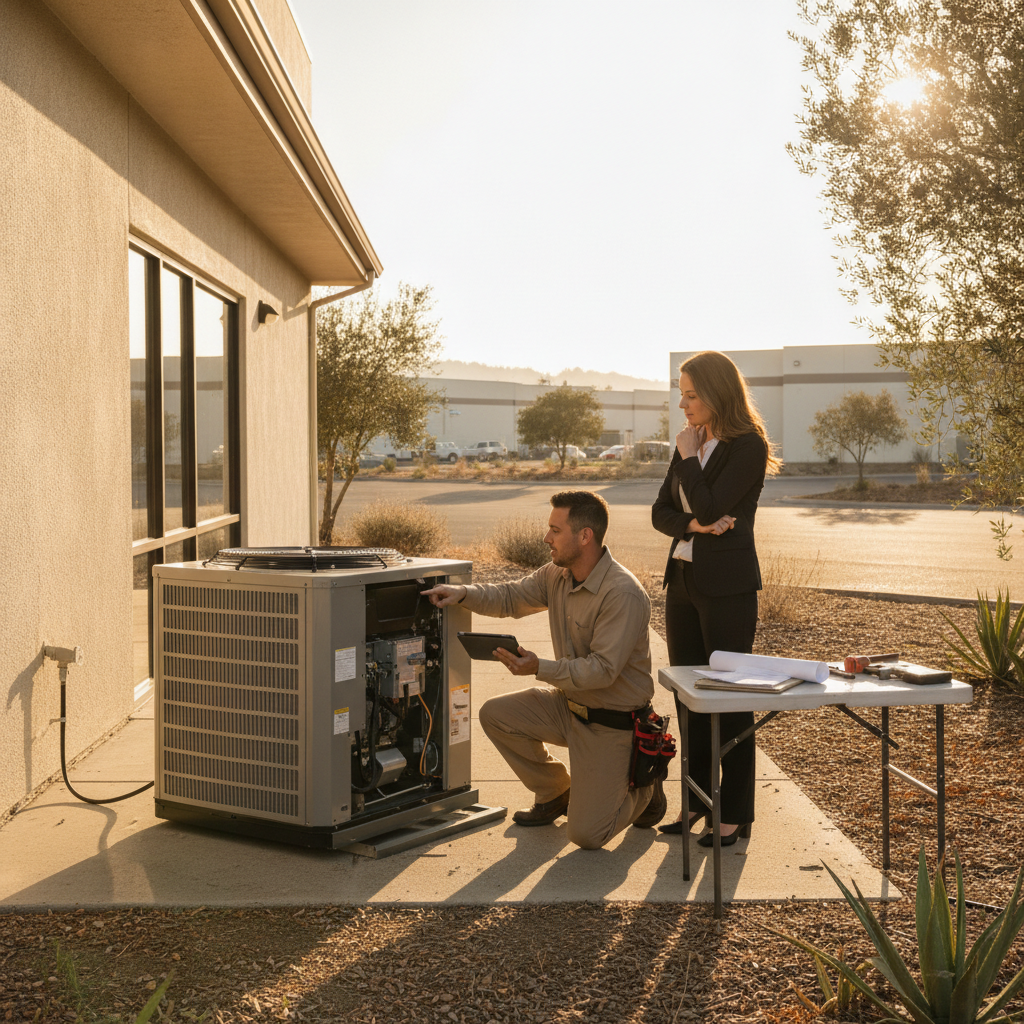
What Santa Rosa Small Business Owners Should Know About Commercial HVAC Contracts — Service Agreements, What They Cover, and How to Avoid Getting Locked Into the Wrong One
If you run a small business in Santa Rosa — a restaurant on Fourth Street, a dental office in Rohnert Park, a retail shop in Petaluma, or a tasting room out near Healdsburg — your HVAC system is not optional equipment. It keeps your staff comfortable, protects your inventory, meets health code requirements, and directly affects whether customers want to stay or leave. So when an HVAC company offers you a service agreement or maintenance contract, it’s worth understanding exactly what you’re signing before you hand over a credit card number.
The honest answer is that commercial HVAC service agreements can be genuinely valuable — or they can be overpriced and full of exclusions that don’t help you when something actually goes wrong. The difference usually comes down to what’s in the fine print and whether the company behind the contract is someone who will actually show up when you call.
What a Commercial HVAC Service Agreement Actually Is
A service agreement — sometimes called a preventive maintenance contract or a planned maintenance agreement — is essentially a recurring arrangement between your business and an HVAC company. You pay a set fee (monthly, quarterly, or annually) and in return the company commits to performing scheduled maintenance visits, priority scheduling, and sometimes discounts on parts and repairs.
What’s included varies widely. Some agreements are bare-bones: one visit per year, a basic filter check, and not much else. Others are more comprehensive, covering bi-annual tune-ups, refrigerant checks, electrical inspections, belt replacements, and priority response during peak season. A few higher-tier contracts cover labor and parts on repairs — essentially functioning like a warranty extension.
None of this is inherently good or bad. What matters is whether the specific agreement you’re being offered matches what your system actually needs, your budget, and the kind of business you’re running.
What Most Competitor Agreements Don’t Tell You Upfront
One thing that’s rarely explained clearly in commercial HVAC contracts — and something we’ve seen cause real frustration for local business owners in Sonoma County — is the difference between what’s inspected and what’s actually fixed under the agreement.
A standard maintenance contract typically covers labor for the scheduled visit and some consumables like filters. It does not cover refrigerant, replacement parts, or the labor to install them. So if the technician discovers a failing capacitor or a slow refrigerant leak during a scheduled tune-up, that repair is usually billed separately — and at full rate, sometimes with a diagnostic fee on top.
That’s not necessarily a scam. It’s just how most agreements are structured. The problem is when it’s not explained that way upfront, and a business owner assumes they’re covered for repairs when they’re really only covered for the visit itself.
Ask specifically: If you find something broken during the maintenance visit, is the repair included or billed separately? A straight answer to that question tells you a lot about how the company does business.
Red Flags to Watch For Before Signing
Not every HVAC company offering a service agreement is a good fit for a small business. Here are some things that should give you pause:
- Multi-year lock-in with no exit clause. A one-year agreement with renewal options is standard. A contract that automatically renews for three years with a penalty to cancel is a red flag, especially if the company is newer to the area or you haven’t worked with them before.
- Vague language around response times. If the contract says “priority service” but doesn’t define what that means — hours, not days — then priority service means nothing. Ask for a written response time commitment, especially if your business is open weekends or evenings.
- Flat pricing that ignores your system’s complexity. A commercial rooftop unit serving a 4,000-square-foot restaurant needs more attention than a two-zone mini-split system in a small retail space. If the company is quoting you the same flat price they quote everyone, that’s worth questioning.
- No mention of what happens when the technician turns over. National HVAC franchise chains entering the Sonoma County market sometimes offer attractive entry-level pricing on service agreements, then struggle with consistency. If the technician who knows your system leaves the company, does that knowledge go with them?
What a Good Commercial HVAC Agreement Should Include for a Sonoma County Business
Given our climate here in the North Bay — hot, dry summers that can push into triple digits in Windsor and Healdsburg, cool wet winters, and increasingly smoky air during wildfire season — a commercial HVAC maintenance plan for a Sonoma County business should address more than generic tune-up items.
For most commercial systems here, a solid agreement should cover at minimum:
- Two scheduled service visits per year — one in spring before cooling season starts, one in fall before heating season
- Filter replacement or inspection at each visit (with upgrade options for higher-MERV or smoke-rated filtration during fire season)
- Refrigerant level check and leak inspection
- Electrical component check — contactors, capacitors, disconnect boxes
- Thermostat calibration and control system check
- Condensate drain clearing (especially important in summer)
- Coil cleaning — both evaporator and condenser
- Priority scheduling and a defined response window for emergency calls
For restaurants, add kitchen exhaust fan inspection and belt checks to that list. For businesses in older buildings along the Highway 101 corridor or in Santa Rosa’s downtown core, ductwork condition and airflow balance are also worth including — older commercial buildings can have significant duct leakage that drives up your energy bills without anyone noticing until someone actually looks.
When a Service Agreement Makes the Most Sense
The businesses that benefit most from a commercial HVAC service agreement are usually the ones where a system failure has real operational consequences. If your air conditioning goes down on a Saturday in July and you have a dining room full of guests, you need a guaranteed response — not a callback window. If your heating fails during a cold snap in December and you run a childcare facility or medical office, the stakes are immediate.
For those businesses, the value of a service agreement isn’t just the maintenance visits — it’s the relationship with a contractor who already knows your equipment and will pick up the phone. That’s worth paying for.
If you’re running a lower-traffic operation where a system hiccup is inconvenient but not catastrophic, you may be just as well served by scheduling bi-annual tune-ups directly without a formal contract. Either way, the maintenance itself matters — skipping it is where most commercial HVAC problems start.
You can learn more about our commercial heater repair services and what we typically find during inspections of deferred-maintenance systems.
A Note on National Chains vs. Local Contractors
We’ve been doing this in Santa Rosa since 1992, and one thing we’ve watched play out more than once is a local business signing a service agreement with a national franchise chain, getting six months of decent service, and then finding out the local branch has turned over its entire crew. The new team doesn’t know their equipment, response times slip, and suddenly they’re locked into a contract that’s not delivering what was promised.
That’s not a knock on every large company — it’s just a structural reality. When you work with a locally owned HVAC contractor, the person who shows up knows your equipment because they’ve worked on it before. There’s accountability that’s harder to maintain at scale.
Check out what our customers have to say about how we handle commercial accounts over at our customer reviews page.
Frequently Asked Questions
How much does a commercial HVAC service agreement typically cost in Santa Rosa?
It varies based on the type and number of units, but most small commercial businesses in Sonoma County pay somewhere between $300 and $900 per year for a basic bi-annual maintenance agreement. Larger systems, rooftop units, or agreements that include parts and labor coverage will cost more. Be cautious of pricing that seems unusually low — it often means something important has been excluded.
Can I get out of a commercial HVAC service agreement if the company isn’t performing?
That depends entirely on what the contract says. Always read the cancellation terms before signing. Look for automatic renewal clauses and any early termination fees. A reputable contractor should have no problem with a straightforward cancellation policy — the work should speak for itself.
Does a service agreement cover emergency repairs after hours?
Not always. Many basic agreements only cover scheduled maintenance visits. If after-hours emergency response matters to your business — and for most restaurants and hospitality businesses in Sonoma County it does — make sure that’s explicitly addressed in the agreement, including any additional charges for emergency calls.
My commercial building is leased. Am I responsible for the HVAC service agreement, or is that the landlord’s job?
This is one of the most common sources of confusion for commercial tenants. The answer depends on your lease. Many commercial leases in California place HVAC maintenance responsibility on the tenant, even if the landlord owns the equipment. Read your lease carefully, and if it’s unclear, ask your landlord in writing before signing any HVAC agreement — you don’t want to be paying for something your landlord is also contracting separately.
We’re in Petaluma and our system is fairly new. Do we really need a service agreement, or can we just call when something breaks?
You can — but most manufacturers require documented proof of annual maintenance to honor warranty claims. If your system is still under warranty and something fails, the manufacturer may ask for service records before covering the repair. A basic maintenance agreement protects both your equipment and your warranty coverage, which is usually worth more than the cost of the contract itself during those first few years.
Talk to Stout’s Before You Sign Anything
If someone has already handed you a commercial HVAC service agreement to sign — or if you’re just starting to think about getting one in place — we’re happy to take a look at your system and give you an honest read on what level of coverage actually makes sense for your business. No pressure, no upsell, just a straight answer from a contractor who’s been working with Santa Rosa and Sonoma County businesses for over 30 years.
We service all major commercial equipment brands including Trane, Carrier, Lennox, York, Daikin, and American Standard, and we offer flexible maintenance arrangements for businesses of all sizes — from a single-unit retail space to a multi-zone commercial property.
Request a free estimate or call us directly at (707) 527-1504 to talk through what your business actually needs. We’ll be straight with you about whether a formal agreement makes sense or whether a simpler approach fits better.