
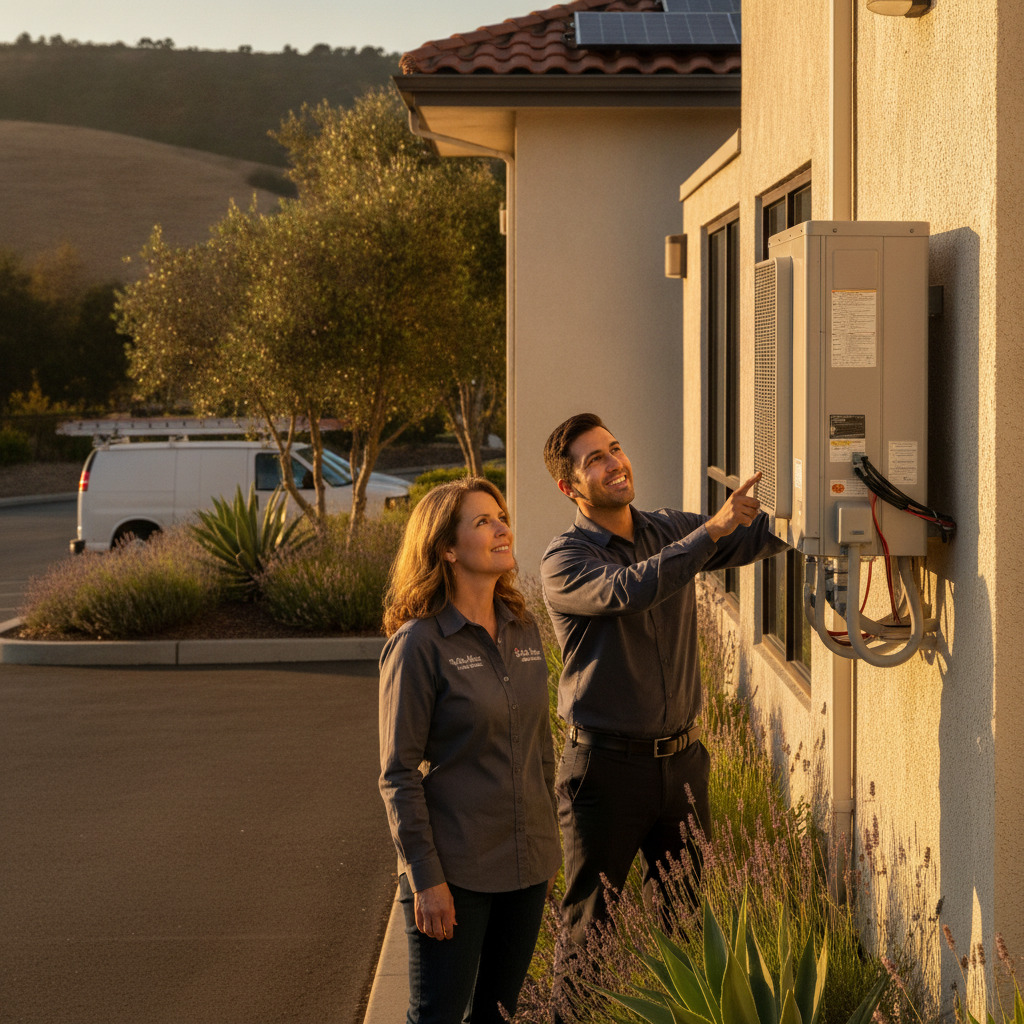
What Santa Rosa Small Business Owners Should Know About Commercial Heat Pump Systems — and Why More Are Making the Switch
If you own or operate a small business in Santa Rosa — whether that’s a retail shop off Mendocino Avenue, a professional office near the Highway 101 corridor, a wine tasting room in Healdsburg, or a service business in a Rohnert Park strip mall — your HVAC system is probably one of your biggest operating expenses and one of your least-understood ones. Lately, we’ve been getting a lot more calls from commercial clients asking about heat pumps specifically. Not just for new installations, but as replacements for aging rooftop units or split systems that are finally giving out. This guide is for you: a plain-language breakdown of how commercial heat pumps actually work, when they make sense for a small business, what the real costs look like, and how to take advantage of California incentive programs that your landlord or building manager may not even know exist.
Why Commercial Heat Pumps Are Getting So Much Attention Right Now
A few things have converged at once. PG&E rates have climbed steadily — if you’re running a business in Sonoma County, you’ve felt it on your monthly bill. At the same time, California has been pushing hard to electrify commercial buildings, and there are now real financial incentives behind that push. Federal tax credits under the Inflation Reduction Act, PG&E commercial rebates, and California’s own efficiency programs have made heat pump upgrades genuinely cost-effective in ways they weren’t five years ago.
But there’s also a practical reason heat pumps are drawing attention from business owners in this region specifically: Santa Rosa’s Mediterranean climate is almost ideal for them. Summers are hot and dry, winters are cool but rarely severe. Heat pumps work by moving heat rather than generating it — they’re most efficient in climates where temperatures don’t regularly drop below freezing for extended periods. That describes most of Sonoma County pretty well. You’re not in Minneapolis. You don’t need a system built for a polar vortex.
How a Commercial Heat Pump Actually Differs From a Residential One
Most of the heat pump conversation in the media focuses on residential systems, which can make it harder for business owners to figure out what applies to them. Commercial heat pumps operate on the same basic principle — they extract heat from outdoor air and move it inside for heating, or reverse the process for cooling — but the equipment and configuration look quite different depending on your space.
For small commercial spaces, the most common options are:
- Commercial rooftop units (RTUs) with heat pump capability: If your business already uses a rooftop unit for heating and cooling, there are now high-efficiency heat pump RTU models that can replace them directly. Brands like Trane, Carrier, and York all make commercial heat pump rooftop units sized for small to mid-size commercial buildings.
- VRF (Variable Refrigerant Flow) systems: These are a step up in sophistication — a single outdoor unit connected to multiple indoor units throughout the building, each controllable independently. They’re excellent for office buildings, retail spaces with multiple rooms, or wine country hospitality businesses where different zones have different needs at different times of day.
- Commercial ductless mini-split systems: Similar to residential ductless systems but sized for larger spaces. Good for warehouses, tasting rooms, or buildings where adding ductwork isn’t practical.
The right configuration depends on your square footage, your existing infrastructure, how many zones you need, and what your utility and rebate eligibility looks like. That’s not a decision to make based on a manufacturer brochure — it requires a proper load calculation and an honest conversation about your actual usage patterns.
The Gap Most Competitors Aren’t Filling: Commercial Heat Pump Rebates and Incentives in California
Here’s something we’ve noticed: a lot of HVAC contractor websites — including several competitors here in Sonoma County — talk about heat pump rebates for homeowners but say almost nothing about commercial incentives. That’s a real gap, because the commercial programs are substantial and underutilized by small business owners.
Here’s a quick overview of what’s currently available (always verify current program availability, as these change):
- Federal Investment Tax Credit (ITC) / 179D Deduction: Commercial property owners who install qualifying high-efficiency HVAC systems may be eligible for tax deductions under Section 179D. Your accountant should be looped in on this.
- PG&E Commercial Energy Efficiency Rebates: PG&E offers rebates for qualifying commercial HVAC equipment, including high-efficiency rooftop units and VRF systems. The amounts vary by equipment type and efficiency rating, but they can be meaningful for a small business on a tight capital budget.
- California’s Self-Generation Incentive Program (SGIP) and other state programs: Depending on your system configuration and whether you’re combining it with solar or battery storage, additional state programs may apply.
When you work with Stout’s on a commercial heat pump installation, we walk you through what’s available before you commit to anything. Too many business owners find out about rebates after the fact — or not at all.
What to Expect From a Commercial Heat Pump Installation: Timeline and Process
One thing that holds small business owners back is uncertainty about disruption. Nobody wants to close their Petaluma retail shop or Windsor office for a week while a new system goes in. Here’s a realistic picture:
- Assessment and proposal: We start with a site visit, a load calculation, and a review of your existing system and infrastructure. This is where we figure out what you actually need — not just what’s cheapest or what’s easiest to install.
- Permit and equipment lead time: Commercial HVAC installations require permits in Santa Rosa and throughout Sonoma County. Equipment lead times vary by brand and model, but most commercial heat pump equipment is available within a few weeks through our supplier network.
- Installation: A straightforward rooftop unit swap can often be done in one or two days. A VRF system in a multi-zone commercial building will take longer — plan for three to five days depending on complexity. We work around your business hours when possible.
- Commissioning and testing: Before we leave, the system gets fully commissioned and tested. You shouldn’t have to call us back because the thermostat in the back office isn’t communicating with the main unit.
When a Commercial Heat Pump Might NOT Be the Right Call
We’re going to give you the honest answer here, not just the answer that sells a heat pump. There are situations where a heat pump isn’t the best fit for a commercial space:
- If your building has a gas infrastructure that’s already paid for and a relatively new gas furnace, a full heat pump replacement may not pencil out financially in the short term — a dual fuel hybrid approach might make more sense.
- If you’re in a building with structural or electrical limitations that make heat pump installation cost-prohibitive, repairs and upgrades to your existing system may be the smarter near-term move.
- If you’re a tenant in a commercial space and don’t control the HVAC decisions, it’s worth understanding what your lease says about system replacements before investing in anything.
Our job is to give you a recommendation you can actually use — not to sell you a system that doesn’t fit your situation.
Frequently Asked Questions: Commercial Heat Pumps in Santa Rosa and Sonoma County
Can a heat pump handle both heating and cooling in a Sonoma County commercial building?
Yes — that’s one of the main advantages. A properly sized commercial heat pump handles both functions from a single system, which simplifies maintenance and can reduce operating costs significantly compared to running separate heating and cooling equipment.
Are commercial heat pumps more expensive to install than traditional rooftop units?
The upfront equipment cost is often higher, but when you factor in available rebates, tax incentives, and lower long-term operating costs — especially given current PG&E rates — the total cost of ownership over 10–15 years is frequently competitive or better. We can run those numbers for your specific situation during a free estimate.
What brands do you install for commercial heat pump systems?
We work with Trane, Carrier, Daikin, Mitsubishi Electric, LG, and York for commercial applications, among others. We’re not locked into one manufacturer — we recommend based on what fits your building, your budget, and parts availability in the North Bay.
How long does a commercial heat pump system typically last?
With regular maintenance, most commercial heat pump systems last 15–20 years. Annual or bi-annual maintenance is the biggest factor in getting full life out of the equipment — skipping tune-ups is usually where we see premature failures.
Do you service commercial heat pumps after installation in areas like Sebastopol or Healdsburg?
Yes. We service commercial HVAC systems throughout Sonoma County — from Sebastopol and Rohnert Park up through Healdsburg and Windsor. If your system needs attention, we’re not going to leave you waiting because you’re outside some arbitrary service boundary.
Ready to Talk Through Your Options?
We’ve been doing this in Santa Rosa since 1992. We know the local buildings, the local climate, and the local permit requirements. If your commercial HVAC system is aging, underperforming, or costing you more than it should every month, a conversation costs you nothing. Request a free commercial HVAC estimate or call us directly at (707) 527-1504. We’ll give you a straight answer — no pressure, no upsell, just honest guidance on what makes sense for your business.