
What Santa Rosa Homeowners Should Know About Carbon Monoxide and Their Heating System — Before Winter Arrives
If your home is heated by a gas furnace — and the vast majority of older homes in Santa Rosa and throughout Sonoma County are — then carbon monoxide is a real, year-round safety consideration. It’s not a scare tactic. It’s just a fact of how combustion heating works. CO is colorless, odorless, and in a home with poor ventilation or a cracked heat exchanger, it can accumulate to dangerous levels before anyone knows something is wrong. The good news is that it’s almost entirely preventable with the right maintenance and a basic understanding of where the risk actually comes from.
This article covers the specific relationship between your heating system and carbon monoxide — how it’s produced, what can go wrong, what the warning signs look like, and what a professional inspection actually involves. This is the kind of practical safety guidance that too few HVAC companies take the time to explain clearly.
How Your Furnace Produces Carbon Monoxide — and Why That’s Normal (Up to a Point)
A gas furnace burns natural gas or propane to generate heat. That combustion process produces several byproduct gases, including carbon monoxide. Under normal operating conditions, those combustion gases are safely contained inside the heat exchanger — a sealed metal component — and then vented out of your home through the flue. The air that actually circulates through your living space never comes in contact with those gases.
The problem is that heat exchangers don’t last forever. Over time, especially in older systems, the metal can develop cracks or stress fractures from years of heating and cooling cycles. When that happens, combustion gases — including CO — can leak into the air handler and get distributed through your ductwork into every room in the house. It’s one of the more serious failure modes in any gas heating system, and it’s a key reason why annual heating inspections matter as much as they do.
Other potential CO sources connected to your HVAC system include:
- Blocked or deteriorating flue pipes — A flue that’s been damaged, improperly connected, or blocked by debris (including bird nests, which are surprisingly common in older Santa Rosa homes) can cause combustion gases to back-draft into living spaces instead of venting outside.
- A furnace that’s running in a poorly ventilated utility closet or mechanical room — Inadequate combustion air supply can cause incomplete combustion, which raises CO output from the burners themselves.
- An oversized or aging furnace cycling on and off too frequently — Short cycling increases thermal stress on the heat exchanger and accelerates cracking over time.
What Carbon Monoxide Symptoms Actually Feel Like — and Why They Get Missed
One of the most disorienting things about CO exposure is that the symptoms — headache, nausea, fatigue, dizziness — are easy to dismiss as a flu or a bad night’s sleep, especially at low exposure levels. People often feel better when they leave the house and worse when they return, which is actually a meaningful pattern worth paying attention to.
If multiple people in your household (including pets) are experiencing unexplained symptoms, especially during the winter months when your heater is running regularly, that pattern warrants a call to a professional — not a wait-and-see approach.
This is especially worth keeping in mind in older neighborhoods like Railroad Square, South Park, and the West End, where homes were built decades before modern combustion safety standards and HVAC systems may not have been updated since. Homes in Healdsburg and Sebastopol with original gas furnaces from the 1980s or early 1990s are in the same boat.
What a Professional Heating Inspection Actually Checks for CO Risks
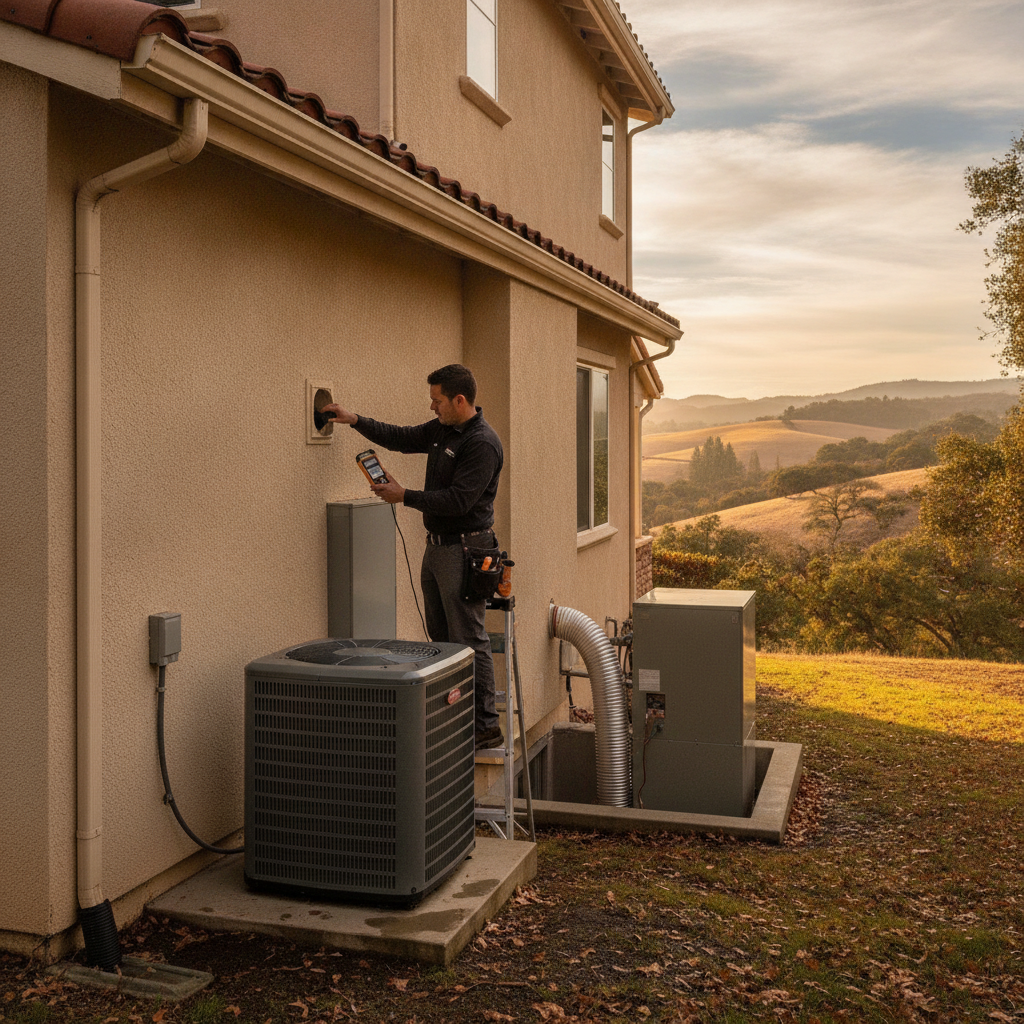
A proper heating inspection isn’t just about cleaning the burners and changing the filter. When done right, it includes a structured evaluation of everything connected to combustion safety. At Stout’s Heating & AC, that means going through the system methodically — not just a quick visual once-over.
Here’s what a thorough pre-season heating inspection should include from a CO-safety standpoint:
- Heat exchanger inspection — Visual and, where needed, dye-test inspection for cracks or stress fractures. This is the single most important CO-related check for any gas furnace.
- Flue and venting inspection — Checking for proper connection, signs of corrosion, blockages, and correct draft direction.
- Combustion air supply check — Verifying that the furnace has adequate air for complete combustion, particularly in tightly sealed mechanical rooms.
- Burner condition and flame pattern — A yellow or orange flame (instead of blue) can indicate incomplete combustion and higher CO output.
- Carbon monoxide detector placement review — A good technician will note if your detectors are correctly positioned and not expired. Most CO detectors have a 5–7 year lifespan that homeowners routinely overlook.
If your furnace is more than 15–20 years old, the heat exchanger inspection becomes especially important. Replacement parts for aging systems can be hard to source, and in some cases, a cracked heat exchanger is the deciding factor in whether to repair or replace a furnace altogether. That’s a conversation worth having with a technician you trust — not one who’s incentivized to sell you a new system regardless of the findings.
Stout’s has been doing exactly this kind of honest, thorough inspection work in Santa Rosa and across Sonoma County since 1992. You can learn more about our residential heating repair and inspection services here.
Do Heat Pumps Produce Carbon Monoxide?
This is a question we hear fairly often, and the answer is straightforward: No. A standard electric heat pump does not produce carbon monoxide. Heat pumps work by moving heat rather than burning fuel, so there’s no combustion involved and no CO risk from the heat pump itself.
That said, if you have a heat pump hybrid system — where a heat pump handles most of the heating load but a gas furnace kicks in during colder nights — then you still have a combustion appliance in the system. The furnace component still needs the same annual safety inspection. The CO risk comes from the gas side of the system, not the heat pump side.
For homeowners in Rohnert Park, Windsor, and other newer communities who are considering switching to a full electric heat pump for both the CO-free operation and the energy efficiency benefits, that’s a conversation worth having before the next heating season. Rising PG&E costs and available California rebates can make the math work better than most people expect.
CO Detector Basics That Often Get Overlooked
A CO detector is not a substitute for a properly functioning furnace — but it is an essential backup. A few things worth knowing:
- CO detectors should be installed on every level of your home and outside sleeping areas. A single detector by the furnace closet is not sufficient coverage.
- Most CO detectors expire after 5–7 years. The manufacture date is typically printed on the back. If yours is older than that, replace it — even if it still beeps when you test it. The electrochemical sensor degrades over time and may not detect lower-level CO buildup.
- Combination smoke/CO detectors are convenient but check that the CO detection component meets UL 2034 standards.
- If your CO detector alarm sounds, don’t silence it and go back to sleep. Get everyone out of the house, leave the door open, and call 911 from outside. Then call your HVAC company for an emergency inspection before operating the heating system again.
Frequently Asked Questions
How often should I have my gas furnace inspected for CO risks?
Once a year, ideally in the fall before heating season begins. An annual inspection catches heat exchanger issues, venting problems, and burner irregularities before they become a safety hazard. Stout’s offers a $90 tune-up special that covers these checks — you can review current offers at our HVAC offers page.
Can I tell if my heat exchanger is cracked without calling a technician?
Not reliably. A cracked heat exchanger usually shows no obvious external signs, and the crack itself may be small enough that only a trained technician with the right tools can detect it. Some cracks are visible only when the furnace is running and the metal has expanded from heat. Don’t rely on a visual inspection you do yourself.
My furnace is only 8 years old. Should I still worry about CO?
Age is a factor, but it’s not the only one. An oversized furnace that short-cycles frequently, or one that’s been running with a restricted airflow issue for years, can develop heat exchanger stress at any age. An 8-year-old furnace in good condition with a clean maintenance history is lower risk than a 20-year-old one, but it still benefits from an annual check.
Is a gas fireplace or wall heater also a CO risk?
Yes. Any gas appliance that relies on combustion is a potential CO source if the venting is blocked or the appliance is malfunctioning. This includes gas fireplaces, wall heaters, and water heaters. If you have multiple gas appliances in your home, they should all be on your annual inspection checklist.
What neighborhoods in Santa Rosa have the most older furnaces?
Railroad Square, South Park, the West End, and parts of Roseland tend to have a higher concentration of older housing stock with original or lightly updated heating systems. If your home was built before 1990 and you’re not certain when the furnace was last inspected, this winter is a good time to schedule one.
Schedule a Heating Safety Inspection Before the Rainy Season Hits
Santa Rosa’s winters are mild compared to most of California — but they’re mild enough that furnaces tend to sit unused through the summer and then get switched on for the first time when temperatures drop in October or November. That first cold snap is exactly when problems surface. A professional inspection before heating season gives you peace of mind and, if something does need attention, time to address it before it becomes an emergency.
Stout’s Heating & AC has been serving homeowners in Santa Rosa and throughout Sonoma County since 1992. We’re a family-owned business, not a franchise, and we give you straight answers about what your system actually needs — not what generates the biggest ticket. If you have a gas furnace, a hybrid heating system, or any other combustion appliance in your home, we’d encourage you to get it looked at this fall.
Contact Stout’s Heating & AC today to schedule a heating inspection or request a free estimate. We offer same-day and emergency service for situations that can’t wait.