
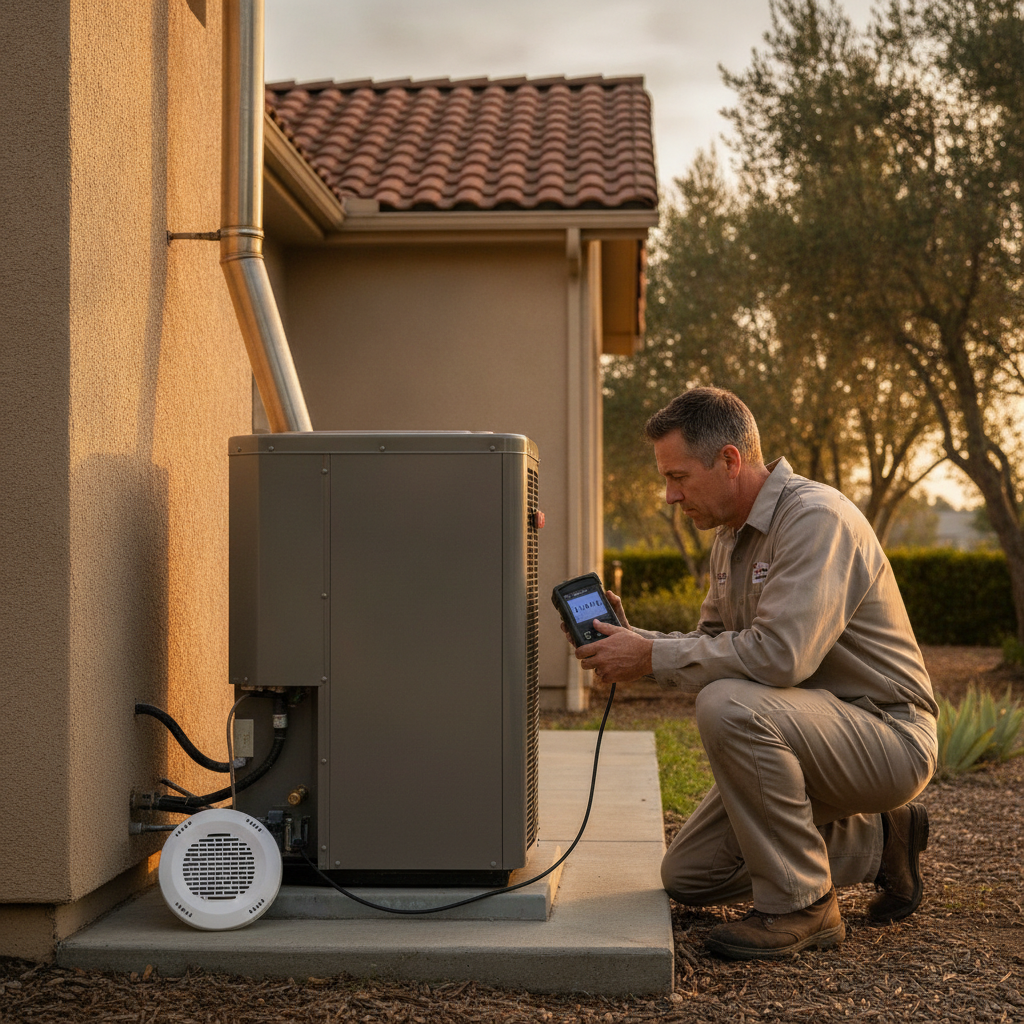
What Santa Rosa Homeowners Should Know About Carbon Monoxide and Their Heating System — Detection, Real Risk, and What to Do If an Alarm Goes Off
Carbon monoxide is one of the most serious hazards tied to home heating — and it’s largely invisible. No smell, no color, no warning until people start feeling sick. If you have a gas furnace, a gas water heater, or any combustion appliance in your Santa Rosa home, you need to understand how CO is produced, what actually causes it, and what to do if your detector goes off. This isn’t a topic to skim. We’ve been doing residential heater repairs across Sonoma County since 1992, and we’ve seen firsthand what happens when a cracked heat exchanger or a blocked flue goes unnoticed through a long, wet winter.
How Your Heating System Produces Carbon Monoxide
Carbon monoxide is a byproduct of incomplete combustion. When natural gas or propane burns cleanly inside a furnace, the combustion process produces carbon dioxide and water vapor — both of which vent safely out of your home. The problem is when something disrupts that combustion cycle, or when the exhaust pathway gets compromised. That’s when CO starts leaking into the living space instead of leaving through the flue.
The most common cause of CO exposure from a furnace is a cracked heat exchanger. The heat exchanger is the component that separates combustion gases from the air that circulates through your ductwork. Over time — especially in furnaces that are 15 to 20 years old, which is common in older Santa Rosa neighborhoods like Coffey Park, Rincon Valley, and Bennett Valley — the heat exchanger can develop small cracks or holes. At that point, combustion gases, including CO, can mix with the air your family breathes every time the heater runs.
Other causes include:
- Blocked or deteriorating flue pipes that prevent exhaust from venting properly
- A dirty or improperly sized burner causing incomplete combustion
- Backdrafting, where pressure imbalances pull exhaust gases back into the home instead of pushing them out
- A failing or oversized furnace cycling too frequently and stressing the heat exchanger
None of these problems announce themselves. That’s why an annual furnace inspection isn’t optional if you have a gas heating system — it’s the only way to catch these issues before they become emergencies.
Where to Place CO Detectors and Why Most Homes Have It Wrong
California law requires carbon monoxide detectors in any home with an attached garage or a fuel-burning appliance. But placement matters significantly, and a lot of homeowners don’t know the details.
CO is slightly lighter than air, but it mixes readily throughout a space. The general guidance is:
- Install a detector on every level of your home, including the basement if you have one
- Place detectors within 15 feet of each sleeping area — CO symptoms often appear while people are sleeping when they’re most vulnerable
- Install one near, but not directly on top of, fuel-burning appliances (give it some distance so it doesn’t false-alarm from brief startup emissions)
- Don’t install detectors in extremely humid areas like directly inside bathrooms, where moisture can damage the sensor
Combination smoke and CO detectors are convenient, but if your current units are more than five to seven years old, they should be replaced — the CO sensors degrade over time even if the smoke detector still works.
What to Do If Your CO Alarm Goes Off
This is where a lot of generic advice falls short. Here’s what actually matters:
Get everyone out immediately. Don’t stop to investigate, don’t open windows first, don’t try to find the source. People and pets out the door right now. CO symptoms — headache, dizziness, nausea, confusion — can escalate fast, and you may already be impaired without fully realizing it.
Call 911 from outside the home. Fire departments have CO detection equipment and will check your home before anyone re-enters. Do not go back inside until emergency responders have cleared it.
After the all-clear, call an HVAC technician before turning the furnace back on. The fire department can confirm elevated CO levels, but they don’t do furnace repairs. You need a licensed HVAC contractor to inspect the heat exchanger, flue, burners, and venting system before you run that heater again. If it’s the middle of January and you’re in Windsor or Healdsburg dealing with a cold snap, we offer emergency service for exactly this situation.
If the alarm goes off at a low level and then stops, don’t assume it was a false alarm. Intermittent CO readings often mean an intermittent problem — a cracked heat exchanger that only leaks when the furnace reaches full operating temperature, for example. That kind of problem is easy to miss on a casual look and easy to find on a proper inspection.
Our residential heater repair service includes full safety inspections of heat exchangers, flue systems, and combustion components — not just a filter swap and a diagnostic readout.
The Heat Exchanger Problem That Too Many Homeowners Don’t Hear About
Here’s something that most HVAC content glosses over: a cracked heat exchanger typically means the furnace needs to be replaced, not repaired. Heat exchangers are generally not serviceable components. If an inspection reveals a cracked or compromised heat exchanger, the honest answer is that continuing to run that furnace is a CO risk, and the unit needs to come out.
We know that’s not always what homeowners want to hear — especially when a furnace seems to be running fine otherwise. But this is exactly the kind of conversation we’ve been having with Santa Rosa families for over 30 years. We’d rather tell you the hard truth upfront than see you patch a problem that can’t be patched.
If your furnace is getting close to 15 to 20 years old and hasn’t had a recent inspection, now is the right time — before the heating season is fully underway and before you’re dealing with an emergency. A full system inspection during a tune-up will catch heat exchanger issues, flue problems, and combustion irregularities while you still have time to make a calm decision rather than a rushed one.
What About Heat Pumps — Do They Produce Carbon Monoxide?
This is a question worth answering directly: no, heat pumps do not produce carbon monoxide. Because heat pumps use electricity to move heat rather than burning fuel to create it, there is no combustion process and no CO risk from the heating system itself. This is one of the reasons heat pumps have become increasingly popular in Santa Rosa and across Sonoma County — particularly for homeowners who want to eliminate gas combustion appliances from their home entirely.
If you have a heat pump system as your primary heating source, you may still want CO detectors in your home if you have other gas appliances (water heater, stove, dryer, fireplace), but the heating system itself is not a CO source.
For homeowners in Sebastopol, Petaluma, or Rohnert Park who are weighing whether to replace an aging gas furnace with a heat pump, CO safety is one factor worth putting on the table — especially in older homes where the ductwork and flue systems may not have been inspected in years.
Frequently Asked Questions
How do I know if my furnace has a cracked heat exchanger?
You usually can’t tell by looking at it or listening to it run. A cracked heat exchanger requires a proper inspection by an HVAC technician using combustion analysis tools and visual inspection equipment. Some signs that warrant a closer look include visible soot around the furnace cabinet, a yellow or flickering burner flame instead of a steady blue one, or a CO detector that intermittently alarms without a clear cause.
How often should I have my gas furnace inspected?
Once a year is the standard recommendation, ideally in the fall before the heating season starts. An annual inspection covers heat exchanger integrity, flue venting, burner condition, and overall system safety — not just performance. At Stout’s, we offer a $90 tune-up special that covers these checks.
Can a CO alarm go off for reasons other than my furnace?
Yes. Gas water heaters, gas stoves, gas fireplaces, attached garages (from vehicle exhaust), and even neighboring units in multi-family buildings can be CO sources. If your furnace checks out clean, the source could be elsewhere. A thorough investigation looks at all combustion appliances in the home.
Is carbon monoxide more of a risk in winter here in Sonoma County?
Yes, for a few reasons. Furnaces run more frequently, which puts more stress on heat exchangers. Homes are closed up more tightly in the cool, wet winters we get here, so there’s less natural air exchange to dilute any CO that does leak. And people are less likely to notice symptoms if they assume they’re just tired or coming down with something. That combination makes fall inspections particularly important.
What happens if my furnace is red-tagged for a CO risk?
If a technician or inspector red-tags your furnace due to a cracked heat exchanger or combustion safety issue, the unit cannot legally be operated until the issue is resolved. In most cases involving a compromised heat exchanger, that means furnace replacement. We can walk you through your options, including available financing and any applicable rebates for high-efficiency replacement systems.
Get a Safety Inspection Before This Heating Season
If you haven’t had your furnace inspected in the last year — or if you’re not sure when it was last looked at — this is a good time to schedule it. We serve Santa Rosa and the broader Sonoma County area including Petaluma, Windsor, Healdsburg, Sebastopol, Rohnert Park, and surrounding communities. Our technicians are straightforward with you about what they find, and we don’t create problems that aren’t there.
Contact Stout’s Heating & AC, Inc. to schedule a furnace safety inspection or request a free estimate on a replacement system. We’ve been doing this work honestly in Sonoma County since 1992, and we’re here when you need us — including same-day service for urgent situations.