
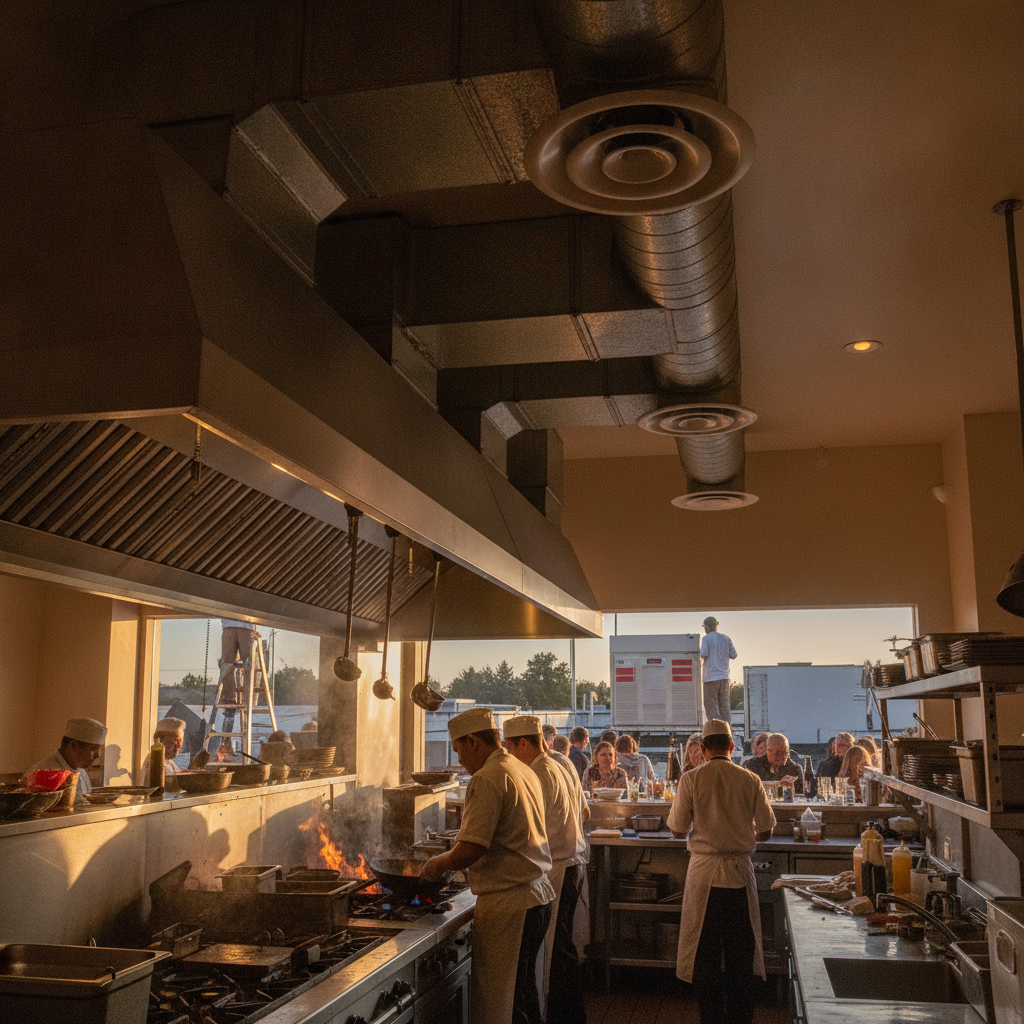
What Petaluma and South Sonoma County Restaurant Owners Should Know About Commercial Kitchen HVAC — Exhaust, Makeup Air, and Keeping Your Staff and Guests Comfortable
If you own or manage a restaurant in Petaluma, Rohnert Park, Cotati, or anywhere in South Sonoma County, your HVAC system isn’t doing the same job as the one in an office building or a house. A commercial kitchen puts an enormous load on your ventilation and cooling equipment — and most of the generic information out there doesn’t come close to addressing what restaurant operators actually deal with on a day-to-day basis. Here’s a practical breakdown of how commercial kitchen HVAC actually works, where owners run into problems, and what to look for when something goes wrong.
Why Restaurant HVAC Is a Completely Different Animal
In a standard commercial building, your HVAC system’s job is pretty straightforward: maintain temperature and move fresh air through the space. In a restaurant, you’re dealing with grease-laden air from cooking equipment, high-heat output from ranges, fryers, and ovens, massive humidity swings, and the competing comfort needs of a hot kitchen crew and guests who just want to enjoy their meal. Add in health department requirements and fire code compliance, and the complexity jumps considerably.
The two systems that are most misunderstood — and most frequently the source of problems — are your exhaust hood system and your makeup air unit. Most restaurant owners know they have both. Fewer understand how they need to work together, and what happens when they don’t.
Exhaust Hoods: What They’re Actually Supposed to Do
Your kitchen exhaust hood’s job is to capture grease vapor, smoke, steam, and heat at the source — before any of it circulates through the rest of the building. The fan inside your hood system pulls air upward and pushes it out through your roof exhaust. That’s the basic concept. Where things get complicated is in the sizing and the maintenance.
An exhaust hood that’s undersized for your cooking equipment won’t capture everything — you’ll notice it when smoke drifts into the dining room or your kitchen crew complains that it’s hotter than it should be even when the hood is running. An exhaust fan that hasn’t been serviced in a while may be running at reduced capacity without anyone noticing, because it often fails gradually rather than all at once.
Grease buildup inside the ductwork is also a fire hazard — a serious one. Health departments and fire inspectors look at this. If you’re in an older building in downtown Petaluma or in a former retail space converted to a restaurant use, there’s a good chance the ductwork hasn’t been assessed as recently as it should be.
The Part Most Restaurant Owners Miss: Makeup Air
Here’s where a lot of restaurants run into a problem they can’t immediately diagnose. Every cubic foot of air your exhaust hood pulls out of the kitchen has to be replaced with fresh air coming in from somewhere. If it isn’t, your building goes into negative pressure. Doors become hard to open or close. Combustion appliances — like your commercial range or water heater — may not draft properly, which creates a carbon monoxide risk. Your HVAC system works harder than it should trying to compensate.
A makeup air unit (sometimes called an MUA unit) is what brings that replacement air in, conditions it to an appropriate temperature, and distributes it into the kitchen. The tricky part is that makeup air needs to be introduced near the hood, not just blown into the kitchen at random. Done wrong, it creates turbulence that actually disrupts the hood’s capture zone and makes it less effective.
If your kitchen staff is always hot even when the exhaust is running, or if you’re noticing pilot lights going out or your commercial range behaving oddly, negative air pressure from an unbalanced or undersized makeup air system is often the culprit. This is one of the more common issues we see in restaurants along the Highway 101 corridor in South Sonoma County — especially in spaces that were built out by contractors who understood general HVAC but didn’t specialize in commercial kitchen systems.
Dining Room Comfort While the Kitchen Is Running Full Blast
Keeping your dining room comfortable is its own challenge. When your kitchen is running at full capacity on a warm evening — which happens frequently during Sonoma County’s dry summer months — the heat generated back there doesn’t stay neatly contained. It migrates. If your dining room and kitchen are served by the same HVAC zone without adequate separation, you’re constantly fighting a losing battle.
Zoning your commercial HVAC system so that the dining area operates independently from the kitchen is one of the more impactful investments a restaurant owner can make. Variable refrigerant flow (VRF) systems are particularly well-suited for this because they allow precise temperature control across multiple zones without requiring separate rooftop units for each space. For restaurants with multiple dining areas — a patio, a private dining room, a bar — VRF systems can be a practical solution that also gives you independent control over each zone.
If you’re running a rooftop unit that serves the whole building, make sure it’s sized for the actual heat load your kitchen adds to the space. A unit sized only for the square footage without accounting for kitchen heat output will run constantly and still not keep up on busy nights.
For more on how commercial ventilation systems are designed and serviced, see our commercial ventilation services page.
Seasonal Factors That Hit Restaurants Harder Than Other Businesses
Sonoma County’s wine country tourism cycle creates real HVAC pressure points for restaurants that don’t exist in the same way for offices or retail spaces. Crush season in the fall and summer weekend rushes in places like Petaluma and Rohnert Park can mean you’re running at full capacity for hours at a time during the hottest parts of the day. That’s exactly when aging equipment tends to fail — and when an emergency service call matters most.
Wildfire smoke season adds another layer of complexity. When air quality index numbers climb during fire events, restaurants face a genuine tension between keeping exterior doors closed for air quality and maintaining positive pressure and fresh air supply for proper kitchen ventilation. Having a well-designed makeup air and filtration setup means you’re not forced to choose between your staff’s air quality and your ventilation system functioning properly.
What to Ask Before You Hire an HVAC Contractor for Your Restaurant
Not every HVAC contractor who works on commercial buildings has real experience with restaurant-specific systems. Before you bring someone in to assess or repair your kitchen ventilation, makeup air unit, or rooftop equipment, ask these questions:
- Have you worked on commercial kitchen exhaust and makeup air systems before? This is a specialty. General commercial HVAC experience doesn’t automatically include it.
- Can you assess whether my exhaust and makeup air are properly balanced? This requires measurement, not just a visual check.
- Are you familiar with local health department and fire code requirements for commercial kitchen ventilation in Sonoma County? Requirements can affect what you’re allowed to modify and how.
- Do you service rooftop units? Most restaurant HVAC equipment lives on the roof. Not every contractor is set up to work up there regularly.
- What brands do you service? You want someone who isn’t locked into a single manufacturer and can work on whatever you already have installed.
At Stout’s Heating & AC, we’ve been working on commercial systems in Santa Rosa and throughout Sonoma County since 1992. We service a wide range of equipment — Trane, Carrier, Daikin, Amana, York, and others — and we’re familiar with the particular demands that restaurant environments put on HVAC systems. We’re also a local, family-owned business, which means when something goes wrong on a Friday night, you’re not navigating a national call center to get someone out.
For commercial heating and cooling issues outside of the kitchen — including rooftop unit failures that affect your dining room — our commercial AC repair services cover the full range of what restaurants in South Sonoma County typically need.
Frequently Asked Questions
How often should a restaurant’s exhaust hood system be professionally serviced?
The general recommendation — and what most health departments and fire codes expect — is quarterly cleaning for high-volume kitchens and semi-annual for lower-volume operations. The HVAC components of the system (the fan motor, belts, and associated ductwork) should be inspected at least annually by a qualified technician.
My kitchen gets unbearably hot even when the exhaust hood is running. What’s going on?
The most common causes are an undersized or underperforming exhaust fan, a makeup air system that isn’t delivering enough conditioned replacement air, or a building that has gone into negative pressure. All three require measurement to diagnose properly — this isn’t something you can assess just by looking at the equipment.
Can a residential HVAC contractor handle my restaurant’s commercial system?
In most cases, no — not well. Restaurant HVAC involves commercial-grade rooftop units, specialized exhaust and makeup air equipment, and code compliance considerations that go well beyond what residential technicians typically encounter. You want someone with actual commercial kitchen experience.
Are there rebates available for upgrading commercial HVAC equipment in California?
Yes. PG&E offers rebates for qualifying high-efficiency commercial HVAC equipment, and there are federal tax incentives for certain commercial energy upgrades as well. The specifics depend on the equipment type and your current system. We can help you understand what’s available when we assess your system.
What’s the typical lifespan of a commercial rooftop HVAC unit for a restaurant?
Most commercial rooftop units are designed for 15–20 years, but kitchen environments are harder on equipment than typical commercial spaces due to the grease, heat, and humidity involved. Regular maintenance is what separates a unit that hits 18 years from one that needs replacement at 10. If your rooftop unit hasn’t had a professional tune-up in the past year, that’s worth addressing before your next busy season.
Ready to Get Your Restaurant’s HVAC Running the Way It Should?
Whether you’re dealing with a kitchen that won’t cool down, a makeup air system that’s never worked quite right, or a rooftop unit that’s been limping along through one too many summers, Stout’s Heating & AC is ready to help. We’ve been serving restaurants and commercial properties in Petaluma, Santa Rosa, Rohnert Park, Cotati, and throughout Sonoma County for over 30 years — and we’re not going anywhere.
Give us a call at (707) 527-1504, email us at help@stoutshvac.com, or reach out through our contact page to schedule an assessment. We’ll take an honest look at what you’ve got and tell you exactly what it needs — no upselling, no runaround.