
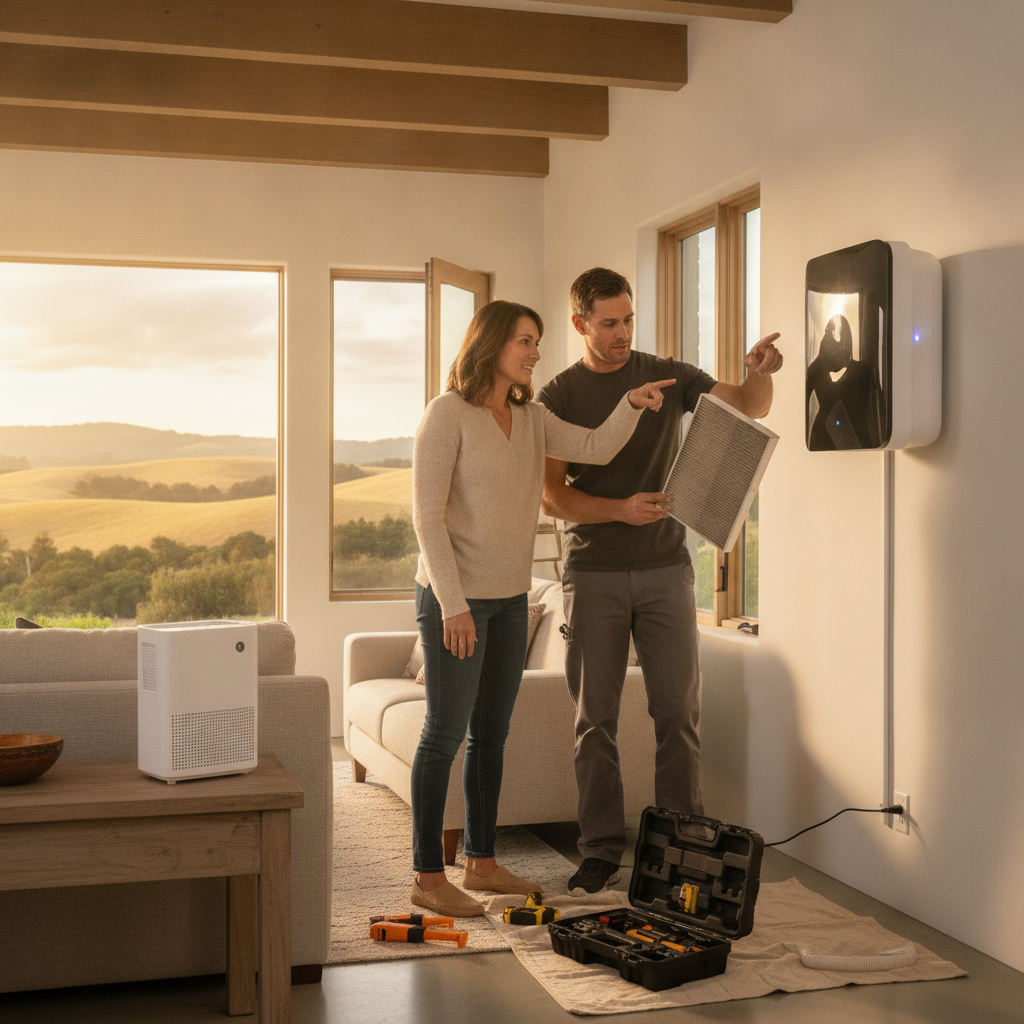
What Petaluma and Sonoma County Homeowners Should Know About Whole-House Air Purification — Not Just Filtration
If your HVAC system has a standard 1-inch filter in the return air vent, you have filtration — but you don’t necessarily have purification. That distinction matters more than most people realize, especially here in Sonoma County where wildfire smoke, seasonal pollen, and coastal humidity can all affect what you’re breathing inside your home. At Stout’s Heating & AC, Inc, we’ve been helping homeowners in Petaluma, Santa Rosa, and across the region improve their indoor air quality since 1992, and this is one of the topics that comes up more and more with every passing fire season.
What’s the Actual Difference Between Filtration and Purification?
Filtration and purification sound interchangeable, but they do fundamentally different jobs. A standard air filter — even a good one — is passive. Air passes through a fibrous media, large particles get trapped, and the filtered air moves on. That’s useful, but it has limits. It won’t touch gases, odors, volatile organic compounds (VOCs), or biological contaminants like mold spores and bacteria at the microscopic level unless you’re using a very high-efficiency filter.
Air purification goes further. A whole-house purification system integrates directly into your existing HVAC equipment and actively treats the air circulating through your home — not just the air flowing through one portable unit in a bedroom. Depending on the technology, a whole-house purifier can neutralize airborne pathogens, break down odor-causing gases, reduce VOCs from household products and building materials, and capture ultrafine particles that slip right through standard filters.
If you’ve only seen portable plug-in air purifiers at the hardware store, a whole-house system is a different category entirely. It works with your ductwork and runs continuously every time your system cycles on — covering your entire living space, not just one room.
Why This Matters More in Sonoma County Than in Many Other Places
We live in a beautiful part of California, but we also deal with some real air quality challenges that most HVAC articles written for a general audience never address. In the hills above Petaluma, Sebastopol, and Cotati, late summer and fall bring smoke from fires that can reach across multiple counties. When smoke levels spike, closing windows and running your AC or heat keeps out some of the particles — but not all of them. Smoke contains fine particulate matter (PM2.5) and chemical compounds that a basic MERV 8 filter simply wasn’t designed to capture.
Add to that the agricultural and grass pollen that moves through the area in spring, the humidity that comes in from the coast affecting homes in western Sonoma County, and the age of many homes in older Petaluma and Santa Rosa neighborhoods — and you have a situation where indoor air quality deserves more attention than a standard filter change every 90 days.
That’s not meant to alarm you. It’s just an honest picture of what local homeowners are actually dealing with — and why an upgrade to your home’s ventilation and air quality system can make a meaningful difference in daily comfort.
A Quick Guide to Whole-House Air Quality Technologies
There isn’t one single product called a “whole-house air purifier.” It’s a category with several different technologies, and the right one depends on what you’re trying to address. Here’s what you’ll typically encounter:
High-MERV and HEPA-grade Filtration
Upgrading from a standard MERV 8 filter to a MERV 13 or hospital-grade media filter captures significantly more fine particles. HEPA-grade whole-house systems push that further. The tradeoff is airflow restriction — higher filtration means denser media, which can reduce airflow through your system if it isn’t sized correctly. This is something your HVAC technician needs to evaluate before recommending an upgrade, because a filter that’s too restrictive for your equipment can actually reduce efficiency and cause problems over time.
Electronic Air Cleaners
These use an electrostatic charge to attract and capture particles — including smaller ones that pass through even high-MERV filters. They’re installed in the ductwork and require periodic cleaning rather than filter replacement. Many homeowners in Rohnert Park and Windsor find these a good fit because of the lower ongoing supply cost once installed.
UV Air Purifiers
Ultraviolet germicidal irradiation (UVGI) systems install inside your air handler or ductwork and use UV-C light to disrupt the DNA of bacteria, mold spores, and some viruses as air passes through. They don’t filter particles — they target biological contaminants. These are often combined with filtration for a more comprehensive approach.
Bipolar Ionization and PCO Systems
Photocatalytic oxidation (PCO) and bipolar ionization systems release charged particles or reactive molecules into the airstream that break down VOCs, odors, and some biological contaminants throughout the living space — not just at the filter. Results vary by product quality and application, so it’s worth having a conversation with a technician who can give you an honest assessment rather than just sell you the most expensive option.
What Competitors Often Don’t Tell You About These Systems
Here’s a gap we’ve noticed in how some local HVAC companies discuss air quality: they present it as an add-on sale without explaining compatibility or realistic expectations. Some whole-house purification products are effective; others are better marketed than they are tested. Before committing to any system, ask the installer which third-party certifications the product carries, what maintenance it requires, and whether your existing ductwork and equipment can support it without restricting airflow or reducing system efficiency.
We’ve seen situations where homeowners paid for a high-MERV upgrade that ended up straining an older furnace blower because the system wasn’t designed to handle that level of filtration resistance. Getting the right system matched to your specific equipment matters — which is why we always look at your setup before making a recommendation.
Cost, Installation, and What to Expect
Whole-house air quality upgrades range considerably depending on the technology. A media filter upgrade is typically a modest cost. A UV system or electronic air cleaner installation runs higher, and a comprehensive multi-technology approach to both filtration and purification will be at the upper end. We don’t publish fixed prices here because every home is different — your ductwork configuration, system age, and the specific products that make sense for your situation all affect the final number.
What we can tell you is that the installation itself is usually a half-day job for an experienced technician, and most whole-house systems require minimal maintenance beyond annual inspection and filter or cleaning cycles. If you’re already doing a seasonal tune-up, we can typically fold an air quality system check into that visit.
California and PG&E rebate programs occasionally include provisions for qualifying air quality equipment — worth checking at the time of installation. Your technician can help identify what’s currently available.
Frequently Asked Questions
Will a whole-house air purifier help with wildfire smoke inside my Petaluma home?
It can make a real difference, but no system eliminates smoke entirely if your home has significant air leakage. A high-MERV filter or HEPA-grade system combined with good building envelope sealing gives you the best protection during smoke events. UV or ionization systems help with odors and some combustion byproducts but are most effective as part of a layered approach.
Can I add an air purification system to my existing HVAC equipment?
In most cases, yes. Most whole-house air quality systems are designed to retrofit into existing ductwork and air handlers. The key is making sure the system is compatible with your equipment’s airflow capacity. We assess this before installation.
Is a whole-house system really better than multiple portable purifiers?
For whole-home coverage, yes. Portable units are only effective in the room they’re running in, and running several of them is often less efficient and more expensive than a single integrated system working through your existing ductwork.
How often does a whole-house purification system need maintenance?
It depends on the technology. Media filters need replacement every 6–12 months depending on usage. UV bulbs typically need replacement annually. Electronic air cleaners need periodic cleaning of the collection plates. All of this can be managed during a regular bi-annual HVAC maintenance visit.
Are there rebates or tax credits for whole-house air quality systems?
Some systems qualify for California or PG&E rebates, particularly when installed as part of a broader HVAC efficiency upgrade. Federal tax credits are more specific to heating and cooling equipment itself, but it’s worth discussing with your installer at the time of your consultation.
Ready to Talk About the Air Quality in Your Home?
If you’re a homeowner in Petaluma, Santa Rosa, or anywhere across Sonoma County and you’ve been thinking about this — especially after the past few fire seasons — it’s worth having a straightforward conversation about your options. We’re not going to push a product at you. We’re going to look at your home, your existing equipment, and what you’re actually trying to address, and give you an honest recommendation.
Stout’s Heating & AC, Inc has been doing this work locally since 1992. We’re not a national franchise with a call center — we’re your neighbors, and we stand behind what we install. Contact us to schedule a consultation or get a free estimate on a whole-house air quality upgrade. We’re available for same-day service across the region when you need us.