
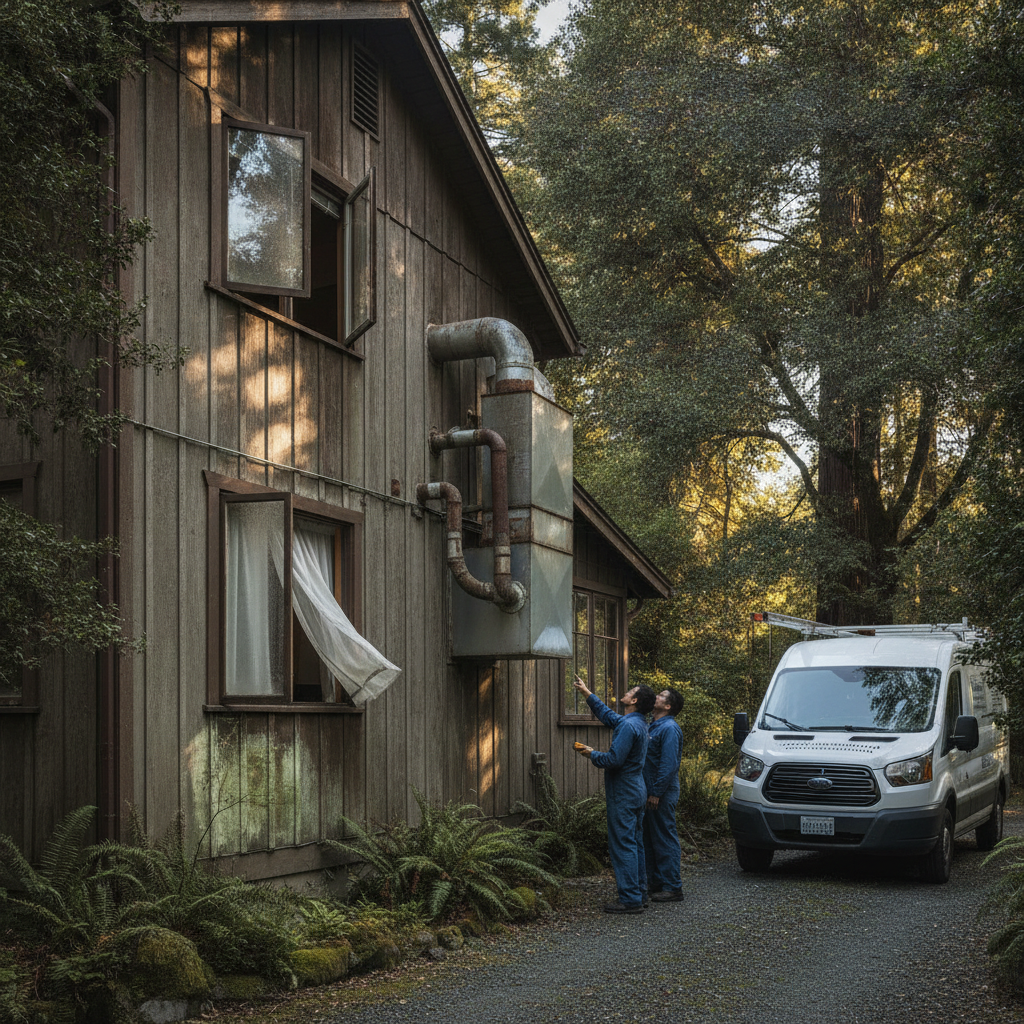
What Occidental and West Sonoma County Homeowners Should Know About Whole-House Ventilation in a Humid, Wooded Climate
If your home in Occidental, Forestville, or along the Russian River feels perpetually damp, smells faintly of mildew, or just never quite freshens up — even on the days you open every window — your heating and cooling system almost certainly isn’t the problem. Ventilation is. And it’s the one part of home comfort that most HVAC companies in this area barely talk about, let alone help you solve correctly.
West County’s wooded hillsides and river valleys are gorgeous, but they create a microclimate that’s meaningfully different from what most of Sonoma County experiences. The redwood canopy holds moisture. Mornings bring heavy coastal fog that pushes inland from Bodega Bay. Winters are wet for months at a time. And older homes — many of them built decades ago with minimal insulation and no mechanical ventilation to speak of — were never designed to handle the indoor air quality challenges that come with that environment. This guide is specifically for homeowners in that part of the county who want to understand what whole-house ventilation actually is, how it works, and whether it makes sense for their situation.
Why Opening Windows Isn’t Enough in a Wooded, Humid Climate
Natural ventilation — cracking a window, running a bathroom exhaust fan — works reasonably well when outdoor air is drier than indoor air and the temperatures cooperate. In Occidental or Guerneville in January, that’s rarely the case. You’re often pulling in outdoor air that’s already saturated with moisture, which makes the indoor humidity problem worse, not better.
Even in summer, the coastal marine layer that West County sees regularly means outdoor air isn’t always the dry, refreshing resource it is further east in Santa Rosa or Kenwood. You can’t simply air out a home the same way you might in a drier inland neighborhood.
The result, over time, is predictable: elevated indoor relative humidity, condensation on windows and walls, musty odors, potential mold growth in attics and crawlspaces, and air that simply feels heavy. None of that gets fixed by a new furnace or a well-maintained air conditioner. It gets fixed with proper mechanical ventilation designed for your specific conditions.
What Whole-House Ventilation Actually Does
A whole-house ventilation system does something exhaust fans and open windows can’t: it manages the exchange of indoor and outdoor air in a controlled, continuous way — without wasting the energy you’ve already spent heating or cooling your home.
The two most relevant systems for homes like yours in West County are:
- Heat Recovery Ventilators (HRVs): These bring fresh outdoor air into the home while simultaneously exhausting stale indoor air. As the two airstreams pass through the unit, heat from the outgoing air is transferred to the incoming air — so you’re not throwing away conditioned air with every air change. HRVs work especially well in colder, damper climates and are a strong fit for the wetter months along the Russian River corridor.
- Energy Recovery Ventilators (ERVs): ERVs do everything an HRV does, but they also transfer moisture between the two airstreams. In a climate that’s humid nearly year-round, an ERV can help moderate the humidity swings that come with bringing in outside air. For many West County homes, an ERV is worth the conversation.
Neither of these is a dehumidifier — though a standalone dehumidifier may also be part of the solution in particularly damp homes. What an HRV or ERV gives you is fresh, filtered air moving through your home continuously, at a rate calibrated to the size of your space, without drafts, without spiking your PG&E bill, and without creating new moisture problems in the process.
If you want to see what a professionally designed residential ventilation system looks like in practice, we’re happy to walk through the options with you.
What the Competitors Aren’t Telling You: Ventilation Sizing and Installation Quality
Here’s the gap that most local HVAC companies — and frankly most of the HVAC content you’ll find online — completely skip over: whole-house ventilation only works correctly when it’s properly sized and installed.
An HRV or ERV that’s undersized for your home won’t move enough air to make a real difference. One that’s oversized will over-ventilate, depressurize the house, and potentially pull backdraft from combustion appliances — a safety concern worth taking seriously in any home with a gas furnace or water heater. And one that’s installed without attention to where the supply and exhaust points are located will leave dead zones in your floor plan where stale air just sits.
The right installation starts with understanding your home’s square footage, ceiling heights, existing ductwork (if any), and the specific air quality challenges you’re dealing with. A Forestville home tucked under redwood trees with a crawlspace that floods in February has different needs than a newer construction home in Sebastopol with a sealed slab. One size does not fit all, and a contractor who doesn’t ask those questions before recommending equipment isn’t doing the job right.
Older Homes in West County: Special Considerations
A lot of the housing stock in Occidental, Guerneville, and the surrounding area was built in an era when “ventilation” meant a window you could open. These homes are often loosely constructed by modern standards — which sounds like it would mean they breathe fine on their own, but it’s more complicated than that.
Random air infiltration through gaps in walls, floors, and attics isn’t the same as controlled ventilation. You get drafts, but not fresh air distribution. You get moisture moving into wall cavities, but not out of them. And when you add insulation or weatherization to one of these homes — which makes sense given rising energy costs — you can actually make the air quality worse by tightening the envelope without adding mechanical ventilation to compensate.
If you’ve recently weatherized your home or you’re planning to, talk to us before you seal everything up. Adding an HRV or ERV at the same time as an insulation or weatherization project is almost always more cost-effective than coming back later.
Wildfire Smoke: Another Reason Ventilation Matters in West County
Wildfire smoke has become a real seasonal concern across Sonoma County, and West County residents aren’t immune — in some years, smoke from fires near Healdsburg, Cloverdale, or further north in Mendocino County settles into the river valleys for days at a time. A properly configured whole-house ventilation system can include filtration that helps reduce particulate matter from smoke before it enters your living space.
This is a meaningful upgrade from just closing your windows and hoping for the best. If smoke season is a concern for your household, it’s worth asking about MERV-rated filtration options when you’re looking at ventilation systems. We can help you understand what filtration levels are appropriate and realistic for your setup.
What to Expect From a Ventilation Assessment
When you call Stout’s to talk about ventilation, here’s what the process actually looks like. We start by understanding your home — age, construction type, whether you have existing ductwork, where you’re noticing problems. We may ask about your heating and cooling setup, since a ventilation system often ties into existing ductwork or air handling equipment. From there, we’ll recommend an approach that fits your home and your budget, explain what installation involves, and give you a clear sense of timeline and cost before any work begins.
We’ve been doing this in Santa Rosa and across Sonoma County since 1992. West County homes are part of our service area, and we understand the specific climate challenges that come with that territory. You can check out what our customers have to say at our customer reviews page.
Frequently Asked Questions
Do I need whole-house ventilation if I already have a forced-air furnace?
A furnace circulates air within your home but doesn’t bring in fresh air from outside. If you’re dealing with stuffiness, odors, or high humidity, a whole-house ventilation system addresses a different problem than your furnace does. The two systems work together, not instead of each other.
How much does an HRV or ERV cost to install in a West County home?
Costs vary based on home size, whether existing ductwork can be used, and the specific equipment selected. We don’t publish flat rates because the range is genuinely wide — a simple installation in a smaller home with existing ductwork looks very different from a larger home that needs dedicated ventilation ducting. A site visit is the only honest way to give you a real number. Contact us for a free estimate.
Will a ventilation system make my home feel colder in winter?
A properly sized HRV or ERV recovers most of the heat from outgoing air before it leaves the house. You shouldn’t notice a meaningful temperature drop. If you have concerns about this, it’s worth discussing during the assessment — there are ways to configure the system that minimize any impact on your comfort.
Can a ventilation system help with wildfire smoke?
Yes, with the right filtration. A whole-house ventilation system can be set up with MERV-rated filters that capture fine particulate matter, including wildfire smoke. During smoke events, you’d typically run the system in recirculation mode rather than bringing in outside air, and the filtration helps maintain cleaner indoor air. Ask us about this when we discuss your options.
Is there financial help available for installing a ventilation system in California?
Incentives vary and change over time, but California has programs that support indoor air quality improvements, and some utility rebates may apply depending on your specific situation. Federal tax credits may also be relevant if ventilation is part of a broader energy-efficiency project. We can point you toward current options — visit our HVAC offers page for what we’re currently aware of, or ask us directly when you call.
Ready to Talk About Your Home’s Ventilation?
If you’re in Occidental, Forestville, Guerneville, or anywhere in West Sonoma County and you’ve been living with damp, stale, or musty air, there’s a real solution — and it’s not as complicated or expensive as you might expect. Stout’s Heating & AC, Inc has been helping Sonoma County homeowners solve comfort and air quality problems since 1992. We’ll give you a straight answer about what your home needs and what it will take to fix it.
Call us at (707) 527-1504, email us at help@stoutshvac.com, or request a free estimate online. We serve the entire West County area and would be glad to come take a look.