
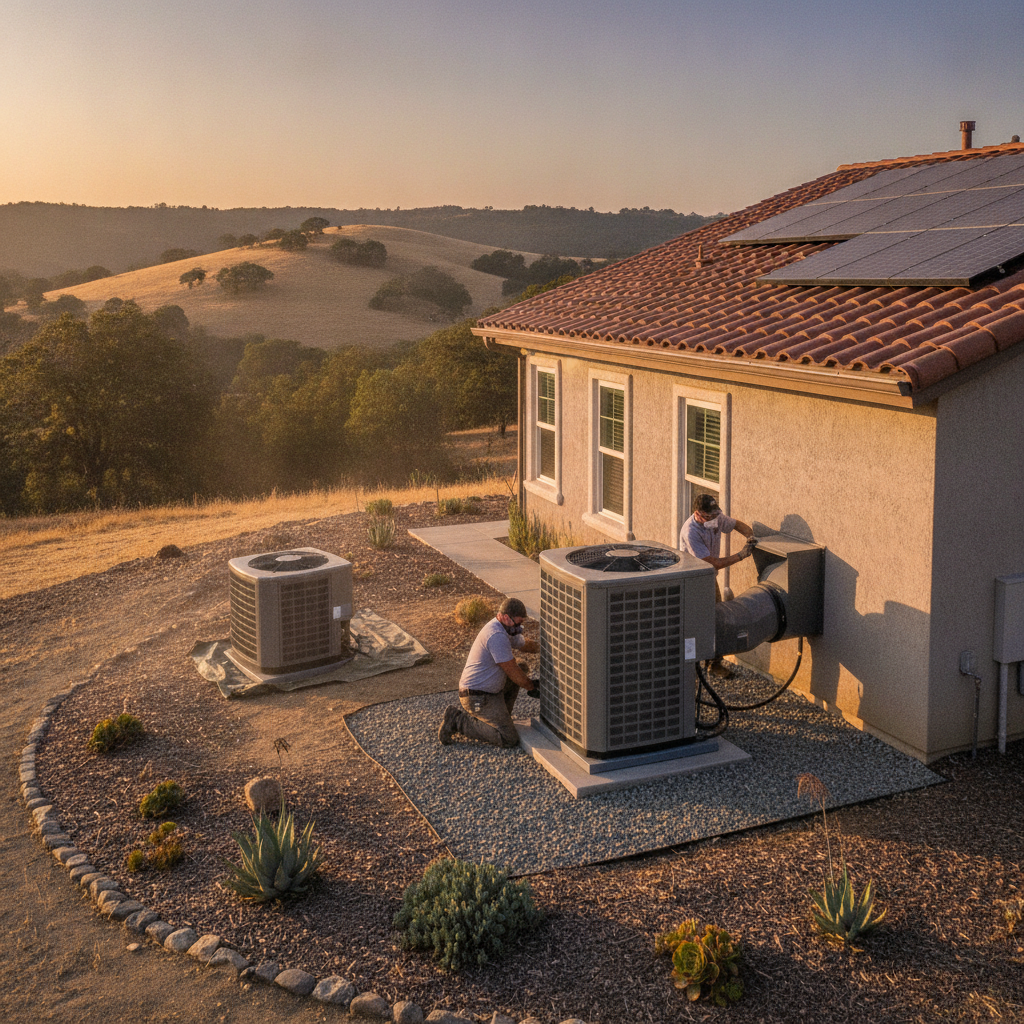
What Kenwood and Bennett Valley Homeowners Should Know About Replacing an Aging HVAC System in a High-Fire-Risk Zone
If you live in Kenwood, Bennett Valley, or anywhere else along the eastern hillsides of Sonoma County, you already know that replacing your heating and cooling system isn’t quite the same as it is for someone in a suburban neighborhood near Highway 101. The combination of older homes, steep terrain, dense vegetation, and the very real threat of wildfire smoke — and fire itself — changes what you need to think about before you sign off on a new HVAC installation. The good news is that with the right guidance and a contractor who actually knows this area, you can replace your system in a way that performs better, lasts longer, and keeps your indoor air genuinely clean when conditions outside are at their worst.
Why High-Fire-Risk Homes Have Different HVAC Needs
Most HVAC installation guides you’ll find online are written for a generic American home in a climate-controlled suburb. They don’t account for what it’s like to live on a ridge above Kenwood in October when a red flag warning goes up, or in a Bennett Valley home surrounded by oak woodland where smoke can settle in a valley for days at a time.
Homes in high fire hazard severity zones (FHSZ) — a designation that covers large swaths of eastern Santa Rosa, Kenwood, Glen Ellen, and the surrounding wine country hillsides — face a specific set of challenges that affect HVAC decisions in ways most contractors don’t bother to explain:
- Outdoor equipment exposure: Your condenser unit or heat pump sits outside year-round. In a fire-prone area, falling ash, airborne embers during a wind event, and radiant heat from nearby vegetation fires can damage equipment that wasn’t positioned or protected with that risk in mind.
- Air intake vulnerability: Standard HVAC systems pull outdoor air into the home through return registers. During a wildfire event, even a system that’s technically running can pull smoke and particulates directly into your living space if it lacks the right filtration.
- Power outages and fuel supply: Wildfire season often means PSPS events — planned power shutoffs by PG&E. A system that relies entirely on electricity, or one that depends solely on natural gas with an electric ignition and no backup, can leave you without heat or cooling exactly when you need it most.
- Aging systems in older homes: Many homes in the Kenwood and Bennett Valley areas were built in the 1970s through 1990s. Systems installed in that era — some of which survived the 2017 fires only to keep running for another decade — are now well past their expected service life and may be operating inefficiently or unsafely.
What to Think About When Placing Outdoor Equipment
Outdoor unit placement is something a lot of homeowners don’t give much thought to — you figure the installer knows where to put it. But in a high-fire-risk zone, placement matters more than you’d think.
Ideally, your condenser or heat pump outdoor unit should be positioned away from overhanging vegetation, out of the path of typical ember drift during north or east wind events, and in a location that allows for defensible space clearance without obstructing airflow to the unit. Concrete pads help. Avoiding placement under wood decks or near dry mulch areas is worth the extra planning.
This isn’t something most HVAC contractors will bring up on their own. It’s worth asking about specifically — and it’s the kind of detail a contractor with genuine local experience in Sonoma County will be prepared to address.
Filtration and Indoor Air Quality: The Part Most Contractors Skip
One of the biggest content gaps we’ve noticed in how local HVAC companies talk about system replacement is what happens to your indoor air quality after installation — especially during wildfire season. A new furnace or heat pump won’t automatically protect you from smoke infiltration. That requires an intentional approach to filtration.
When replacing a system in a high-fire-risk area, you should be asking your contractor about:
- Filter compatibility: Can the new system accommodate a MERV-13 or higher filter? High-efficiency filtration traps the fine particulates associated with wildfire smoke, but not every air handler is built to handle the increased static pressure that comes with a denser filter.
- Whole-home air purification: Systems like iWave ionizers or media air cleaners can be added at the air handler to neutralize particles, bacteria, and odors — including smoke compounds — before they circulate through your home.
- Fresh air intake controls: Some systems include motorized dampers or ERV (energy recovery ventilator) components that let you shut off outdoor air intake during a smoke event and recirculate indoor air instead. This is worth serious consideration in Kenwood, Glen Ellen, and the Bennett Valley corridor.
Learn more about whole-home ventilation options that can be paired with a new HVAC system to improve air quality year-round.
Why Heat Pumps Make Sense Here — With Some Caveats
Sonoma County’s Mediterranean climate — warm dry summers, cool wet winters, rarely extreme on either end — is genuinely well-suited for heat pump technology. A modern heat pump can handle both heating and cooling from a single system, and in a climate where you’re not regularly sitting below 25°F, it can do so efficiently year-round.
For homeowners in Kenwood and Bennett Valley, heat pumps offer some real advantages when replacing an older gas furnace and separate AC system:
- One outdoor unit instead of two pieces of equipment to maintain
- Reduced gas dependence, which matters during PSPS events if you add a battery backup system
- Eligibility for federal tax credits under the Inflation Reduction Act (up to 30% of installation costs) and PG&E rebates through the Sonoma Clean Power and Electrification programs
- Lower operating costs compared to resistance electric heat, and increasingly competitive with gas heating as PG&E rates continue to climb
The caveat worth knowing: if your home sits at higher elevation and regularly sees temperatures in the upper 20s overnight in winter, a cold-climate heat pump or a dual fuel hybrid system — which pairs a heat pump with a gas furnace backup — may serve you better than a standard heat pump alone. A proper load calculation and honest conversation about your local microclimate should drive that decision.
Permits, Insurance, and Fire Zone Compliance
This is an area where homeowners in high-fire-risk zones sometimes get tripped up. In unincorporated Sonoma County and in areas governed by CalFire’s jurisdiction, HVAC replacement work may trigger permit requirements that are slightly different from standard City of Santa Rosa permits — particularly if you’re modifying ductwork, adding equipment, or making changes to the structure to accommodate a new system.
Additionally, if you’ve recently had your homeowner’s insurance reassessed (or dropped and replaced, as many Kenwood and Bennett Valley homeowners have experienced in recent years), your new insurer may have specific requirements around HVAC equipment, venting, and fire safety compliance. It’s worth confirming what documentation your contractor will provide after installation, including the permit and final inspection record.
Working with a licensed, locally established contractor matters here. A contractor who knows Sonoma County’s permit offices and has done work in fire-affected neighborhoods isn’t going to leave you holding the paperwork bag.
Frequently Asked Questions
Can I keep my existing ductwork when replacing an HVAC system in an older Kenwood or Bennett Valley home?
Sometimes, but it depends on the condition of the ducts, their sizing relative to the new equipment, and whether they’ve been compromised by smoke, heat, or pests. A reputable contractor will inspect the ductwork before recommending whether to reuse, seal, or replace it. Don’t let anyone skip that step.
What filter rating should I use if wildfire smoke is a regular concern?
MERV-13 is generally recommended for wildfire smoke filtration in residential systems. HEPA filtration is more effective but requires a dedicated air handler designed for it. Your contractor should confirm what your specific system can safely handle — using a filter that’s too dense for your air handler can reduce airflow and damage equipment.
How long does a full HVAC replacement typically take to schedule in Sonoma County?
For a standard swap-out replacement (same fuel type, similar location), most jobs can be completed in one to two days once equipment is ordered. Lead times on equipment vary by season and brand — during peak summer demand, some systems may take a week or more to arrive. Planning your replacement in spring or early fall is generally easier on scheduling.
Are there rebates available for replacing an old gas furnace with a heat pump in California?
Yes. Federal tax credits under the Inflation Reduction Act, PG&E rebates, and Sonoma Clean Power incentives are all potentially available depending on equipment type and household income. These programs change periodically, so it’s worth asking your contractor and checking directly with Sonoma Clean Power. Visit our current offers and financing page for details on what we’re currently offering.
What should I do with my HVAC system during a wildfire evacuation warning?
If you’re under an evacuation warning and have time, set your thermostat to recirculate mode rather than pulling fresh air from outside, and consider upgrading to a higher-rated filter before wildfire season begins. If you evacuate, turn the system off entirely. Running HVAC during an active fire event nearby can pull smoke and ash into your home and put unnecessary stress on the equipment.
Ready to Replace Your System? Talk to a Local Contractor Who Knows the Area
At Stout’s Heating & AC, Inc, we’ve been serving homeowners in Santa Rosa, Kenwood, Bennett Valley, Glen Ellen, Sonoma, and the surrounding wine country since 1992. We know what it’s like to work in fire-affected neighborhoods, in homes with challenging terrain and aging ductwork, and with homeowners who need honest guidance — not a sales pitch.
If your system is aging, underperforming, or you’re just not sure what the right move is before wildfire season, we’re happy to take a look and give you a straight answer. Contact us today to schedule a free estimate or ask us anything about your home’s heating and cooling setup.