
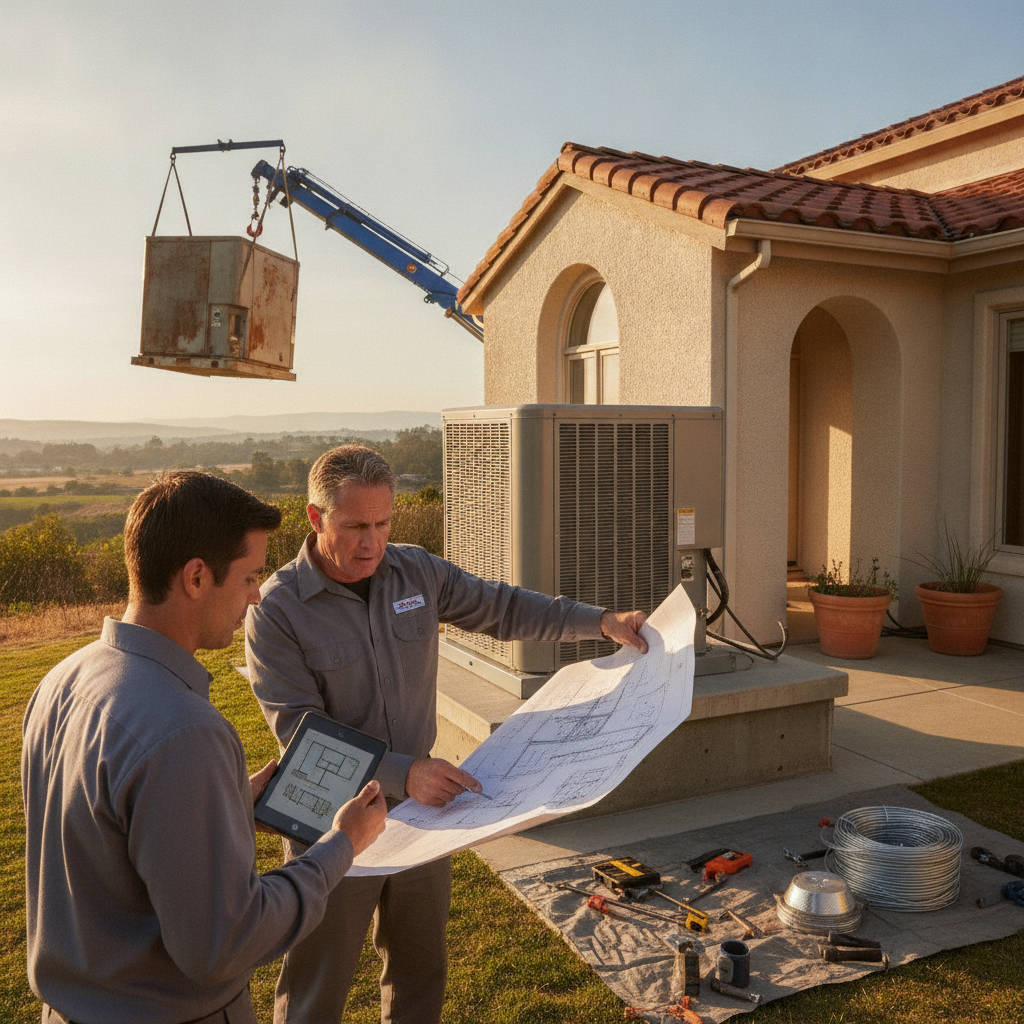
What Sonoma County Homeowners Should Know About HVAC System Sizing — and Why Bigger Isn’t Always Better
If you’re replacing a furnace or air conditioner in Sonoma County, the most important number isn’t the price tag on the equipment — it’s whether the system is the right size for your home. An oversized unit will short-cycle, meaning it fires up, reaches temperature too fast, shuts off, and repeats that cycle over and over again. An undersized unit will run almost constantly and never quite catch up during a hot Santa Rosa afternoon or a cold January night. Either way, you end up paying more and getting less. This is one of the most common — and least talked about — mistakes made during HVAC replacements in our area.
Why System Sizing Is More Complicated Than Square Footage
Most homeowners assume that sizing an HVAC system is as simple as matching the tonnage of whatever was installed before, or using a rough square-footage formula. Some contractors will do exactly that — take a quick look, write down your square footage, and spec out a system without doing any real analysis. That shortcut is a problem.
Proper HVAC sizing requires what’s called a Manual J load calculation — an industry-standard process that accounts for much more than just floor space. A real load calculation factors in:
- The orientation of your home and how much direct sun it receives
- Window size, type, and placement
- Insulation levels in the attic, walls, and crawl space
- Ceiling height and layout
- Local climate data, including average design temperatures for your specific area
- Air infiltration and duct leakage if a forced-air system is involved
- The number of occupants and internal heat sources
Santa Rosa and the surrounding Sonoma County area have a Mediterranean climate — hot, dry summers and cool, wet winters — but conditions vary significantly depending on where you live. A home in Rincon Valley sits in a warmer inland microclimate than one near Sebastopol, which gets more coastal influence and stays considerably cooler. A hillside property in Fountaingrove may face stronger afternoon winds than a home in Bennett Valley a few miles away. These differences are real, and they affect what size system your home actually needs.
What Happens When the System Is the Wrong Size
This is the part most local competitor sites skip past entirely, and it’s worth spelling out clearly because the consequences show up in your utility bill and your comfort level for years.
Oversized systems are probably more common than undersized ones, partly because some contractors think bigger sounds better to a customer. Here’s what actually happens with an oversized system:
- It reaches your thermostat setpoint quickly and shuts off — before it’s had time to adequately dehumidify the air. This leaves your home feeling clammy even when the temperature reads correctly.
- The constant on-off cycling puts more wear on the compressor and other mechanical components, shortening the system’s lifespan.
- You pay for a system that’s larger and more expensive than you needed, and you’ll likely pay higher energy bills due to the inefficiency of short cycling.
Undersized systems have a different set of problems:
- During a summer heat wave — which Santa Rosa gets a handful of each year — the system runs continuously and can’t bring indoor temperatures down to a comfortable level.
- The constant runtime leads to accelerated wear on components and higher energy consumption.
- In winter, an undersized heating system may struggle to keep up on cold nights, especially in older homes with less insulation.
If your current system seems to run constantly in summer or cycle on and off every few minutes, there’s a real chance it was never properly sized in the first place — or that your home has changed since it was installed.
How to Know If a Contractor Is Actually Sizing Your System Correctly
This is a question worth asking directly before you agree to any equipment quote. A contractor who is doing this correctly will either perform a Manual J calculation on-site or ask you a detailed set of questions and gather measurements before recommending equipment. If a contractor shows up, glances around, and immediately quotes you a specific system size without any real assessment, that’s a red flag.
You should also be skeptical of the common shortcut of simply matching what you already have. If your existing system was installed 15 or 20 years ago — which is common in older Sonoma County neighborhoods — it may have been wrong to begin with. And if you’ve made improvements to your home since then (added insulation, replaced windows, enclosed a porch, built an addition), those changes affect the calculation.
At Stout’s Heating & AC, we’ve been doing this work in Santa Rosa and the surrounding area since 1992. We don’t guess at equipment size — we assess your home the right way, and we’re happy to walk you through what we find and why we’re recommending a particular system. You can also request a free estimate and we’ll schedule a time to come out and take a proper look.
System Sizing and Heat Pumps: A Special Consideration
If you’re considering upgrading to a heat pump — which makes a lot of sense for Sonoma County’s relatively mild climate — sizing becomes even more critical. Heat pumps operate differently than gas furnaces. They’re designed to run longer at lower intensity rather than short-bursting at high capacity. An oversized heat pump will short-cycle just like an oversized AC, but it will also struggle to operate efficiently in its heating mode when temperatures drop.
Windsor, Petaluma, and other parts of the county that see colder winter temperatures than coastal areas need especially careful sizing to ensure a heat pump can handle heating load on the coldest nights without relying too heavily on the backup resistance heat strip, which is expensive to run. This is one of the reasons that heat pump installations done by an experienced local contractor tend to perform much better over the long run than equipment sized and sold by a company that doesn’t understand the local climate.
What About Replacing Just the Outdoor Unit?
One situation that comes up regularly is a homeowner whose outdoor AC unit fails and who gets a quote to replace just that component. This is sometimes called a “split” or partial replacement. The problem is that if you replace only the outdoor unit without checking whether the indoor coil is compatible and whether the system is properly sized for your current home conditions, you can end up with efficiency and performance problems that weren’t there before. We always evaluate the full system when any major component is being replaced.
Frequently Asked Questions
How long does a proper load calculation take?
A thorough Manual J calculation for a typical Sonoma County home takes roughly 30 to 60 minutes on-site, depending on the home’s complexity. It’s not a reason to avoid proper sizing — it’s a basic part of doing the job right.
My neighbor has the same size house as me — can’t I just use the same system they have?
Not reliably. Even two homes with identical square footage can have very different heating and cooling loads depending on insulation, window placement, sun exposure, age of construction, and duct condition. What works well for your neighbor may be wrong for you.
Does system sizing affect my PG&E bill?
Yes, significantly. A correctly sized system runs more efficiently, which translates to lower monthly energy costs. Given how much PG&E rates have climbed in recent years, a properly sized high-efficiency system can make a noticeable difference in what you’re paying to heat and cool your home.
What if I’ve already been quoted a system — how do I know if it’s the right size?
Ask the contractor to show you the load calculation that supports their recommendation. If they can’t produce one, get a second opinion. We’re always happy to review a quote or perform our own assessment before you commit to anything.
Does Stout’s service homes outside of Santa Rosa?
Yes — we serve communities throughout Sonoma County including Windsor, Petaluma, Sebastopol, Healdsburg, and many others. If you’re not sure whether we cover your area, just give us a call.
Get an Honest Assessment Before You Buy Anything
HVAC equipment is a significant investment, and it’s one you’ll live with for 15 to 20 years. The size of the system you install matters at least as much as the brand name on the side of it. If you’re planning a replacement or you’re not sure whether your current system was ever properly sized for your home, we’d rather have that conversation with you now than have you dealing with comfort problems and high energy bills for the next decade.
Stout’s Heating & AC has been serving Santa Rosa and Sonoma County homeowners since 1992. We’re a local, family-owned company — not a franchise, not a call center. You can reach us at (707) 527-1504, email us at help@stoutshvac.com, or contact us online to schedule a free in-home estimate. We’ll take the time to get it right.