
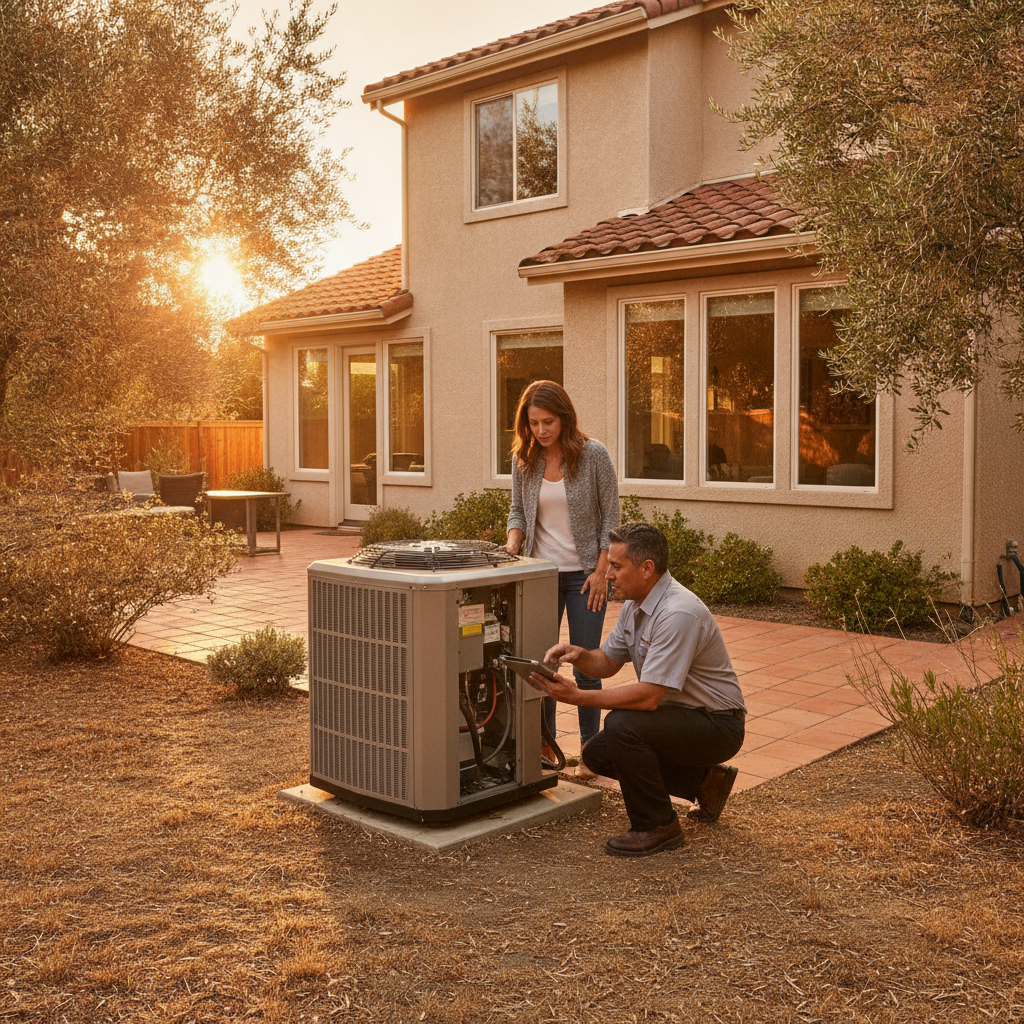
What Santa Rosa Homeowners Should Know About HVAC and Home Sales — Inspection Red Flags, Disclosure Rules, and When to Repair or Replace Before Listing
If you’re selling a home in Santa Rosa, your HVAC system is going to come up — probably during the inspection, possibly during negotiation, and occasionally as a deal-breaker if it’s bad enough. This is a topic that most local HVAC companies don’t address directly, even though it affects a significant number of homeowners every year. Here’s a straightforward look at what to expect, what California law actually requires you to disclose, and how to decide whether repairing or replacing your system before you list is worth the money.
Why HVAC Comes Up So Often in Sonoma County Home Sales
Santa Rosa and the surrounding Sonoma County area have a wide range of housing stock — older bungalows in the Railroad Square and West End neighborhoods, post-fire rebuilds in Coffey Park and Fountaingrove, mid-century ranchers throughout Rohnert Park and Windsor, and everything in between. The age of the housing stock matters a lot here, because HVAC systems in older homes are often original or near end-of-life by the time the house hits the market.
Home inspectors in this area know what to look for. They’re going to check the age of the furnace and air conditioner, test whether the system actually heats and cools, look for rust, corrosion, or visible damage, inspect the filter and accessible ductwork, and note any safety concerns — carbon monoxide risks, cracked heat exchangers, improperly vented equipment. A 20-year-old furnace in marginal shape is going to show up in that report, and buyers and their agents will use it in negotiations.
What California Requires You to Disclose
California has some of the most comprehensive real estate disclosure requirements in the country. As a seller, you’re required to disclose known material defects — and a failing HVAC system almost certainly qualifies. If you know your furnace has a cracked heat exchanger, that your AC compressor is on its last legs, or that you’ve had repeated service calls on the system in the past few years, you generally need to disclose that on your Transfer Disclosure Statement.
What you don’t have to do is proactively dig up problems you didn’t know existed. But once a home inspector flags something and it’s in writing, you’re aware of it — and trying to hide it after that point creates real liability. The cleaner path is to get in front of it before you list.
The Case for a Pre-Listing HVAC Inspection
One of the most useful things a seller can do is schedule an HVAC evaluation before putting the house on the market. This isn’t the same as the buyer’s inspection — it’s you, proactively, finding out what shape your system is in so you can make informed decisions rather than reactive ones.
A pre-listing HVAC check typically covers the same ground a buyer’s inspector will: system age and condition, heating and cooling output, refrigerant levels, heat exchanger integrity, filter and airflow, and any visible safety issues. The difference is that when you find a problem first, you control how to handle it. You can repair it, replace it, price the home to account for it, or simply disclose it accurately — rather than being blindsided mid-escrow when a buyer’s inspector finds it and demands a credit or threatens to walk.
At Stout’s Heating & AC, we’ve been doing this kind of work in the Santa Rosa area since 1992. We’re not going to oversell you on a new system if the one you have is serviceable. Our job is to give you an honest read on what you’re working with. You can learn more about our residential heater repair services if you’re dealing with a furnace that’s been flagged.
Repair or Replace Before Listing? How to Think About It
This is the question we get most often from sellers, and the honest answer is: it depends on the system’s age, the cost of repair, and the local market.
Here are some general guidelines that apply well to the Santa Rosa market:
- If the system is under 10 years old and the repair is under $500–$700: Fix it before you list. It’s a small number relative to the sale price, and having a clean bill of health on the system is worth more in buyer confidence than the cost of the repair.
- If the system is 15+ years old and needs a significant repair: Run the math. A $1,500 repair on a 17-year-old furnace may buy you another season or two at best. A buyer’s inspector is still going to note the age, and the buyer will still ask for a credit. In this situation, replacement may make more sense — you get a clean report, you can market the home with a new HVAC system, and you avoid the negotiation entirely.
- If the system is truly at end-of-life and you’d rather not invest: Disclose it honestly and price accordingly. Some buyers, especially investors or flippers, will accept an older system if the price reflects it. This is a legitimate path — just make sure what you’re disclosing is accurate.
One thing worth knowing: if you do replace the system before listing, a new heat pump or high-efficiency central system is a genuine selling point in today’s Sonoma County market. Rising PG&E rates and California’s energy policies have made buyers more attentive to utility costs than they used to be. A home with a new, efficient system can legitimately justify a higher ask.
What Buyers in Santa Rosa Are Asking About HVAC Right Now
Buyer expectations have shifted in recent years. Here’s what we hear from real estate agents and from buyers who call us for second opinions after an inspection:
- Is this system going to last? Buyers want to know the realistic remaining life of the equipment, not just whether it’s currently functioning.
- What will it cost to run? Especially in areas like Petaluma, Windsor, and Sebastopol where older homes may have undersized or inefficient systems, buyers are asking about efficiency ratings and monthly operating costs.
- Is the air quality okay? Post-wildfire, this is a real concern throughout Sonoma County. Buyers are paying attention to filtration, duct condition, and whether the system has any air purification capability.
- Has it been maintained? If you have records of regular tune-ups, that’s worth sharing. A well-maintained 12-year-old system looks much better than a neglected 8-year-old one.
If you don’t have maintenance records but you want to get a tune-up done before listing, we offer a $90 tune-up special that covers the inspection, cleaning, and a written summary of what we found. That summary can go directly into your disclosure package or be shared with the buyer’s agent. Check our current HVAC offers for details.
A Note on Post-Fire Rebuilds in Coffey Park and Fountaingrove
If you’re selling a home that was rebuilt after the 2017 Tubbs Fire in neighborhoods like Coffey Park or Fountaingrove, your HVAC system is likely newer — often five to seven years old at this point. That’s generally good news for inspections. But there are a few things specific to post-fire rebuilds worth checking: installation quality (not all rebuild contractors used licensed HVAC subs), duct sealing, and whether the system was properly sized for the rebuilt floor plan. We’ve seen cases where a rebuild came with an undersized system that never quite kept up. Worth verifying before the buyer’s inspector points it out.
Frequently Asked Questions
Do I have to replace my HVAC system before selling my home in Santa Rosa?
No. There’s no legal requirement to replace a functioning system, even an older one. You’re required to disclose known defects, but a working system — even one that’s aging — doesn’t have to be replaced before sale. The decision is strategic, not mandatory.
How much does a pre-listing HVAC inspection cost?
It varies, but a basic HVAC evaluation is typically in the $90–$150 range depending on what’s involved. Some companies, including Stout’s, bundle this with a tune-up so you get the inspection and service in one visit.
Will a buyer’s inspector check my HVAC the same way you would?
Home inspectors are generalists — they’ll check basic function, visible condition, and age. They’re not licensed HVAC technicians. If they flag something specific (like a heat exchanger concern), you’ll want a licensed HVAC contractor to do a more detailed follow-up before making any decisions.
What if the buyer asks for a credit instead of a repair?
That’s a common outcome. If a buyer asks for a credit based on the HVAC system, it helps to have your own contractor’s written estimate so you’re negotiating based on actual costs rather than whatever number the buyer’s agent floats. Get your own bid in hand before you respond to any credit request.
Is a new heat pump a good selling feature in Sonoma County?
Yes, increasingly so. With PG&E rates where they are and California’s push toward electrification, a new heat pump — especially a high-efficiency model — is a genuine value-add. You can learn more about heat pump installation options if you’re considering this route before listing.
Ready to Get an Honest Assessment Before You List?
If you’re planning to sell your Santa Rosa home and want a straight answer on what shape your HVAC system is in — not a sales pitch, just an honest evaluation — we’re happy to help. Stout’s Heating & AC has been serving homeowners across Santa Rosa and Sonoma County since 1992, and we’ve seen enough pre-sale situations to give you useful, practical guidance without pushing you toward something you don’t need.
Call us at (707) 527-1504, email us at help@stoutshvac.com, or reach out through our contact page to schedule an evaluation. We can usually get out to you quickly — and if something does need attention, we’ll tell you exactly what it is and what it’ll take to fix it.