
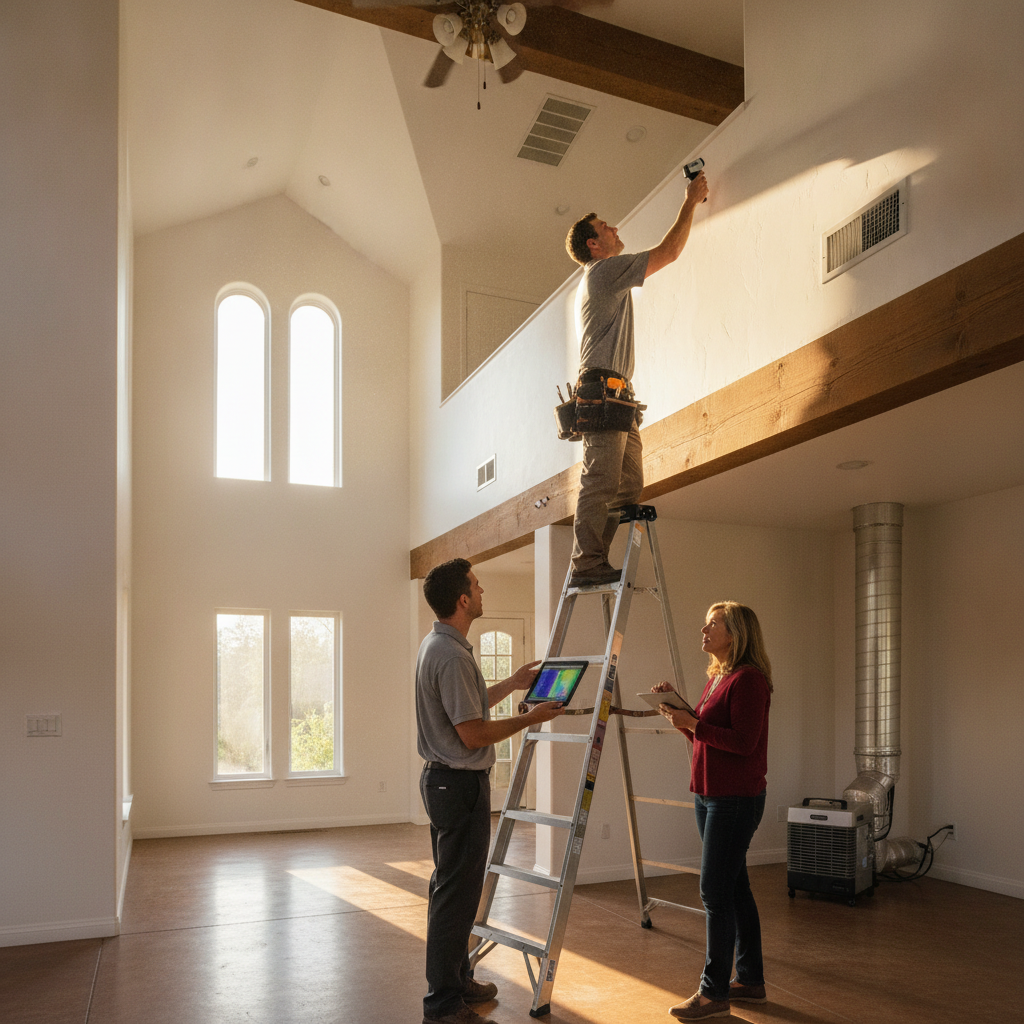
What Petaluma and Sonoma County Homeowners Should Know About Heating and Cooling a Home With High Ceilings — Why Stratification Is a Real Problem and How to Fix It
If your Petaluma home has a great room with 12-foot ceilings, a loft-style open floor plan, or any kind of dramatic vertical space, you’ve probably noticed something frustrating: the floor is cold in January, but the upstairs loft feels stuffy and warm. Or in summer, you crank the AC and the living area at eye level finally cools down — but the bedroom above stays uncomfortably hot. This isn’t a thermostat issue, and it’s not a sign your HVAC system is failing. It’s a physics problem called air stratification, and it affects a surprising number of homes across Sonoma County. The good news is that it’s fixable — but the fix is rarely what most homeowners assume.
Why High Ceilings Make Heating and Cooling So Much Harder
Hot air rises. That’s not a mystery — it’s basic physics. But the practical consequence in a home with high ceilings or open vertical space is significant. When your furnace or heat pump runs in winter, warm air naturally floats upward toward the ceiling, collecting in the upper portion of the room where no one is sitting or sleeping. Meanwhile, the air where you actually live — at floor level, on your couch, at your kitchen table — stays noticeably cooler. Your thermostat registers a certain temperature, the system shuts off, but the occupied zone of your home never actually reached comfortable.
In summer it works in reverse. Your air conditioner pushes cooled air into the space, but heat accumulates at the ceiling and radiates back down slowly. If you have a sleeping loft or an open staircase that connects to an upper level, that upper area acts almost like a heat trap. The system runs longer and works harder to compensate, and your PG&E bill reflects it.
This is a particularly common complaint in older Craftsman-era homes in Petaluma’s historic core, remodeled Victorian properties in Santa Rosa, and the mid-century ranch-style homes throughout Rohnert Park and Sonoma that have been opened up with structural modifications over the years. It also comes up frequently in newer construction — especially the kind of open-concept Wine Country style builds you see in Sonoma and Windsor — where architectural drama was prioritized over thermal efficiency.
The Most Common Mistake: Oversizing the System
When a homeowner with high ceilings complains about uneven comfort, the most common contractor response is to recommend a bigger furnace or a higher-capacity air conditioner. More output, more airflow, problem solved — right?
Usually not. Oversizing a forced-air system in a high-ceiling home often makes the problem worse. A larger system tends to short-cycle — it reaches the thermostat setpoint quickly, shuts off before the air has had time to circulate properly, and leaves you with exactly the same stratification you started with. You’ve spent more money on equipment, your energy bills are higher, and you’re still cold at floor level in January.
What actually addresses stratification is not raw capacity — it’s smarter air distribution, better equipment placement, or a system designed to move air through the full vertical height of the space. That usually means one or more of the following approaches, depending on your specific home.
Real Solutions for High-Ceiling Comfort Problems
Ceiling Fans — But Used Correctly
A ceiling fan set to run in reverse (clockwise, at low speed) in winter pushes the warm air pooling at the ceiling back down along the walls and into the occupied zone without creating a wind-chill effect. It’s a simple, inexpensive fix that genuinely helps in rooms where the ceiling height is in the 10–14 foot range. It won’t solve a major stratification problem on its own, but it’s a reasonable first step and often dramatically improves comfort for very little cost.
Ductwork and Register Placement Adjustments
In many high-ceiling homes with forced-air systems, the supply registers are positioned in ways that were fine for a standard 8-foot ceiling but don’t work well in a taller space. If the warm air is being delivered up high and returning through a low-wall return, it’s essentially recirculating through the upper zone of the room without ever reaching the floor. Repositioning or adding low-wall supply registers — so heated air is introduced at floor level and allowed to rise naturally — is often one of the most effective and cost-efficient corrections a contractor can make.
This kind of ductwork modification is something Stout’s has done in dozens of Sonoma County homes over the years. It’s not glamorous work, but it gets results without requiring you to replace perfectly functional equipment. If you’re unsure whether your current duct layout is part of the problem, an honest assessment from an experienced local technician is worth more than an online calculator.
Ductless Mini-Splits With Strategic Placement
For rooms where ductwork modifications aren’t practical — or where you’re trying to condition a space that was never properly served by the central system — a ductless mini-split installed at the right height can be a more elegant solution than you might expect. The key word there is right height. Many homeowners and even some contractors assume that because mini-split wall-mounted heads deliver air horizontally, they work the same regardless of placement. In a high-ceiling room, a head mounted too high will send conditioned air across the upper portion of the room without meaningfully affecting the zone where people are.
A properly placed mini-split in a high-ceiling space is typically positioned lower on the wall than you’d expect, aimed to project airflow across the occupied zone. In spaces with dramatic ceiling heights — 16 feet or more — a floor-console unit can be especially effective, delivering heat at floor level during winter exactly where you want it. Heat pump mini-splits from manufacturers like Mitsubishi Electric, Fujitsu, and Daikin are well-suited to Sonoma County’s moderate climate and handle this kind of targeted conditioning efficiently.
Zoning Your Existing Forced-Air System
If your home has a central system you’re not ready to replace, adding a zoning setup with dampers and multiple thermostats can help by giving you independent control over different areas. For a two-story home where the upper level consistently overheats in summer, zoning lets you reduce airflow to the upper zone while maintaining full output downstairs — rather than running the whole system harder to compensate for what’s happening in one area. It’s an investment, but it’s often far less expensive than replacing functional equipment and far more effective than just turning the thermostat up or down.
What This Means for Energy Costs in Sonoma County
PG&E rates in this region have increased significantly over the past few years, and homeowners in Sebastopol, Rohnert Park, and throughout the county are feeling it. A home with unresolved stratification problems isn’t just uncomfortable — it’s actively wasting energy as the system runs longer cycles trying to hit a setpoint it can never quite reach. Fixing the root cause of uneven conditioning almost always reduces runtime, which reduces your monthly bill. In some cases, the energy savings alone justify the cost of the fix within a few heating seasons.
There are also California and PG&E rebates available for qualifying high-efficiency heat pump equipment and zoning upgrades. Check our current offers page for what’s available right now — these programs change, and a local contractor who stays current on them can help you capture savings that a national chain or a discount install company is unlikely to mention.
Frequently Asked Questions
Does a higher-SEER air conditioner help with stratification problems?
Not directly. SEER ratings measure efficiency, not air distribution. A high-SEER system running with poor register placement or the wrong equipment configuration will still struggle with stratification. The efficiency rating matters for your energy bill, but it doesn’t address where the air is going inside the room.
My Petaluma home has a two-story great room. Do I need two separate systems?
Not necessarily. Depending on the square footage, ceiling height, and how the existing ductwork is configured, you may be able to address comfort issues with register modifications and ceiling fan use. In some cases, adding a single ductless head to serve the upper zone is a more practical solution than a full second system. The right answer depends on your specific layout — it’s worth having someone walk through the home before committing to anything.
Can a ceiling fan really make a meaningful difference in winter?
Yes, for moderate ceiling heights — roughly 10 to 14 feet — running a ceiling fan in reverse at low speed in winter can noticeably improve comfort at floor level without drafts. Above 14–15 feet, the effect diminishes and you’ll likely need a more targeted solution. It’s an inexpensive first test worth trying before pursuing anything else.
My floors are always cold even when the thermostat says the house is warm. Is this a stratification problem or something else?
It could be stratification, but cold floors can also result from slab or crawl space heat loss, inadequate insulation in the floor assembly, or supply registers positioned to deliver air too high in the room. In older homes in Sonoma and Petaluma, the answer is sometimes a combination of factors. A good technician will look at the whole picture rather than jumping to a single explanation.
Is this something Stout’s handles, or is it more of a remodeling contractor issue?
We handle it. Register repositioning, duct modifications, mini-split installations, and zoning retrofits all fall within what we do for residential customers across Sonoma County. If there’s a structural element involved — say, you want to move a return air chase that’s built into a wall — that’s where a general contractor might need to be involved. But in most cases, the HVAC side of the fix is entirely within our scope.
Ready to Stop Fighting Your Own Ceiling?
Stratification in high-ceiling homes is a solvable problem, but it takes someone who’s willing to look at the whole system — not just hand you a quote for a bigger unit. At Stout’s Heating & AC, Inc, we’ve been working in Sonoma County homes since 1992. We know the housing stock, we know the climate, and we’d rather give you an honest answer than sell you equipment you don’t need.
If your home has comfort issues that seem tied to ceiling height or vertical air distribution, reach out and schedule a visit. We’ll take a look at what’s actually happening in your home and tell you straight what will fix it.