
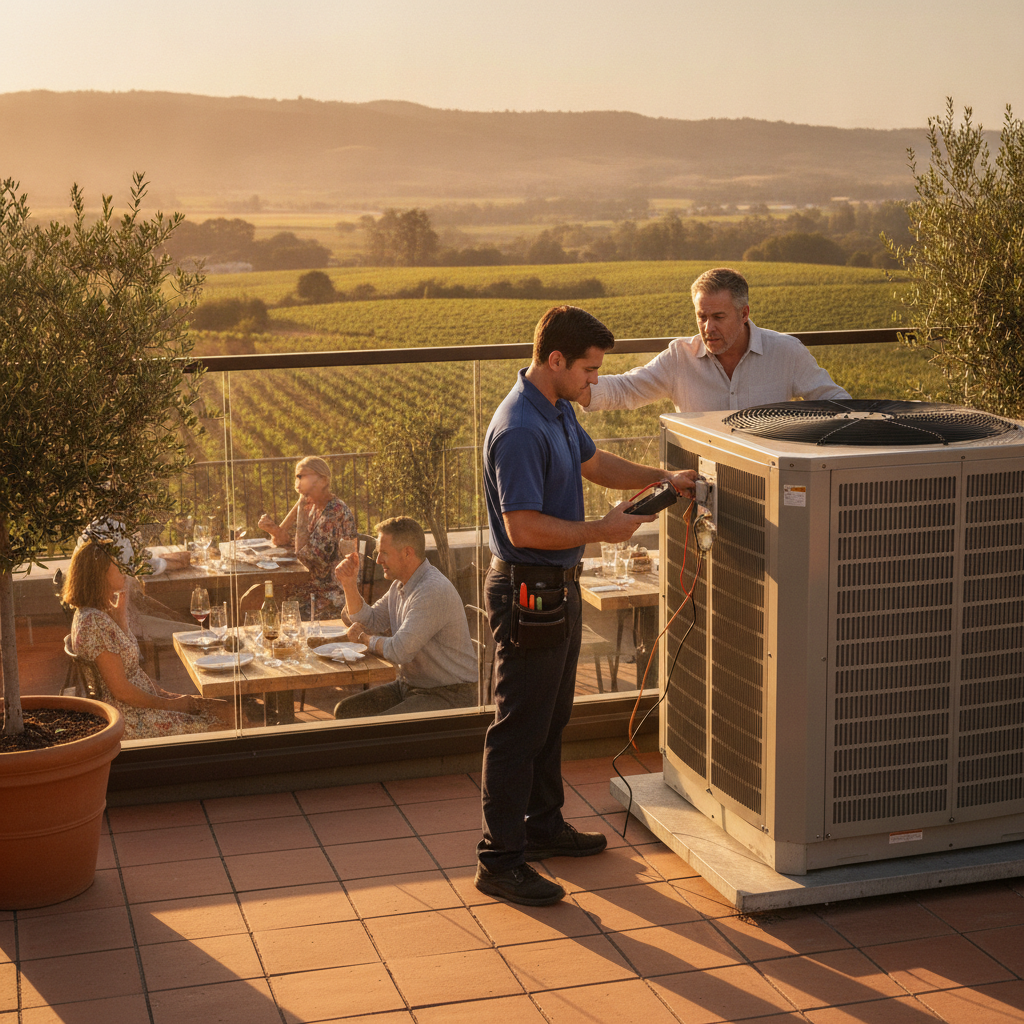
What Healdsburg Wine Country Businesses Should Know About Commercial HVAC in Tasting Rooms and Restaurants
If you run a tasting room, winery restaurant, or hospitality business in Healdsburg, your HVAC system is one of your most business-critical pieces of equipment — and it’s probably one of the last things you think about until it breaks down during a Saturday afternoon wine club event in August. The truth is, commercial heating and cooling in Wine Country comes with a specific set of demands that generic HVAC advice simply doesn’t address. At Stout’s Heating & AC, Inc, we’ve been working with businesses across Sonoma County since 1992, and we’ve seen what happens when a tasting room’s rooftop unit goes down on a 100-degree weekend in peak tourist season. It’s not pretty.
This guide is for Healdsburg business owners — tasting rooms, winery hospitality spaces, restaurants on the plaza, small hotels, and event venues — who want to make smarter decisions about their commercial HVAC systems before the next season catches them off guard.
Why Tasting Rooms and Winery Restaurants Have Unusual HVAC Demands
Most commercial spaces have fairly predictable occupancy patterns. A tasting room doesn’t. You might have 10 guests on a Tuesday morning and 80 people on a Saturday afternoon for a wine club release party. Your kitchen — if you have one — generates a completely different heat load than your barrel room or your outdoor-to-indoor patio transition area. And your guests are paying premium prices for a premium experience. A room that’s too hot, too stuffy, or smells like kitchen exhaust is a one-star Yelp review waiting to happen.
Healdsburg’s climate adds another layer. Summers along the Alexander Valley corridor regularly push into the upper 90s and past 100°F — hotter and drier than coastal areas of Sonoma County — while winter evenings can get genuinely cold. Your system needs to handle both extremes reliably, and it needs to handle the transition periods well too, because spring and fall are some of the busiest times for Wine Country tourism.
Rooftop Units vs. VRF Systems: Which Makes Sense for Your Space?
Most commercial buildings in Healdsburg and the surrounding Wine Country are served by rooftop packaged units — those large HVAC boxes you see bolted to the top of restaurants and retail buildings along Healdsburg Avenue and out toward Windsor. Rooftop units are workhorses. They’re familiar, parts are widely available, and a good contractor can keep them running for 15 to 20 years with proper maintenance.
But rooftop units have a real limitation for tasting rooms and hospitality spaces: they’re not great at zoning. If your building has a tasting bar, a private barrel cave events room, a kitchen, and a patio lounge, a single rooftop unit treats all of those spaces the same — which means someone is always too hot or too cold. That’s a guest experience problem.
Variable Refrigerant Flow (VRF) systems are worth a serious look if you’re building out a new tasting room, renovating an existing space, or replacing an aging rooftop unit. VRF systems use one outdoor unit connected to multiple indoor air handlers, each of which can be controlled independently. The barrel tasting room can stay cooler. The events patio can ramp up when it fills up. The private dining room runs quietly without the blasting airflow of a traditional unit. The technology has become mainstream enough that it’s practical and cost-competitive for mid-sized commercial spaces — and contractors like Stout’s work with brands like Mitsubishi Electric, Daikin, and LG that make reliable commercial VRF equipment.
The right answer depends on your building’s layout, your existing ductwork, and your budget. That’s a conversation worth having with a local HVAC contractor who actually knows commercial systems — not a residential-only outfit that’s expanding into commercial work.
Kitchen Exhaust and Ventilation: The Part Most Businesses Get Wrong
If your tasting room includes a commercial kitchen — even a small prep kitchen or a catering kitchen for events — ventilation is where most operators run into trouble. Kitchen exhaust hoods have to be properly matched to your cooking equipment, balanced with makeup air systems, and kept clean to pass health department inspections. More importantly, a poorly designed or maintained ventilation system will push heat, grease odors, and smoke directly into your guest-facing spaces.
This is a gap we see frequently in smaller Wine Country hospitality businesses: the dining and tasting areas are comfortable, but the kitchen ventilation was treated as an afterthought. When the health inspector comes through, or when a summer dinner service starts pushing smoke into the main room, the problem becomes expensive fast. Commercial ventilation for food service spaces needs to be designed as part of the whole system, not bolted on separately.
What About Businesses Just South in Windsor?
Many of our commercial clients in Healdsburg have sister properties, satellite tasting rooms, or distribution facilities closer to Windsor along the Highway 101 corridor. Commercial HVAC needs in those spaces tend to be more straightforward — warehouse-style buildings, office suites, or smaller retail tasting rooms with simpler layouts. But the same principle applies: the right system for the space, properly maintained, is far less expensive than emergency repairs during a busy weekend.
Seasonal Demand and the Tourism Calendar
One thing that doesn’t come up enough in generic commercial HVAC advice: if your business is driven by Wine Country tourism, your HVAC system’s busiest periods are not the same as a typical office building’s. Summer harvest season, Passport Weekend, wine club release events in spring and fall — these are your peak occupancy moments, and they don’t care whether your compressor is having a bad week.
A commercial AC repair call on a Friday before a major wine weekend is a real scenario we respond to. Having a maintenance relationship with a local HVAC contractor means you’re not starting from scratch when that call needs to happen fast. It also means someone who knows your equipment and your building history is on the other end of the phone — not a national dispatch center routing a technician who’s never been to your property.
A Word on Energy Costs and Rebates
PG&E commercial rates in Sonoma County are not getting cheaper, and a tasting room running an aging, inefficient rooftop unit through a hot summer can see energy bills that make a system upgrade look very attractive by comparison. High-efficiency commercial systems — including VRF and modern rooftop units with better SEER ratings — may qualify for PG&E commercial rebates and federal tax incentives. If you’re planning a capital improvement this year, it’s worth asking your HVAC contractor to walk through what’s currently available before you commit to equipment. Check our current offers and financing options to see what we have available on the residential and light commercial side.
Frequently Asked Questions: Commercial HVAC for Healdsburg Tasting Rooms and Restaurants
How often should a commercial tasting room HVAC system be serviced?
Twice a year is the standard recommendation — once in spring before the summer tourist season and once in fall before the holiday event rush. Commercial systems in high-occupancy spaces like tasting rooms accumulate wear faster than residential equipment, so skipping a service cycle is a real risk.
Can I use a residential mini-split in a small tasting room?
For a very small, low-occupancy space — say a small wine shop with a tasting bar for 6 to 8 people — a commercial-grade ductless mini-split can work well. But residential mini-splits are not designed for the duty cycles and occupancy loads of a true commercial hospitality space. Make sure any equipment is properly sized and rated for commercial use.
What’s the difference between a packaged rooftop unit and a split system for commercial use?
A packaged rooftop unit contains the entire heating and cooling system in a single cabinet mounted on the roof, with ductwork running into the building. A commercial split system has an outdoor condenser and indoor air handling equipment. Both can work well — the right choice depends on your building’s layout, available roof space, and existing infrastructure.
What happens if my HVAC fails during a private event?
Call us. We offer same-day and emergency service response for commercial clients in Healdsburg, Santa Rosa, and across Sonoma County. We know that a failed system during a private event isn’t an inconvenience — it’s a business problem. We treat it that way.
Are there rebates available for upgrading commercial HVAC equipment in California?
Yes. PG&E offers commercial rebate programs for qualifying high-efficiency HVAC equipment, and federal tax incentives under the Inflation Reduction Act may apply to commercial property upgrades as well. The specific amounts depend on the equipment installed and your business structure — your HVAC contractor can help you identify what’s applicable when we discuss a replacement or upgrade.
Talk to Someone Who Actually Knows Wine Country Commercial HVAC
Stout’s Heating & AC, Inc has been serving businesses and homeowners across Sonoma County since 1992. We’re a family-owned contractor based in Santa Rosa, and we’ve worked on commercial systems ranging from small Healdsburg tasting rooms to larger hospitality operations across the region. We give you straight answers about what your system needs, what it’s going to cost, and what makes sense for your building and your budget — without upselling you on equipment you don’t need.
If you’re heading into a busy season with questions about your commercial HVAC system, or if you’ve been putting off a service call, now is the right time to have that conversation. Contact us today to schedule a commercial service visit or get a free estimate on new equipment.