
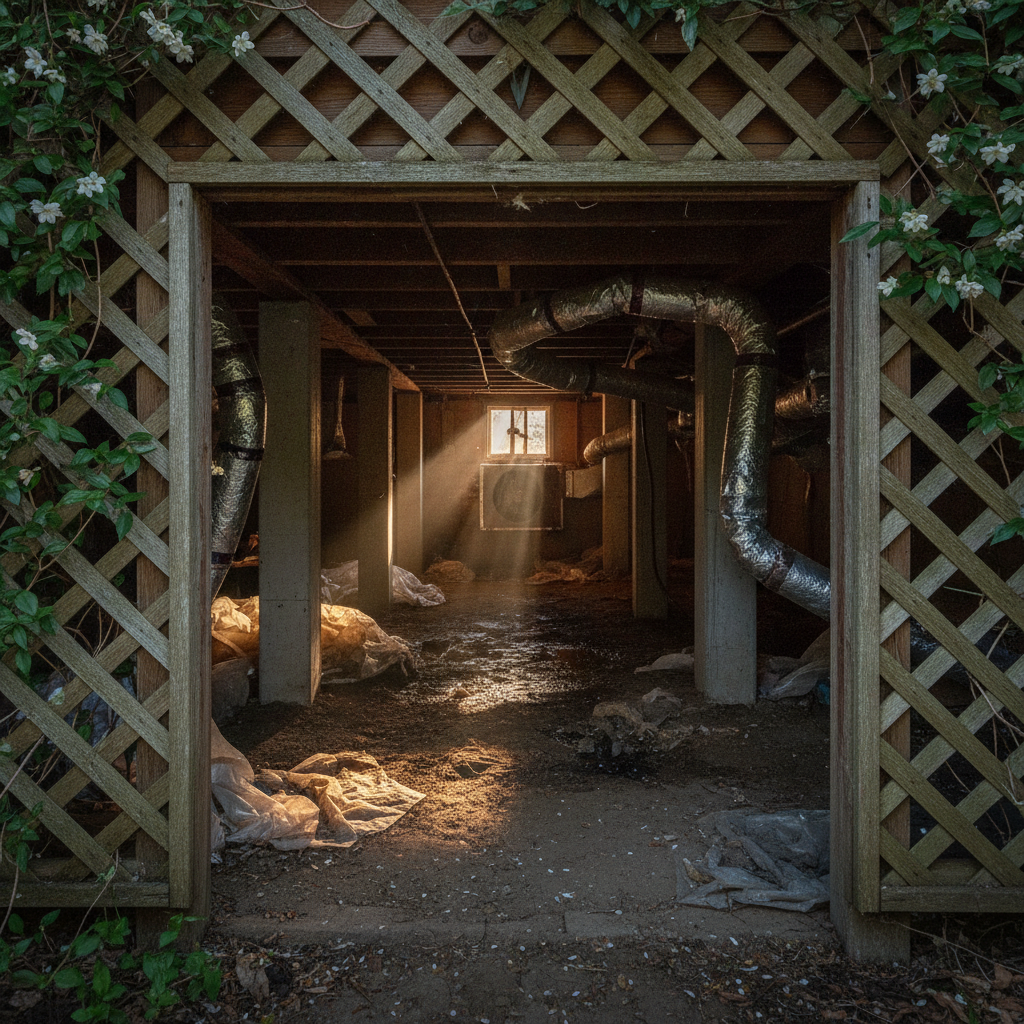
What Healdsburg and North Sonoma County Homeowners Should Know About HVAC and Crawl Space Ventilation — Why What’s Under Your House Affects the Air You Breathe
If your Healdsburg home sits over a crawl space — and many homes in north Sonoma County do — the condition of that space has more to do with your comfort and air quality than most homeowners realize. Moisture, stagnant air, mold, and deteriorating ductwork under your floor don’t stay under your floor. They work their way into your living space, undermine your heating and cooling system’s efficiency, and in some cases make the air inside your home measurably worse. It’s a topic that most HVAC companies gloss over or ignore entirely, but it’s one that comes up regularly when we’re working on older homes across north Sonoma County.
Why Crawl Spaces Are a Real HVAC Issue — Not Just a Pest or Contractor Problem
A lot of homeowners think of their crawl space as someone else’s problem — a plumber’s domain, or something a pest control company handles. But if your ductwork runs through your crawl space, which is common in homes built before the 1980s throughout Healdsburg, Windsor, and the surrounding area, then your HVAC system is directly exposed to whatever environment exists down there.
Here’s what that actually means in practice:
- Moisture and seasonal humidity cause flexible duct connections to sag, disconnect, or develop small gaps over time. When that happens, you’re conditioning air that never reaches your living space — it’s being dumped under your floor.
- Mold and mildew that establish themselves in a damp crawl space can be pulled directly into your air distribution system and circulated through your home. This is especially relevant in the wet winter months that characterize Sonoma County’s Mediterranean climate.
- Rodent damage to insulation and ductwork is a known issue in rural north Sonoma County properties. Chewed insulation and punctured flex duct significantly reduce system efficiency and can introduce contaminants into the airstream.
- Temperature extremes in an uninsulated crawl space mean your duct system is working against itself — heated or cooled air loses a significant portion of its energy before it ever reaches a register, driving up your PG&E bill without any improvement in comfort.
What “Crawl Space Ventilation” Actually Means — and Why There’s More Than One Answer
This is where it gets a little complicated, and it’s worth understanding before you call anyone to fix it. There are two distinct approaches to crawl space ventilation, and they’re not interchangeable.
Traditional Vented Crawl Spaces
Older building codes in California required crawl spaces to have foundation vents — screened openings that allow outside air to circulate underneath the home. The theory was that airflow would carry away moisture before it could cause damage. In some climates and home configurations, this works reasonably well. In Sonoma County, where winter brings significant moisture and some properties sit in low-lying areas near creeks or have clay-heavy soil, it often doesn’t. Outside air flowing in during wet months can actually bring more moisture in than it removes, leading to condensation, wood rot, and mold growth.
Encapsulated (Sealed) Crawl Spaces
The alternative — now increasingly preferred by building scientists and required by newer California building standards in certain applications — is to seal the crawl space entirely with a vapor barrier on the ground and insulated walls, essentially treating it as a semi-conditioned space. This approach keeps outdoor humidity out, protects ductwork, and dramatically reduces the load on your HVAC system. Some encapsulated crawl spaces also incorporate a dedicated exhaust fan or a small mechanical ventilation system to maintain air quality and slight negative pressure.
Which approach is right for your home depends on its age, foundation type, local soil conditions, and how your HVAC system is configured. This is a conversation worth having with someone who has actually been under homes like yours in north Sonoma County — not a national website offering a one-size-fits-all answer.
The HVAC Efficiency Piece: What You’re Losing Without Knowing It
One of the most common situations we see in older homes in Healdsburg and the surrounding area is a homeowner who’s frustrated that their heating or cooling bill seems high relative to how comfortable their home actually feels. They’ve replaced filters regularly, maybe even had a tune-up recently, but something still feels off. Often, when we get under the house, the answer becomes clear within minutes.
Disconnected or poorly sealed duct joints, flex duct that has collapsed in a section, or duct insulation that’s fallen away and is sitting on the ground — these are not rare findings. They’re routine in homes where the crawl space hasn’t been inspected in years. A system that’s nominally working fine at the air handler may be delivering 70% or less of its conditioned air to the living space, with the rest going straight into the crawl space.
If your heating and cooling equipment is functioning but your home still doesn’t feel right, a ventilation and ductwork inspection that includes the crawl space is often the missing piece. It’s not glamorous work, but it’s some of the highest-impact work we do for homeowners in this area.
Wildfire Smoke and the Crawl Space Connection
Sonoma County residents who’ve lived through wildfire smoke seasons know how much air quality can deteriorate in a matter of hours. What’s less commonly understood is that a leaky or poorly sealed crawl space can act as a pathway for smoke and particulate matter to enter the home — bypassing your HVAC filter entirely. Gaps around duct penetrations, unsealed foundation openings, and deteriorated vapor barriers all create routes for outdoor air to migrate in without going through any filtration system.
During active smoke events, homes with well-maintained crawl spaces and properly sealed ductwork consistently perform better at keeping indoor air cleaner than homes where that groundwork hasn’t been done. If you’re investing in air filtration or purification upgrades — which many Sonoma County homeowners are, for good reason — it makes sense to also address the pathways that bypass those systems altogether.
What to Expect From a Crawl Space and HVAC Assessment
If you’re calling a contractor specifically to evaluate your crawl space in the context of your HVAC system, here’s what a thorough assessment should include:
- A physical inspection of all accessible ductwork — checking for disconnected joints, damaged insulation, and improper support
- Evaluation of existing foundation vents and vapor barrier condition
- A look at standing water, moisture staining, or active mold growth
- Assessment of whether the current configuration (vented vs. sealed) makes sense for the home
- A clear explanation of what they found and what the options are — without pressure to immediately commit to a full encapsulation project if that’s not warranted
Be cautious of any contractor who does a crawl space assessment and immediately tells you that you need a full encapsulation system costing tens of thousands of dollars. Some homes need that. Many just need duct sealing, a new vapor barrier, and some attention to foundation vent screens. A trustworthy contractor will tell you what’s actually necessary.
At Stout’s Heating & AC, Inc., we’ve been working under homes across Sonoma County since 1992. We’ll tell you what we find, explain what it means for your comfort and your system, and give you honest options — whether that’s a straightforward duct repair or a more involved ventilation improvement. You can learn more about our services in the Healdsburg area or reach out directly to schedule an assessment.
Frequently Asked Questions
Does my HVAC contractor handle crawl space work, or do I need a separate company?
It depends on the scope. An HVAC contractor should absolutely be the one evaluating and repairing your ductwork, duct insulation, and any ventilation components in the crawl space. Vapor barrier installation and full encapsulation sometimes overlap with general contractors or specialized crawl space companies. A good HVAC contractor will be honest about where their scope ends and who else you might need to involve.
How do I know if my crawl space is causing my HVAC to underperform?
Some signs include rooms that are consistently harder to heat or cool than others, unexplained spikes in energy bills, musty odors in the home (especially near the floor), or visible gaps around floor registers. A ductwork pressure test, sometimes called a duct blaster test, can quantify how much air your system is losing before it reaches the living space.
Is crawl space encapsulation worth the cost in Sonoma County?
For homes with significant moisture problems, damaged ductwork, or recurring mold issues, it often pays for itself over time through reduced HVAC operating costs and avoided repairs. For homes with a reasonably dry crawl space and intact vapor barrier, simpler improvements may be all that’s needed. There’s no universal answer — it depends on your specific home.
Can a bad crawl space affect my indoor air quality even if my furnace filter is clean?
Yes. Air can enter your living space through gaps in the floor, around duct penetrations, and through leaky return air ducts in the crawl space, all without passing through your filter. This is one of the reasons indoor air quality improvements sometimes need to address the building envelope, not just the HVAC equipment.
How often should crawl space ductwork be inspected?
Every three to five years is a reasonable interval for most homes, more frequently if you’ve had pest activity, flooding, or if the home is older with original flex duct. It’s also worth a look any time you notice a sudden change in HVAC performance or energy use that doesn’t have an obvious explanation.
Ready to Find Out What’s Actually Going On Under Your House?
If you’ve been wondering why your home doesn’t quite heat or cool the way it should — or if you’ve never had your crawl space and ductwork properly evaluated — we’re happy to take a look. Stout’s Heating & AC, Inc. has been serving homeowners in Healdsburg, Santa Rosa, Windsor, Cloverdale, and throughout Sonoma County for more than 30 years. We know what older homes in this area need, and we’ll give you a straight answer about what we find.
Request a free estimate or call us at (707) 527-1504 to schedule an assessment. No pressure, no upsell — just an honest look at what your home’s HVAC system actually needs.