
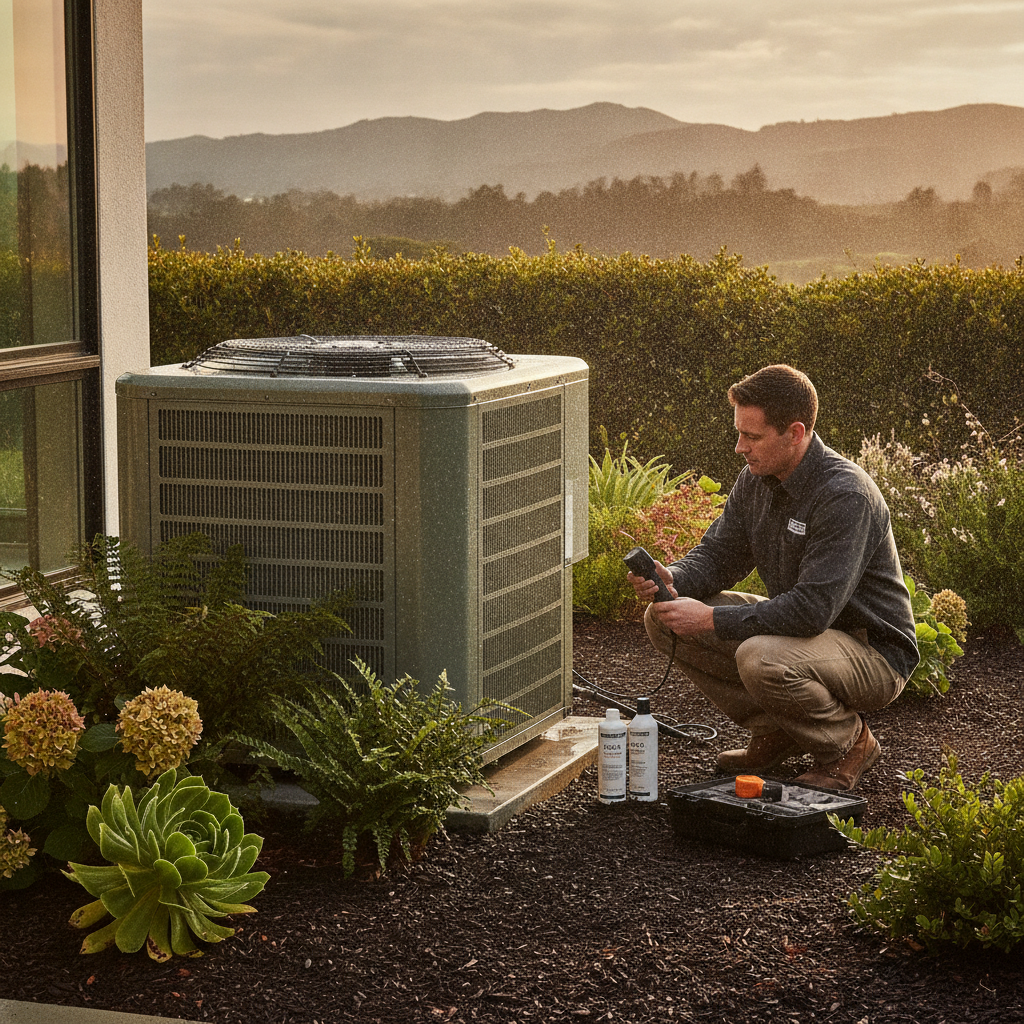
What Guerneville and West County Homeowners Should Know About HVAC and High Humidity — How Coastal Air and River Fog Are Affecting Your System Year-Round
If you live in Guerneville, Forestville, Occidental, or along the Sonoma Coast near Bodega Bay, your home exists in a genuinely different climate than the one most HVAC contractors plan around. The Russian River corridor stays noticeably cooler and damper than Santa Rosa — sometimes by 15 degrees in summer — and the marine layer that pushes inland through the coastal gaps doesn’t just make for pleasant mornings. It also means your heating and cooling system is operating in persistently high relative humidity for much of the year. That changes everything from how efficiently your equipment runs to what’s quietly growing inside your ductwork.
Most HVAC content online treats California as one big warm, dry place and designs advice around that assumption. If you’re in West Sonoma County, that’s not your reality — and equipment or maintenance practices designed for inland Sonoma don’t always translate directly to your situation.
Why High Humidity Is Harder on HVAC Systems Than Most People Realize
HVAC systems aren’t just about temperature. They move air, and the air they move carries moisture. In a dry inland climate like Rohnert Park or Windsor on a summer afternoon, that moisture load is fairly predictable. In Guerneville in June, July, or November, it’s a different conversation.
When ambient humidity is high, a few things happen to your system:
- Your AC’s evaporator coil works harder. Air conditioning removes heat and moisture simultaneously. In humid conditions, the system is constantly shedding water vapor in addition to heat — which is exactly what it should do, but it means the system runs longer and works harder to achieve the same thermostat setpoint.
- Drain lines become a problem faster. The condensate drain that carries moisture away from your evaporator coil can develop algae, mold, or blockages more quickly when the system is pulling large volumes of water out of the air. A clogged drain line can back up and damage your equipment or cause water intrusion into your home.
- Coils and internal components stay damp longer. When humidity is high and the system cycles off, moisture lingers on internal surfaces. Over time, this contributes to microbial growth inside the air handler — something you absolutely do not want circulating through your house.
- Ducts in unconditioned spaces absorb ambient moisture. If your ductwork runs through a crawl space, attic, or uninsulated wall cavity that’s exposed to West County air, the outer surface of those ducts can collect condensation. That moisture can degrade duct insulation, promote mold growth on the duct exterior, and in some cases seep inside through leaky seams.
The Gap That Most HVAC Contractors Don’t Address in Humid Microclimates
Here’s something worth knowing: most standard HVAC maintenance checklists — the same ones used from Petaluma to Cloverdale — don’t specifically account for the conditions that homes near the Russian River or the Sonoma Coast face. Drain line inspection gets checked off, coil cleaning gets done, and that’s often the end of it. But there’s a broader set of questions that actually matter in your climate:
- Is the system actually pulling enough moisture out of the air, or are indoor humidity levels staying elevated even when the AC is running?
- Is there any visible mold or biological growth on or near the air handler, return air grilles, or duct boots?
- Are supply registers showing any signs of condensation on the outside surface — which would indicate the air coming through is colder than the ambient air at the register location?
- Is the ductwork in unconditioned spaces insulated adequately to prevent exterior condensation?
These aren’t exotic questions. They’re just not the ones that standard service templates prompt a technician to ask in a drier climate. When we work in West County homes, they’re part of the conversation.
Ductless Mini-Splits Deserve a Second Look in West County Homes
Many older homes in Guerneville, Occidental, and Forestville were built without central duct systems — or with ductwork that’s aged to the point where sealing and insulating it isn’t practical. If you’re in that situation, a ductless heat pump system deserves serious consideration, and not just for the usual reasons.
In a humid coastal environment, eliminating ducts in unconditioned spaces also eliminates one of the main pathways through which moisture enters your HVAC system and your living space. A ductless system handles conditioning at the room level — the air handler is inside the conditioned envelope, the refrigerant lines to the outdoor unit are sealed, and there’s no ductwork sitting in a damp crawl space collecting moisture.
Brands like Mitsubishi Electric, Fujitsu, and Daikin make equipment specifically designed to operate efficiently across a wide temperature and humidity range, which makes them well-suited to the conditions along the Sonoma Coast corridor. They also offer zone-by-zone humidity sensing in higher-end models, which can be a real quality-of-life improvement in a home that’s fighting persistent dampness.
What to Do When Your AC Runs But the House Still Feels Damp
This is one of the most common complaints we hear from homeowners in the Guerneville area and from people in coastal Sebastopol: “The AC is on, the thermostat shows the right temperature, but it still feels clammy.” That’s a humidity problem, not a temperature problem — and they’re not the same fix.
A few things can cause this:
- An oversized system. This one surprises people. If your AC is too large for the space, it cools the air to setpoint temperature very quickly and shuts off — but doesn’t run long enough to properly dehumidify. This is called short-cycling, and it’s a common consequence of imprecise equipment sizing. The house hits 70°F in 10 minutes and the system turns off, but the air still holds a lot of moisture.
- Running the fan on “on” instead of “auto.” When the fan runs continuously, it blows air across the still-damp evaporator coil between cooling cycles, re-evaporating the moisture the system just removed. Setting your thermostat fan to “auto” so it only runs when actively cooling makes a noticeable difference in humid conditions.
- A standalone dehumidifier may be the right answer. In truly persistent humidity situations — especially in older homes with less-than-ideal building envelopes — a whole-house dehumidifier integrated into your HVAC system can do what your AC alone cannot. These units run independently of the cooling cycle and maintain a target relative humidity level regardless of whether you’re heating, cooling, or doing neither.
If your indoor humidity is regularly sitting above 60% relative humidity, that’s the threshold where mold and dust mite populations grow significantly — and where the air starts feeling uncomfortable even at a reasonable temperature. It’s worth addressing directly rather than hoping the AC handles it on its own. Our residential ventilation services include assessments of your home’s overall moisture management, not just airflow.
Maintenance Timing Matters More in West County
We recommend bi-annual tune-ups for most Sonoma County homeowners — once in spring before cooling season and once in fall before heating season. For homes in Guerneville, Forestville, Bodega Bay, and similar areas, the fall visit is particularly important. Going into the wet season with a drain line that’s partially obstructed, a coil that hasn’t been cleaned in a year, or a filter that’s been collecting moisture-laden air all summer is a setup for problems during the months when you’re least likely to notice them.
Our current tune-up special is available on the HVAC offers page — it’s a straightforward way to get eyes on your system before the rainy season kicks in.
Frequently Asked Questions
Does the fog and marine layer near the Sonoma Coast actually affect my heating system, or just AC?
Both. High ambient moisture affects heating systems too — particularly the air handlers, filters, and ductwork that all systems share regardless of whether they’re in cooling or heating mode. Gas furnaces with aging heat exchangers can also show accelerated corrosion in persistently damp environments.
How do I know if I have mold growing inside my HVAC system?
The clearest sign is a musty smell when the system first turns on — especially after it’s been off for a day or more. Visible dark staining around supply registers or on the return air grille is another indicator. If you suspect it, don’t ignore it. Mold in ductwork circulates through your living space every time the system runs.
Is a whole-house dehumidifier worth the cost for a West County home?
For homes that consistently struggle with indoor humidity — particularly older homes with crawl spaces, single-pane windows, or minimal insulation — yes, it typically is. It’s a targeted solution to a specific problem, and it protects both your health and your HVAC equipment over the long run.
Can a heat pump handle the cooler, damper summers near the Russian River?
Yes. Modern heat pumps are significantly more capable in cool, humid conditions than older equipment was. High-efficiency models from manufacturers like Mitsubishi and Daikin are rated to operate effectively even when outdoor temperatures drop into the low 40s — which is well within the range of a cool Guerneville summer night.
How often should I replace my HVAC filter if I live in a high-humidity area?
More often than the packaging suggests. In a damp environment, filters accumulate moisture in addition to particulates, which can reduce airflow and become a growth medium for mold and bacteria. Check it monthly and replace it every 4–6 weeks during heavy-use periods rather than waiting for the standard 90-day interval.
Ready to Talk About What Your Home Actually Needs?
Stout’s Heating & AC has been working in Sonoma County homes since 1992 — including out in West County where the climate does its own thing. If your system feels like it’s working too hard, your home feels damper than it should, or you’re just not sure your HVAC setup is right for where you live, we’re glad to take a look. No pressure, no upsell scripts — just honest assessment from people who know this area. Contact us to schedule a visit or ask a question. We’re based in Santa Rosa and serve the full Russian River corridor and Sonoma Coast.