
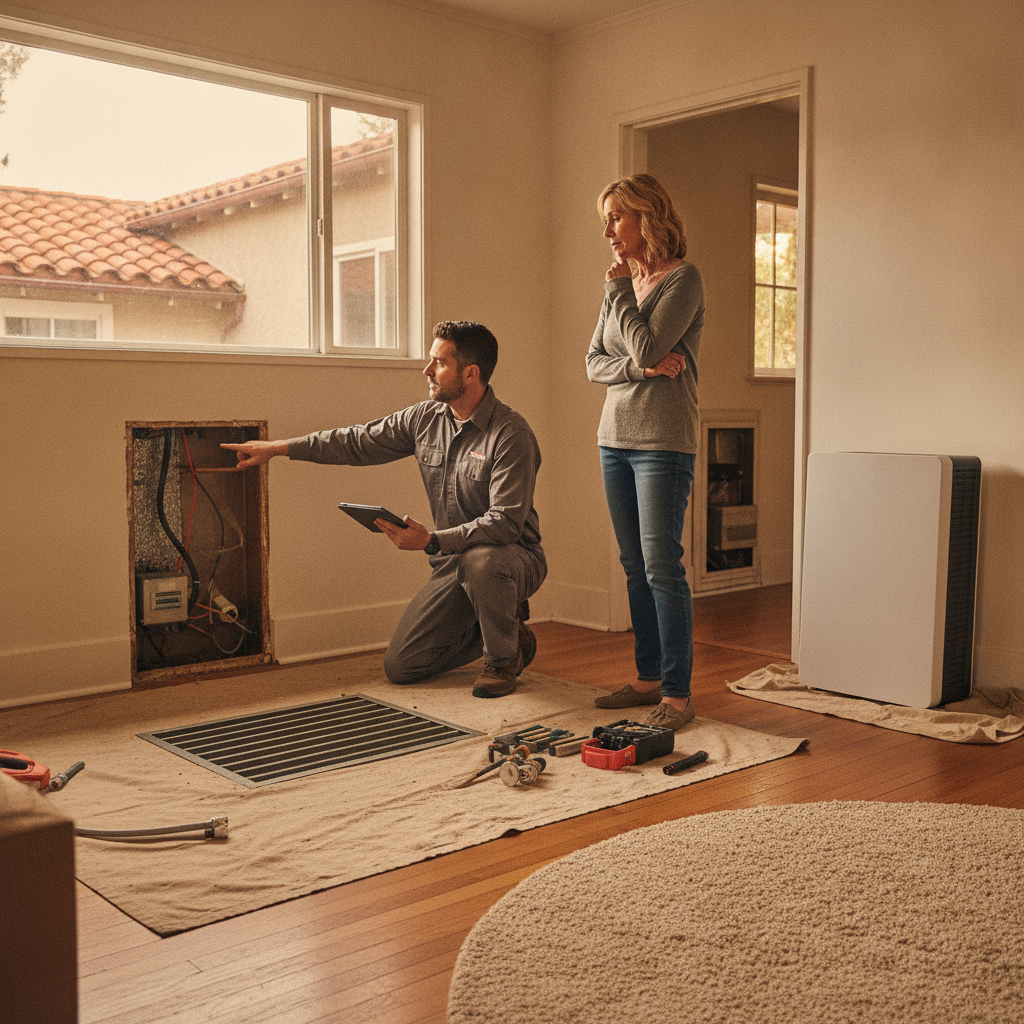
What Forestville and West Sonoma County Homeowners Should Know About Replacing a Wall Furnace or Floor Furnace — and What to Put There Instead
If your home in Forestville, Guerneville, or Occidental still has a wall furnace or a floor furnace as its primary heat source, you’re not alone — and when that system finally stops working, most homeowners are surprised to discover they can’t simply order a new one and call it done. Replacing a wall furnace or floor furnace is more complicated than it looks, and the right solution depends on your home’s layout, age, and how you actually use the space. Here’s what you should know before you make any decisions.
Why Wall Furnaces and Floor Furnaces Are Still So Common in West Sonoma County
The Russian River corridor — Forestville, Guerneville, Monte Rio, and Occidental — has a lot of older housing stock. Many of these homes were built as vacation cabins decades ago and later converted to year-round living. Others are genuine mid-century homes that were never retrofitted with ductwork because it wasn’t required and wasn’t cheap.
Wall furnaces (the kind mounted into an interior wall with a gas valve and a grille facing the room) and floor furnaces (recessed into the subfloor, usually under a metal grate in a hallway or main room) were the practical solution for single-story homes without basements or attic space for duct runs. They heated the immediate area reasonably well, they required no ductwork, and for a small cabin or bungalow, that was enough.
The problem is that most of these units are now 20, 30, or even 40-plus years old. Parts are increasingly hard to find. And when they finally fail — a cracked heat exchanger, a faulty thermocouple, a gas valve that sticks — the repair conversation quickly turns into a replacement conversation.
Can You Just Replace a Wall Furnace With a New Wall Furnace?
Sometimes, yes — but it’s getting harder and less practical than it used to be. A handful of manufacturers still produce natural gas wall furnaces, and if your existing unit is properly vented and in an approved location, a direct replacement may be possible. But there are several things that complicate this path:
- Venting requirements have changed. Older wall furnaces often used unvented or gravity-vented configurations that don’t meet current California codes. A new unit may require a dedicated flue or sealed combustion setup that didn’t exist before.
- BTU sizing has evolved. Older units were often oversized for the space. A direct swap might mean installing something that short-cycles or wastes gas.
- Floor furnaces are even more limited. The selection of new floor furnace units is extremely narrow. In many cases, the cavity and flue arrangement from the original installation can’t accommodate a modern replacement, and the opening needs significant modification.
- Gas line work may be required. If the line serving your old unit doesn’t meet current pressure and sizing requirements, that’s an additional cost before anything else gets done.
None of this means a replacement wall furnace is off the table. It means you need a realistic conversation with a contractor who will assess your actual setup — not just quote you a new unit over the phone.
The Better Question: What Should You Put There Instead?
For most West Sonoma County homeowners replacing an aging wall or floor furnace, this is the more productive question. The honest answer depends on a few factors: How large is the space you’re heating? Do you also want cooling? Is there any possibility of adding ductwork? And what’s your long-term plan for the property?
Option 1: Ductless Mini-Split Heat Pump
For a lot of older homes in Forestville and Occidental, a ductless mini-split heat pump is the most practical modern replacement. These systems mount a small indoor air handler on the wall or ceiling, connected by a refrigerant line to a compact outdoor unit. No ductwork required. They heat and cool from the same unit, which addresses the fact that many older cabins and bungalows also have no air conditioning at all.
In Sonoma County’s moderate coastal climate, a heat pump operates efficiently throughout the year. The winters in Forestville are cool and damp but rarely extreme enough to overwhelm a properly sized heat pump. Brands like Mitsubishi Electric, Daikin, and Fujitsu offer systems designed for high-humidity environments — which matters along the Russian River, where moisture in the air during winter months can be significant.
A single-zone mini-split is well-suited to the open-plan layout common in older converted cabins. If you have multiple rooms that need conditioning, a multi-zone system can serve several areas from one outdoor unit — without touching the walls where your old furnace used to live.
Option 2: Direct-Vent Wall Heater (Gas)
If you want to stay with gas heat and your home doesn’t need cooling, a modern direct-vent wall heater is a cleaner, safer option than older unvented or gravity-vented wall furnaces. These units pull combustion air from outside through a sealed pipe and exhaust directly through the same assembly — no chimney required, no risk of back-drafting combustion gases into the living space. They’re more efficient than their predecessors and work well in small to mid-size spaces.
This isn’t the solution for everyone, and it doesn’t solve the cooling problem. But for a small, well-insulated guest cottage or a property where gas is already on-site and electric costs are a concern, it’s worth discussing.
Option 3: Central Forced-Air System (When the Home Warrants It)
If your home has been substantially renovated, expanded, or is large enough that a wall furnace was always a compromise rather than a real solution, it might finally be time to talk about a central system. Adding ductwork to an existing home isn’t cheap — it involves running supply and return lines through walls, floors, or an attic — but it may make sense if you’re already doing a significant renovation or if you plan to stay in the property long-term.
In that case, a gas furnace paired with a central air conditioner, or a ducted heat pump, gives you whole-home comfort in a way that a wall unit never could. This is a longer conversation, but one worth having with someone who will actually assess your home — not just give you a ballpark over email.
What This Costs and How Long It Takes
Replacement timelines and costs vary based on the solution, but here’s a general framework to help you plan:
- Wall furnace direct replacement: Typically a one-day job if the venting situation is straightforward. Parts availability is the bigger variable.
- Single-zone ductless mini-split: Usually completed in one day. Requires a small refrigerant line penetration through an exterior wall and a dedicated electrical circuit.
- Multi-zone ductless system: One to two days depending on the number of zones and routing complexity.
- Central system with new ductwork: Typically several days of installation, with additional time if permits or inspections are required.
California and PG&E offer rebates on qualifying heat pump systems, and federal tax credits are available for high-efficiency installations. If you’re replacing an old gas wall furnace with an electric heat pump, those incentives can meaningfully reduce your out-of-pocket cost. Visit our current offers and financing page to see what’s available right now.
A Note on Safety: Don’t Ignore the Warning Signs
If your wall furnace or floor furnace is producing a yellow or orange flame instead of blue, making unusual sounds, or producing any smell of combustion in the room — stop using it and call a technician. These are signs of incomplete combustion or a venting problem, both of which can lead to carbon monoxide accumulation. This is especially important in older homes where combustion appliances may not have been serviced in years. Don’t wait on this one.
Why Local Experience Matters Here
The homes along the Russian River corridor are different from the newer subdivisions in Rohnert Park or Santa Rosa’s east side. Slab foundations, tight crawl spaces, post-and-beam construction, and non-standard wall framing all affect what’s possible and what isn’t. A contractor who mostly works on newer tract homes may look at your Forestville bungalow and default to a solution that doesn’t fit the space — or they may underestimate the complexity of the job and leave you with a system that was never properly sized.
We’ve been working on homes throughout Sonoma County since 1992, including a lot of older properties along the Highway 116 corridor and deeper into the hills toward Occidental and Sebastopol. We know the building stock, we know what permits look like in unincorporated Sonoma County, and we’re not going to oversell you a system you don’t need.
If you want to talk through your heating situation — whether your wall furnace just stopped working or you’ve been thinking about upgrading for a while — we’re glad to come out and take a look. No pressure, no upsell, just an honest conversation about what your home actually needs.
Frequently Asked Questions
Are floor furnaces still legal in California?
Existing floor furnaces aren’t automatically illegal, but installing a new floor furnace is increasingly difficult due to current California building and mechanical codes. If yours fails, you’ll likely be looking at an alternative solution rather than a like-for-like replacement.
Can a ductless mini-split handle Forestville winters?
Yes. The winters along the Russian River corridor are cool and damp but rarely drop to temperatures that challenge a modern heat pump. Many current mini-split models operate efficiently at temperatures well below freezing, which is more than adequate for West Sonoma County conditions.
Do I need a permit to replace a wall furnace in unincorporated Sonoma County?
Usually yes — replacing a gas appliance typically requires a mechanical permit and inspection. Requirements vary depending on whether you’re doing a straight swap or changing the system type. We handle the permit process for our customers so you don’t have to figure it out on your own.
Will I qualify for rebates if I switch from a gas wall furnace to an electric heat pump?
Likely yes. California’s TECH Clean California program and PG&E’s rebate offerings both support heat pump installations, including ductless mini-splits. Federal tax credits are also available for qualifying high-efficiency systems through the Inflation Reduction Act. The actual amounts depend on equipment efficiency ratings and your tax situation — we can walk you through what applies to your project.
How do I know if my wall furnace is worth repairing versus replacing?
If the unit is more than 15–20 years old and the repair cost is more than a third of what a replacement would run, replacement is usually the smarter financial call. If parts aren’t readily available or the unit lacks a safety shutoff, that tips the balance even further toward replacement. A technician can give you a straight answer after looking at the unit.
Ready to Talk Through Your Options?
If you’re dealing with a failing wall furnace or floor furnace in Forestville, Guerneville, Occidental, or anywhere in West Sonoma County, we’re here to help you figure out what makes sense — not just what’s easiest to sell. Reach out to Stout’s Heating & AC, Inc to schedule a visit or ask a question. We’ll come out, look at your setup, and give you honest options. That’s been our approach since 1992, and it’s not changing.