
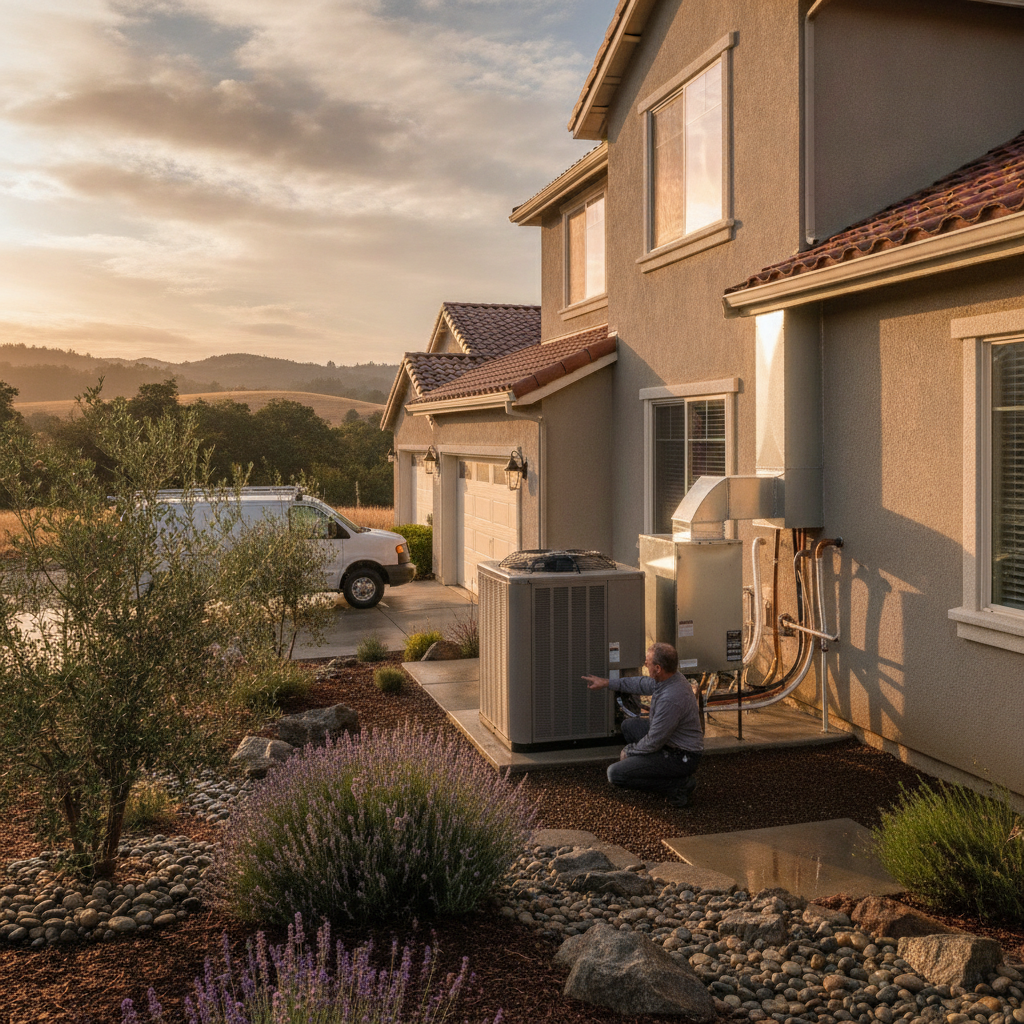
What Petaluma and Sonoma County Homeowners Should Know About Dual Fuel HVAC Systems — How Pairing a Heat Pump With a Gas Furnace Can Save Money Without Sacrificing Comfort
A dual fuel system — also called a heat pump hybrid system — pairs an electric heat pump with a gas furnace in a single, coordinated setup. The system automatically switches between the two depending on which one is more efficient at the current outdoor temperature and energy costs. If you’re a homeowner in Petaluma, Santa Rosa, or anywhere across Sonoma County who’s been weighing the move from a straight gas furnace toward something more efficient but doesn’t want to give up backup heat on the coldest nights, this configuration is worth understanding in real detail — not just the marketing version of it.
How a Dual Fuel System Actually Works
The core idea is simple, even if the engineering behind it is not. A heat pump moves heat rather than generating it — in winter, it pulls warmth from the outdoor air and brings it inside. This process is significantly more efficient than burning gas, as long as outdoor temperatures stay above a certain threshold. Once temperatures drop low enough that the heat pump struggles to extract enough heat efficiently, the gas furnace takes over automatically.
That switchover point is called the balance point, and it’s one of the most important settings in a dual fuel installation. Set it too high and you’re burning gas when the heat pump could still handle the load. Set it too low and you’re running an inefficient heat pump in conditions where gas would have been cheaper. A properly commissioned dual fuel system has this balance point dialed in based on your specific equipment, your home’s heat loss characteristics, and local utility rates.
This is not something to leave to guesswork or a one-size-fits-all setup. It requires a technician who understands both systems and knows how to program the control logic correctly — which is part of why installation quality matters so much with these setups.
Why Sonoma County’s Climate Makes Dual Fuel Worth Considering
Sonoma County has what’s often described as a Mediterranean climate — warm, dry summers and cool, wet winters. In Petaluma especially, marine influence from San Pablo Bay keeps temperatures moderate for much of the year. That matters because heat pumps are most efficient in exactly this kind of climate: temperatures that rarely drop into the low twenties or below.
Compare that to mountain climates where temps can hit single digits for weeks at a stretch. In those environments, a heat pump alone struggles, and a gas furnace does nearly all the work anyway. Here, the heat pump can carry your heating load efficiently for the majority of the winter. The gas furnace only kicks in on those colder December and January nights when outdoor temps dip into the low thirties or below — which does happen in inland areas like Santa Rosa and Windsor, but not every night and not for weeks on end.
The result: you get heat pump efficiency most of the time and gas backup reliability when you actually need it. That combination tends to lower your annual energy costs compared to running gas heat exclusively, while also avoiding the rare but real situation where an all-electric heat pump is underpowered on a cold night.
The PG&E Cost Equation: Why It’s Not Just About Efficiency
Efficiency alone doesn’t determine your bill. What matters is the cost of the energy source at the moment you’re using it. PG&E electricity rates in Sonoma County have increased significantly in recent years, and time-of-use pricing means electricity can be considerably more expensive during peak hours in the evening. Natural gas pricing fluctuates differently.
A well-configured dual fuel system can account for this. Advanced thermostats and control boards in modern dual fuel setups can factor in utility rate differentials, not just outdoor temperature, when deciding which fuel source to use. This kind of intelligent switching is one of the genuine advantages of the technology — and one more reason the installation and programming matter as much as the equipment itself.
It’s also worth knowing that both California and PG&E offer rebates for qualifying heat pump systems, and federal tax credits under current energy efficiency legislation may apply to the heat pump component of a dual fuel installation. The specifics change, so it’s worth asking about current incentives when you’re getting an estimate. You can see what current offers and financing options are available through Stout’s Heating & AC.
What You Already Have Matters: Existing Furnace Compatibility
One practical question homeowners often ask: can I add a heat pump to my existing furnace and turn it into a dual fuel system? Sometimes yes, sometimes no — and the answer depends on a few things.
Your existing furnace needs to be compatible with the heat pump you’re adding. That means the control board needs to support dual fuel communication, the blower motor needs to be sized for the airflow the heat pump requires, and the furnace itself needs to be in solid enough condition that it makes sense to build around it rather than replace it. If your furnace is fifteen years old with a cracked heat exchanger, it’s not a good anchor for a new hybrid system.
Many homeowners in Rohnert Park, Sebastopol, and older Santa Rosa neighborhoods find that a full replacement — furnace and heat pump together — is the cleaner path, especially when rebates and financing make the upfront cost more manageable. Others with newer furnaces in good shape can often retrofit a heat pump add-on and be in good shape. The only way to know for sure is to have someone look at what you have.
Dual Fuel vs. All-Electric Heat Pump: Which Is Right for Your Home?
This is the question most homeowners in Sonoma County are really asking when they start researching dual fuel. If you have an existing gas line and a home that gets genuinely cold in winter, dual fuel is often the more practical choice. You’re not betting everything on one energy source, and you’re not asking a heat pump to work at maximum output when outdoor temps drop below what it handles well.
If your home is well-insulated, in a milder microclimate, and you’re trying to get completely off natural gas, an all-electric heat pump may make more sense — especially if you’re pairing it with solar. But for the typical Sonoma County home with an existing gas system, dual fuel tends to offer the best balance of efficiency, reliability, and total operating cost. Learn more about how dual fuel systems work and what’s involved in a local installation.
Frequently Asked Questions
How cold does it need to get before the gas furnace kicks in on a dual fuel system?
That depends on your specific equipment and how the system is configured, but in most Sonoma County installations the balance point is set somewhere between 35°F and 40°F. Below that threshold, the furnace typically takes over. Above it, the heat pump handles heating on its own.
Will a dual fuel system work with my existing ductwork?
Usually yes, if your ductwork is in reasonable condition. Heat pumps move a higher volume of air at lower temperatures than gas furnaces, so undersized or leaky ducts can limit performance. A duct inspection is worth doing before installation if you haven’t had one recently.
Are there rebates available for dual fuel systems in Petaluma or Santa Rosa?
Yes — California and PG&E both offer incentives for qualifying heat pump equipment, and federal tax credits may apply to the heat pump component. The specific amounts and eligibility rules change, so ask your installer to walk you through what’s currently available before you commit to equipment.
How long does a dual fuel system installation typically take?
For most homes, installation takes one to two days depending on what’s already in place. If you’re adding a heat pump to an existing furnace, it may be closer to one day. A full system replacement takes longer. Your installer should be able to give you a realistic timeline after assessing your home.
Can a dual fuel system also cool my home in summer?
Yes. The heat pump side of a dual fuel system also functions as your air conditioner in summer. You’re essentially getting year-round heating and cooling from one outdoor unit, with the gas furnace available as a heating backup when temperatures drop.
Ready to Find Out If Dual Fuel Makes Sense for Your Home?
Stout’s Heating & AC, Inc has been helping Sonoma County homeowners navigate these decisions since 1992. We’re not going to push you toward a system that doesn’t fit your home, your budget, or your actual winter temperatures. If a dual fuel setup makes sense, we’ll tell you why and show you the numbers. If something else serves you better, we’ll tell you that too.
Give us a call at (707) 527-1504, email us at help@stoutshvac.com, or request a free estimate online. We serve Petaluma, Santa Rosa, Rohnert Park, Sebastopol, Windsor, and the surrounding Sonoma County area — and we’re available for same-day service when you need it.