
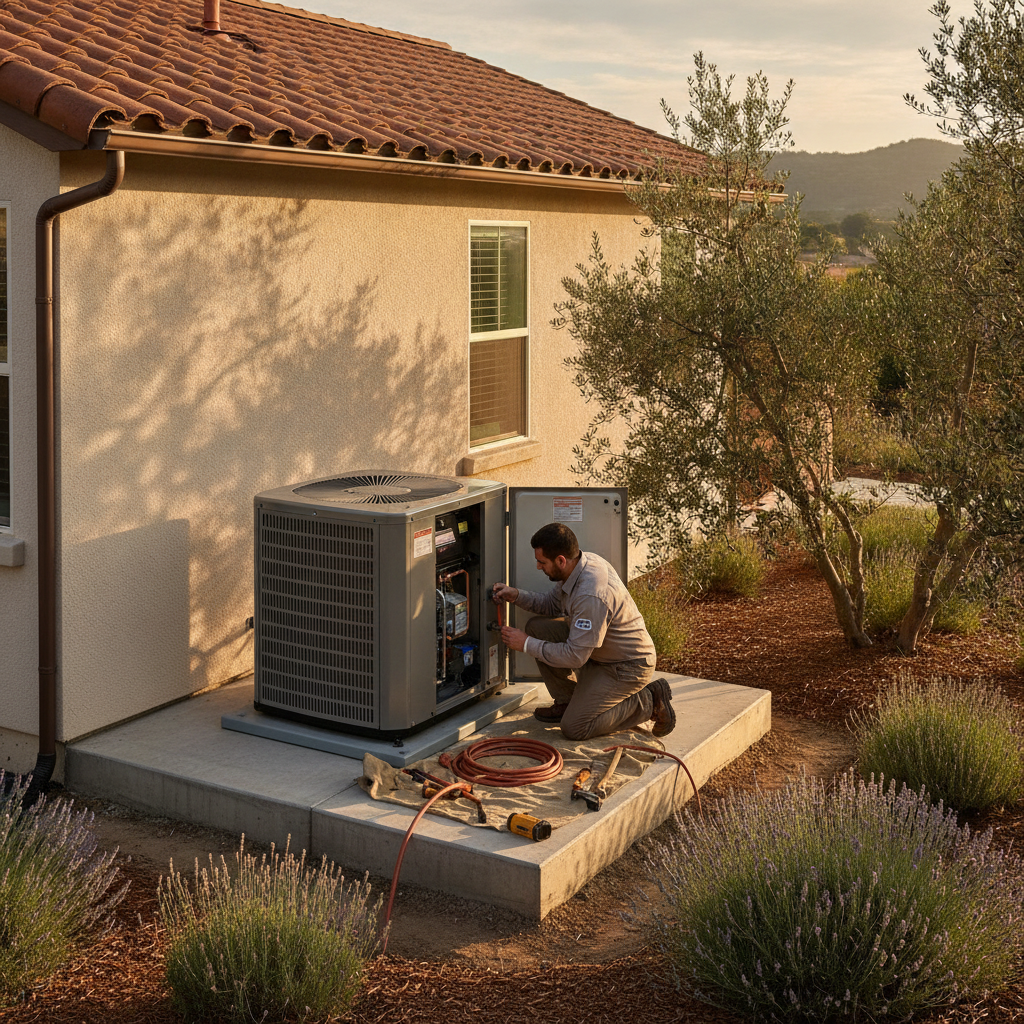
What Cotati and Rohnert Park Homeowners Should Know About HVAC and Slab Foundations — Why Your Heating and Cooling Setup Is Different From Most Homes
If your home in Cotati or Rohnert Park sits on a concrete slab — which describes a large share of the post-war and mid-century tract homes throughout this part of Sonoma County — your heating and cooling system operates under a different set of constraints than homes built over a crawl space or basement. That difference matters when something breaks, when you’re thinking about upgrading your system, or when you’re trying to figure out why your floors feel cold in January or certain rooms never seem to cool down in August. The short answer is that slab homes require more thought and more options on the table. Here’s what you need to know.
Why Slab Foundations Complicate HVAC Work
In a home built on a raised foundation, ductwork typically runs through a crawl space beneath the floor or through an attic above. Either way, a technician can access it without major disruption. In a slab-on-grade home, original ductwork was often embedded directly in or beneath the concrete during construction. That was a common practice through the 1970s, and it made sense at the time — but it creates real problems decades later.
Ducts buried in concrete are exposed to moisture from the ground, soil shifting, and the natural settling of the slab over time. Over the years, those ducts can corrode from the inside, collapse partially, or develop cracks that pull conditioned air into the ground instead of into your rooms. The result is a system that runs constantly, costs more to operate, and still doesn’t keep you comfortable. In some cases, air flowing through degraded underground ducts also picks up soil gases, mold spores, and other contaminants — which is a separate concern worth taking seriously.
What makes this tricky is that the problem often develops gradually. Your system doesn’t fail overnight. You just start noticing that your PG&E bills are creeping up, that the back bedroom never gets warm, or that your furnace seems to run for unusually long cycles. By the time most homeowners in Rohnert Park or Cotati connect those symptoms to slab ductwork, the ducts have often been degraded for years.
What Happens When You Need HVAC Work on a Slab Home
This is the part that catches most homeowners off guard: accessing or replacing buried ductwork is genuinely difficult and disruptive work. Depending on the condition and layout, a contractor may need to break into the concrete to reach damaged sections — which involves cutting or jackhammering the slab, making repairs, and then patching everything back. That’s expensive, messy, and time-consuming. It’s not always the wrong call, but it shouldn’t be the default answer either.
A good HVAC contractor — one with real experience in Sonoma County’s housing stock — will look at the whole picture before recommending that route. There are several alternatives worth understanding before anyone starts swinging a jackhammer.
Option 1: Reroute Ductwork Through the Attic
In many slab homes, the most practical long-term solution is to abandon the buried ductwork entirely and install a new duct system through the attic. This gives you clean, accessible ductwork that can be properly insulated, sealed, and maintained. The upfront cost is higher than a simple repair, but it solves the underlying problem instead of patching a failing system. It also gives you a better-performing distribution network than most slab duct systems ever had to begin with.
This approach works well in single-story homes with accessible attic space — which covers a lot of the ranch-style homes in Cotati and the older sections of Rohnert Park. It requires careful equipment sizing and duct design, but the results are worth it when done right.
Option 2: Ductless Mini-Splits
For homes where attic rerouting isn’t practical — or where you’re only trying to solve a comfort problem in one or two rooms — ductless mini-split systems are often the cleanest solution. These systems require no ductwork at all. An outdoor unit connects to one or more indoor air handlers mounted on interior walls or ceilings, delivering heating and cooling directly to each room without relying on a distribution system buried in concrete.
Mini-splits have become increasingly popular in Sonoma County homes over the past decade, and for slab homes in particular, they sidestep the ductwork problem entirely. Modern systems from brands like Mitsubishi Electric, Daikin, and Fujitsu are highly efficient, quiet, and capable of both heating and cooling — which makes them a practical year-round solution in a climate like ours. If you’re dealing with a slab home that has one problematic zone or a room addition without ductwork, a mini-split is often the most cost-effective path forward.
Option 3: Heat Pumps With New Attic Ductwork
If you’re already planning a larger system replacement, combining a new attic duct system with a heat pump installation makes a lot of sense for slab homes in the Rohnert Park and Cotati area. Heat pumps handle both heating and cooling from a single outdoor unit, so you’re replacing your old furnace and central air conditioner at the same time you’re solving the ductwork problem. California’s current rebate landscape — including PG&E incentives and federal tax credits — can offset a meaningful portion of that investment, which makes the timing better than it’s been in years.
The Issue Most Local HVAC Contractors Don’t Address Upfront
Here’s something worth knowing: a lot of HVAC companies will come out, diagnose a comfort problem, and recommend a straightforward equipment replacement without ever discussing the state of your buried ductwork. A new furnace or air conditioner connected to a degraded slab duct system will underperform from day one. You’ll spend money on new equipment and still have the same problems — or worse, because a more powerful system will pull harder on failing ducts.
Before any equipment goes in, a qualified contractor should evaluate your existing ductwork. For slab homes, that means asking directly: are these ducts accessible, what condition are they in, and what are the options if they’re failing? If a contractor you’re talking to doesn’t raise this question on their own, it’s worth raising yourself. An honest assessment upfront saves a lot of frustration later.
At Stout’s, we’ve been working on HVAC systems throughout Sonoma County since 1992, and slab homes are a regular part of what we see — especially in Rohnert Park, Cotati, and parts of Petaluma. We’re not going to sell you a new system and ignore what the air has to travel through to reach your rooms. That’s just not how we operate.
If you’re dealing with a heating problem in a slab home and not sure what’s actually causing it, that diagnostic conversation is exactly where we’d start.
A Note on Radiant Floor Heat in Slab Homes
Some older slab homes — particularly those built in the 1950s and 1960s — were originally heated with radiant systems embedded in the concrete itself. Hot water or electric heating elements run through the slab, warming the floor and radiating heat upward. These systems were common enough in this part of Sonoma County that you may encounter them in older Cotati neighborhoods.
Radiant slab heat is comfortable when it works, but repairs are complicated and expensive when the in-slab elements fail. Many homeowners with aging radiant systems have converted to forced air or ductless systems over the years. If you’re in that situation and trying to figure out what makes sense, that’s a conversation worth having with a contractor who actually understands the options — not just someone who installs one type of system and recommends it regardless of your situation.
Frequently Asked Questions
How do I know if my slab ducts are the problem?
Common signs include rooms that are difficult to heat or cool despite a functioning system, unusually high energy bills, musty or earthy odors coming from vents, and visible corrosion around floor registers. A duct leakage test can quantify how much conditioned air you’re losing before it reaches your living spaces.
Is it worth fixing buried slab ductwork, or should I just replace it?
It depends on the extent of the damage and the layout of your home. Minor leaks in accessible sections can sometimes be sealed. More widespread deterioration usually makes a full reroute through the attic — or a switch to ductless — the better long-term investment. A thorough inspection is the only way to give you an honest answer.
Can I add a mini-split to just one room without replacing my whole system?
Yes. Mini-splits work well as standalone solutions for individual zones. Many Rohnert Park and Cotati homeowners add one to a room addition, a sunroom, or a master bedroom that’s never been comfortable — without touching the rest of the house. It’s a practical, lower-cost option when you don’t need a whole-home solution.
Do heat pumps work well in Rohnert Park’s climate?
Very well. Rohnert Park and Cotati sit in a moderate Mediterranean climate — hot, dry summers and cool, wet winters, but rarely extreme cold. Heat pumps are highly efficient in these conditions and can handle both heating and cooling without backup gas heat for most of the year. A hybrid system pairing a heat pump with a gas furnace backup is also an option for homeowners who want added reliability during occasional cold snaps.
What rebates are available for replacing a slab home’s HVAC system?
California and PG&E currently offer rebates for qualifying heat pump installations, and federal tax credits are available for high-efficiency systems through 2032. The exact amounts depend on the equipment you install and your tax situation. We’re happy to walk you through what’s available when we talk through your options.
Ready to Figure Out What Your Slab Home Actually Needs?
Slab foundation HVAC isn’t a specialty most companies are upfront about — but it’s a reality for a lot of homeowners in Cotati, Rohnert Park, and surrounding parts of Sonoma County. If you’ve been living with uneven comfort, high bills, or an aging system and you’re not sure where to start, we’re glad to take a look and give you a straight answer about what’s going on and what your real options are.
Stout’s Heating & AC has been serving this area since 1992. We’re a local, family-owned company — not a franchise — and we work on all makes and models. Request a free estimate or give us a call at (707) 527-1504. We’ll come out, assess your system honestly, and help you figure out the path that makes the most sense for your home and your budget.