
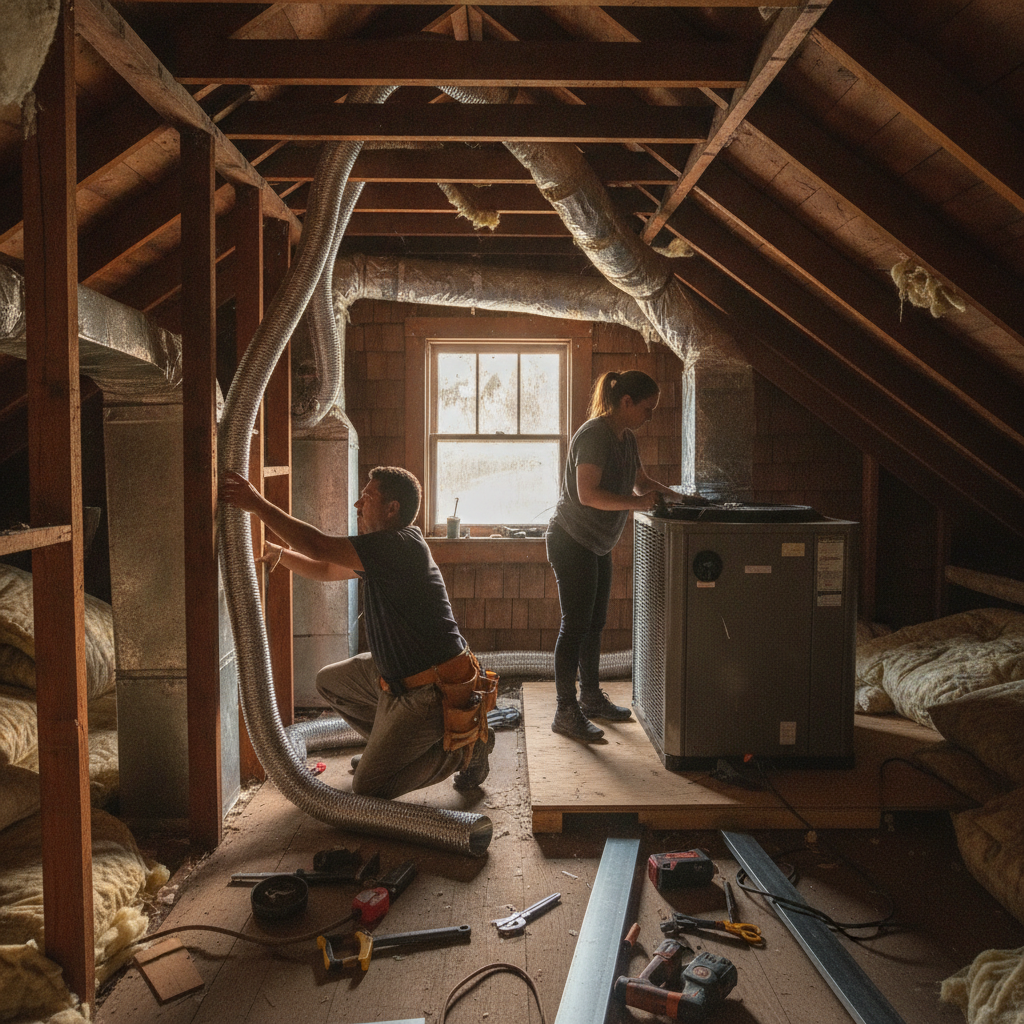
How Do Older Homes in Santa Rosa’s Railroad Square and West End Handle Central AC Installation?
Installing central air conditioning in an older Santa Rosa home is a genuinely different project than what you’d see in a newer neighborhood like Fountaingrove or out in Windsor. Homes in Railroad Square, the West End, South Park, and Roseland were often built in the 1920s through the 1960s — long before central AC was even a consideration. They have plaster walls, narrow stud cavities, shallow or nonexistent attic space, and most importantly, no existing ductwork. If you’re a homeowner in one of these neighborhoods trying to figure out how to add air conditioning without gutting your house, here’s an honest look at what your options actually are and what to expect when you call a local contractor.
Why Older Santa Rosa Homes Present Real Installation Challenges
Most HVAC contractors — and nearly every blog you’ll find online — describe AC installation as a fairly straightforward process. What they’re describing, almost always, is a newer home that already has a forced-air furnace and a duct system in place. For those homes, adding central AC is relatively simple: you install an outdoor condensing unit, an air handler or coil, connect refrigerant lines, and tie into the existing ducts.
In a pre-1960s home in the West End or along the streets near Railroad Square, that starting point doesn’t exist. Here’s what tends to make these jobs more complicated:
- No ductwork at all. Many older homes were heated with floor furnaces, wall heaters, or radiant systems — none of which use air ducts. Adding traditional central AC means building an entire duct system from scratch, which is invasive and expensive.
- Plaster walls and ceilings. Running new ductwork through plaster walls without significant demolition is very difficult. It usually means working through attic or crawlspace, which may be tight or poorly accessible.
- Low or no attic clearance. Older Craftsman and Victorian-era homes common in Santa Rosa’s historic neighborhoods often have minimal attic space — sometimes less than 18 inches — making traditional duct installation impractical.
- Electrical panels that haven’t been upgraded. A central AC system requires a dedicated circuit, and many older homes still have 100-amp or even 60-amp panels. You may need an electrician involved before any AC work begins.
Your Real Options for AC in an Older Santa Rosa Home
The good news is that you’re not stuck. There are three main routes for homeowners in these neighborhoods, and the right one depends on your home’s layout, your budget, and how much disruption you’re willing to tolerate.
Option 1: Ductless Mini-Split Systems
For most older homes in Santa Rosa without existing ducts, a ductless mini-split is the most practical and least invasive solution. A mini-split system uses a small outdoor unit connected to one or more indoor air handlers via a narrow refrigerant line that passes through a small hole in the wall — typically about three inches in diameter. No ductwork required.
You can install a single indoor unit for one room or zone, or a multi-zone system with several indoor units throughout the house — each controlled independently. Brands like Mitsubishi Electric, Daikin, and Fujitsu make systems well-suited to Santa Rosa’s Mediterranean climate, where summers are hot and dry but winters are mild enough that you want heating capability too. Most mini-splits are actually heat pumps, meaning they handle both heating and cooling in one system — which is a real advantage for homeowners who are also dealing with an aging wall heater or floor furnace.
The trade-off is aesthetics and cost per zone. Wall-mounted indoor units are visible, and some homeowners in historic homes prefer a less visible solution. A multi-zone system covering a full house can also carry a higher upfront cost than a single central system — though you gain individual room control and often better efficiency. California and PG&E rebates are available for qualifying heat pump systems, and financing options can help spread that cost out.
Option 2: High-Velocity (Small-Duct) Systems
If you want the feel of central air conditioning without tearing up walls to run traditional ductwork, a high-velocity system is worth understanding. These systems use very small, flexible tubing — typically about two inches in diameter — that can be threaded through existing wall cavities, floor joists, and attic spaces with minimal demolition. The supply outlets are small round vents that can be placed discreetly in walls, ceilings, or floors.
High-velocity systems cost more than conventional central AC but far less than a full gut-and-remodel to add traditional duct work. They’re a popular choice in the Sebastopol area and in older Bennett Valley homes where preserving interior finishes matters. They also dehumidify very effectively, which is a plus during Santa Rosa’s occasional humid stretches in late spring.
Option 3: Full Duct Installation with Central AC
If your home has a large enough attic, or you’re planning a significant renovation anyway, running traditional ductwork and installing a conventional central AC system is still possible — and it may be the most cost-effective path long-term if the access is there. A qualified contractor will need to do a thorough site assessment first. This isn’t something to estimate over the phone.
If your home already has a gas furnace (even an older one), adding a central AC coil and outdoor condenser is the least expensive route — assuming the duct system is in reasonable shape. Many homes in Santa Rosa’s older neighborhoods that received furnace upgrades in the 1980s or 1990s do have some duct infrastructure, even if it’s undersized or inefficient. A contractor who’s familiar with these older systems can evaluate whether that existing ductwork can be used or extended.
What Competitors Don’t Tell You About These Jobs
Most HVAC websites in Sonoma County — including several local competitors — describe AC installation in broad strokes that assume you’re starting from a modern baseline. What’s missing is a frank conversation about the realities of older housing stock. If you’re in Railroad Square, the West End, or South Park, and a contractor gives you a firm quote over the phone without seeing your attic access, your electrical panel, and your wall construction, that quote is likely to change significantly once they arrive.
At Stout’s, we’ve been working in these neighborhoods since 1992. We know what the housing in these parts of Santa Rosa looks like from the inside, and we won’t give you a number that doesn’t reflect your actual home. That’s not a sales pitch — it’s just the honest way to do business, and it saves everyone time. Residential AC services in older homes require a site visit, not a ballpark estimate.
A Note on Wildfire Smoke and Indoor Air Quality
One thing that’s changed the conversation about home cooling in Santa Rosa over the last decade is wildfire season. During smoke events, opening windows is not an option — which means a home without mechanical cooling becomes genuinely uncomfortable and potentially unhealthy when temperatures spike in August and September. Older homes with no AC and no filtration are particularly vulnerable.
If you’re adding AC to an older home, it’s also worth thinking about filtration at the same time. Mini-split systems can include multi-stage filtration, and whole-house ventilation solutions can be paired with high-MERV filters or air purification to manage smoke intrusion during bad air quality days. This is especially relevant for homes in the western parts of Santa Rosa and down toward Sebastopol, which tend to sit in smoke corridors during major fire events.
Frequently Asked Questions
Can I add central AC to my 1940s Santa Rosa home without major demolition?
It depends on your attic access and whether any ductwork exists already. In many cases, a ductless mini-split system is the most practical option — it requires only a small hole through an exterior wall and no ductwork at all. A high-velocity small-duct system is another option if you want more of a central-air feel. A site visit is the only way to know for sure.
How much does it typically cost to add AC to an older home in Santa Rosa?
Costs vary widely based on the system type, the number of zones or rooms, your electrical panel situation, and how accessible your home’s structure is. A single-zone ductless mini-split installation generally runs less than a full central AC retrofit with new ductwork. We don’t publish flat-rate prices for installations because every older home is different — contact us for a free estimate.
Will my electrical panel handle a new AC system?
Older homes in Railroad Square, the West End, and similar Santa Rosa neighborhoods sometimes still have outdated panels. A new AC system requires a dedicated circuit, and if your panel is at capacity or outdated, you may need an electrical upgrade before installation. We can identify this during our site assessment and coordinate accordingly.
Are there rebates available for AC installation in California?
Yes. Qualifying heat pump systems — including many ductless mini-splits — may be eligible for PG&E rebates and federal tax credits under current energy efficiency incentive programs. Eligibility depends on the system’s efficiency rating and your utility account. Ask us about current incentives when you schedule your estimate.
Do you service homes in Sebastopol and South Park, not just central Santa Rosa?
Yes. We serve homeowners throughout Sonoma County, including Sebastopol, Bennett Valley, Roseland, and neighborhoods across Santa Rosa. Older housing stock is common throughout the county, and we’re familiar with what it takes to do these installations right without unnecessary damage to your home’s interior.
Ready to Talk Through Your Options?
If you own an older home in Santa Rosa and you’ve been putting off adding AC because you weren’t sure it was even possible — or because you got a quote that didn’t make sense — we’re happy to take a look and give you a straight answer. Stout’s Heating & AC has been doing this work locally since 1992. We know these neighborhoods, we know these homes, and we’re not going to oversell you on a system that doesn’t fit your situation.
Request a free estimate or call us at (707) 527-1504 to schedule a time for us to come out and take a look. No pressure, no guesswork — just honest answers from a contractor who’s been in your neighborhood before.