
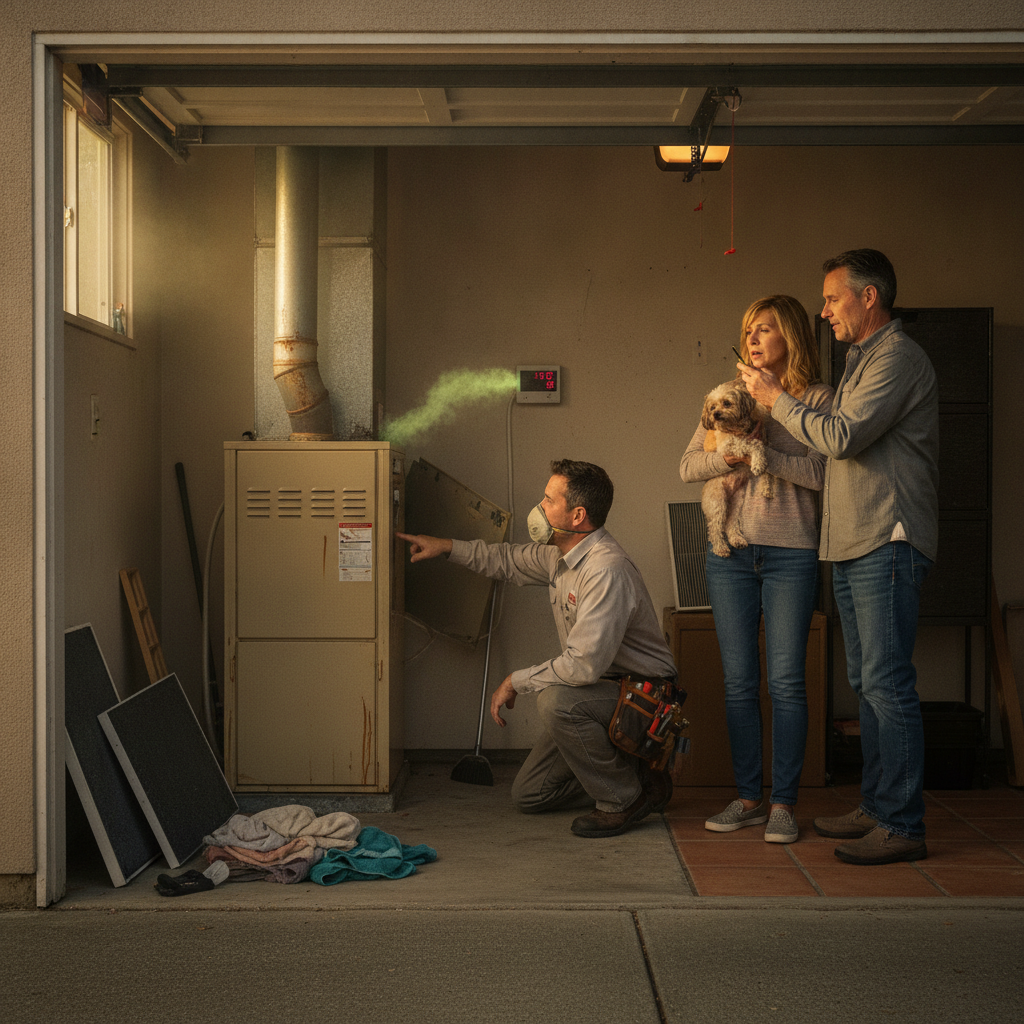
What Cotati and Rohnert Park Homeowners Should Know About Carbon Monoxide Safety and Gas Furnace Repairs
Carbon monoxide is colorless, odorless, and completely invisible — and when a gas furnace starts to fail, it can become a serious risk inside your home before you have any idea something is wrong. If you live in Cotati, Rohnert Park, or anywhere in the South Sonoma County corridor, your furnace is probably working harder than you think during those cold, wet winters we get here. The problem is that most local homeowners don’t find out their furnace has a problem until the system stops heating — or worse, until a CO detector goes off in the middle of the night. This article covers what you actually need to know about carbon monoxide risks from gas furnaces, what warning signs to watch for, and when to call a professional before the situation becomes dangerous.
Why Gas Furnaces and Carbon Monoxide Go Together
Your gas furnace burns natural gas to generate heat. Under normal operation, the combustion byproducts — including carbon monoxide — are safely vented out of your home through the flue and exhaust system. The key component that keeps those combustion gases separated from the air you breathe is called the heat exchanger. It’s a metal chamber that transfers heat from the burner to the circulating air without letting exhaust gases mix in.
When a heat exchanger develops a crack — which happens more often than most homeowners realize, especially in furnaces over 15 years old — combustion gases can leak directly into your home’s air supply. You won’t smell it. You won’t see it. What you might notice are symptoms that get dismissed as something else: mild headaches, fatigue, nausea, or a feeling that’s hard to describe but just feels off when you’re home.
Furnaces in Rohnert Park and Cotati neighborhoods that were built in the 1970s through the 1990s are especially worth monitoring. Many of those homes still have the original or first-replacement furnace, and a lot of those units are operating well past their safe service life.
Warning Signs Your Furnace May Be a Carbon Monoxide Risk
The honest truth is that a cracked heat exchanger rarely announces itself clearly. But there are signs worth paying attention to:
- The furnace flame is yellow or orange instead of blue. A healthy burner flame should be mostly blue. A flickering yellow or orange flame suggests incomplete combustion and a possible CO problem.
- You notice soot or black streaks around the furnace. This can indicate that exhaust gases aren’t being contained properly.
- There’s unusual condensation on windows when the heat runs. Excess moisture can be a sign of combustion gases escaping into the living space.
- Your CO detector goes off. This should never be dismissed as a false alarm. Get everyone out of the house and call for help.
- Family members feel headaches or dizziness that improve when they leave home. This pattern is a classic sign of low-level CO exposure.
- The furnace is short-cycling — turning on and off more frequently than normal — which can indicate a safety limit tripping due to overheating caused by a compromised heat exchanger.
None of these signs on their own are a definitive diagnosis. But any one of them is reason enough to have a licensed HVAC technician inspect the system before you keep running it.
What a Professional Furnace Safety Inspection Actually Looks Like
This is an area where we’ve noticed competitor sites in Sonoma County tend to be vague. They’ll tell you to call a technician, but they don’t explain what a thorough furnace inspection actually involves — so here’s what you should expect when a qualified tech comes out.
A proper furnace safety inspection goes beyond checking the filter and cycling the system. At Stout’s Heating & AC, a furnace inspection includes a visual inspection of the heat exchanger for cracks or corrosion, a combustion analysis to measure CO levels in the flue gases, a check of the burner operation and ignition system, an inspection of the flue and exhaust venting for blockages or damage, and a review of the safety switches and limit controls. If the heat exchanger is cracked, you’ll get a straight answer — not a runaround.
We’ve been doing this in Santa Rosa and surrounding Sonoma County communities since 1992, and we’ll always tell you exactly what we find, what it means, and what your realistic options are — whether that’s a repair, a component replacement, or an honest conversation about whether the furnace has reached the end of its useful life.
If you’re due for a check-up or haven’t had your system looked at in more than a year, our residential heater repair and inspection service is a good place to start.
CO Detectors: What Rohnert Park and Cotati Homeowners Should Know
California law requires carbon monoxide detectors in all single-family homes. But there’s a difference between having one and having it in the right place — and having one that’s still working properly.
A few things worth knowing:
- CO detectors have a lifespan of roughly 5–7 years. If yours is older than that, it may not be reliable even if it powers on.
- You should have a detector on each level of the home, and one near each sleeping area.
- Detectors should be mounted according to manufacturer instructions — CO is roughly the same weight as air and distributes evenly, so placement matters less than with smoke detectors, but following instructions still matters.
- Test your detectors monthly and replace them on schedule.
A CO detector is your last line of defense. The better strategy is making sure your furnace doesn’t have a problem to begin with — and that starts with regular maintenance and not ignoring warning signs.
When to Repair vs. Replace a Gas Furnace
If a technician finds a cracked heat exchanger, the repair path depends on the unit’s age and condition. On a newer furnace still under manufacturer warranty, replacing the heat exchanger may make sense. On a furnace that’s 18–20 years old with other wear issues, replacement is often the more practical and cost-effective answer.
A failed heat exchanger is not a fix-it-yourself situation. It’s also not something to shop around for the cheapest quote on. This is a life-safety component, and you want it handled correctly.
If replacement makes sense for your situation, it’s also worth looking at your options beyond a like-for-like gas furnace swap. Petaluma and Rohnert Park homeowners have been increasingly interested in heat pump systems, which eliminate combustion entirely and can provide both heating and cooling from a single unit. With rising PG&E costs and available California rebates and federal tax credits, the math has shifted significantly in recent years. You can learn more on our heat pump service page if that’s something you’d like to explore.
Frequently Asked Questions
How do I know if my furnace is producing carbon monoxide?
The only reliable way to detect carbon monoxide is with a working CO detector. Symptoms like headaches, fatigue, and nausea that improve when you leave the home can be warning signs. If you suspect a problem, leave the house immediately and call for help — don’t wait to confirm it.
How often should a gas furnace be inspected in Sonoma County?
Once a year is the standard recommendation, ideally in fall before the heating season begins. If your furnace is more than 15 years old, an inspection is even more important — this is when heat exchanger failures become more common.
Can a cracked heat exchanger be repaired?
In some cases, yes — but only if the furnace is relatively new and the crack is limited. On older systems, a cracked heat exchanger is typically a sign that the furnace has reached the end of its useful service life. A licensed technician can give you an honest assessment after inspection.
Is it safe to run my furnace if the CO detector goes off?
No. Turn the furnace off if you can do so safely, get everyone out of the home, leave doors open as you exit, and call 911 or your gas utility. Don’t re-enter until the home has been inspected and cleared. Have your HVAC system professionally inspected before running the furnace again.
What’s the difference between a furnace tune-up and a safety inspection?
A tune-up focuses on maintaining performance and efficiency — cleaning components, checking airflow, testing controls. A safety inspection includes combustion analysis and a specific check of the heat exchanger and venting for CO-related risks. A thorough annual service should include both.
Don’t Wait Until Winter to Find Out Your Furnace Has a Problem
The worst time to discover your furnace has a failing heat exchanger is at 10 p.m. on a cold January night — or worse, never discovering it at all. If your furnace is getting up there in age, hasn’t been serviced recently, or you’ve noticed any of the warning signs above, it’s worth getting it checked out now.
Stout’s Heating & AC has been serving Cotati, Rohnert Park, Santa Rosa, and the rest of Sonoma County since 1992. We’re a local, family-owned business — not a franchise — and we’re honest with our customers about what their system actually needs. We offer same-day and emergency service when you need it most, and we’ll always give you a straight answer about what we find.
Contact us today to schedule a furnace inspection or to ask any questions about your heating system. We’re here when you need us.