
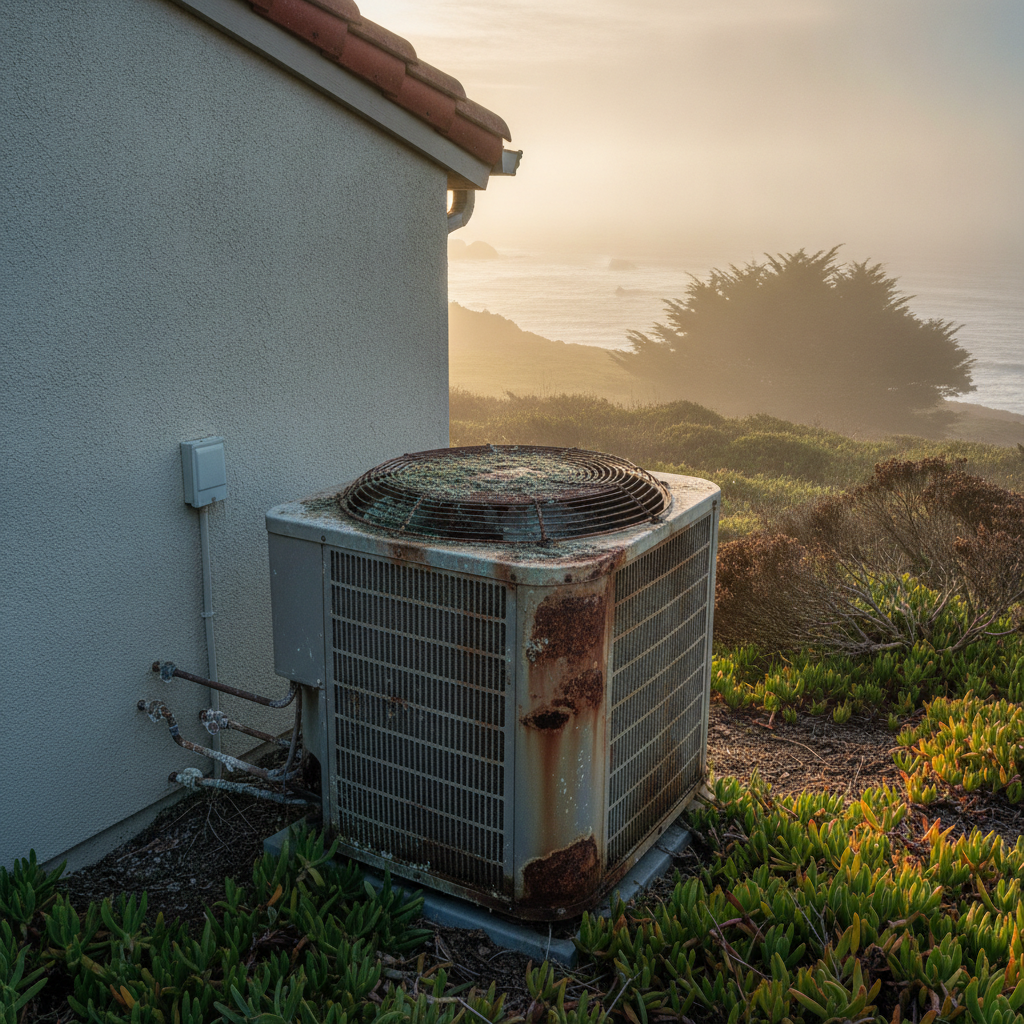
What Bodega Bay and Coastal Sonoma County Homeowners Should Know About HVAC in a Salt Air Environment
If you live in Bodega Bay or anywhere along the Sonoma Coast — Occidental, Jenner, the western edges of Sebastopol and Guerneville — your HVAC equipment is working in one of the harshest environments in the region. Salt-laden marine air, persistent coastal fog, and high ambient moisture don’t just make for dramatic scenery. They actively eat away at standard heating and cooling equipment, often cutting system lifespan in half compared to what the same unit would last in Santa Rosa or Rohnert Park. This isn’t something most HVAC companies talk about when they quote you a replacement, but it’s one of the most important factors in choosing the right equipment and the right service plan for a coastal home.
Why Salt Air Is Harder on HVAC Equipment Than Most People Realize
Standard HVAC equipment is designed and tested for average residential conditions. The outdoor coils, copper refrigerant lines, electrical contactors, and cabinet finishes on most systems are not built to handle continuous exposure to salt-laden air. When microscopic salt particles settle on aluminum fins and copper components, they accelerate oxidation — basically, they speed up rusting and corrosion in ways that aren’t visible until the damage is already significant.
In a home a mile from the ocean in Bodega Bay, you might see an outdoor condenser unit develop corroded coils within four or five years rather than the ten to fifteen years a homeowner farther inland might expect. Electrical contacts can fail early. Refrigerant coils develop pinhole leaks. Fan motors seize. The result is more frequent repairs, shorter equipment life, and replacement costs that arrive sooner than your budget planned for.
The coastal fog belt that stretches from Bodega Bay inland toward Occidental and Forestville also keeps humidity elevated for much of the year, even when it isn’t raining. This sustained moisture exposure compounds the salt corrosion problem and creates conditions where mold growth inside air handlers and ductwork is a genuine concern — not just a theoretical one.
What Equipment Holds Up Better in Coastal Conditions
Not all HVAC equipment is equally vulnerable. If you’re replacing a system or installing new equipment in a coastal Sonoma County home, there are specific things worth asking about before you commit to any particular unit or brand.
- Coil coating matters. Look for outdoor units with epoxy-coated or polymer-coated coils, sometimes marketed as “coastal” or “seaside” variants by manufacturers. Brands like Daikin, Mitsubishi Electric, and Carrier offer units with enhanced corrosion resistance that are worth the modest price premium in a coastal environment. A standard unit at a lower price point will cost you more in repairs and earlier replacement.
- Ductless mini-split systems are often a better fit. For many coastal homes — especially older properties in Occidental or the Bohemian Highway corridor — a ductless mini-split system eliminates the ductwork corrosion problem entirely, keeps the outdoor unit compact and accessible for cleaning, and allows for easier targeted maintenance. Heat pump-based mini-splits are particularly well-suited to the mild coastal climate, where temperatures rarely drop to extremes that would stress a heat pump’s efficiency.
- Cabinet and housing materials. Ask about painted versus galvanized steel cabinets on outdoor units. Some manufacturers use heavier gauge materials with better corrosion-resistant coatings on their higher-tier models. This is an area where cutting to the cheapest option genuinely costs you more over time.
Maintenance Schedules That Actually Account for Where You Live
Standard HVAC maintenance advice — tune it up once or twice a year — is a fine baseline for Santa Rosa, but it doesn’t go far enough for homes near the coast. If your equipment sits within a mile or two of saltwater, here’s what a more realistic maintenance approach looks like:
- Coil cleaning every season, not just annually. Salt deposits on outdoor coils should be rinsed off regularly — gently, with low-pressure water — to slow corrosion. This is something a homeowner can do carefully on their own between professional visits, or your technician can handle it during each tune-up.
- Electrical component inspection at every visit. Contactors, capacitors, and wiring connections corrode faster in marine environments. A technician who knows your location should be checking these closely, not just glancing at them.
- Refrigerant line inspection for pinhole leaks. Coastal corrosion often shows up first as slow refrigerant loss through tiny leaks in copper lines. If your system seems to be gradually losing cooling or heating capacity, this is one of the first things to check.
- Indoor air quality checks. The combination of fog humidity and poor ventilation in older coastal homes creates real conditions for mold and mildew in ductwork and air handlers. If your home smells musty when the system runs, don’t ignore it.
Stout’s offers bi-annual tune-ups starting at $90 that can be tailored to the specific demands of coastal properties. If you’re in Bodega Bay or western Sebastopol and your current service provider isn’t asking where your home sits relative to the ocean, it might be worth a second opinion.
The Gap Most Local HVAC Companies Don’t Fill: Coastal-Specific Advice
Here’s something you won’t find clearly addressed on most Sonoma County HVAC company websites: coastal-specific equipment recommendations and maintenance guidance. Most competitors in this market write general content about AC repair or furnace installation without acknowledging that a home in Bodega Bay has fundamentally different needs than a home in Healdsburg or Fountaingrove. That gap costs homeowners real money when they end up with equipment that wasn’t selected with their environment in mind.
At Stout’s, we’ve been working in Sonoma County since 1992. That’s long enough to have seen what happens to HVAC systems on the coast over time — the premature coil failures, the corroded contactors, the ductwork problems in homes that have been in the fog belt for decades. When we quote a coastal property, we factor in where you live, not just what the manufacturer’s standard specifications say. We regularly serve homeowners in Sebastopol and the surrounding coastal communities, and we bring that local experience to every site visit.
Financing, Rebates, and the Case for Investing in Better Equipment Upfront
Coastal homeowners sometimes hesitate at the price difference between a standard unit and one with enhanced corrosion protection. It’s a fair concern, but the math usually works in favor of the better equipment. A system that lasts twelve years instead of six — even at a higher initial cost — saves you a significant amount over time, especially when you factor in the repair bills that tend to pile up in the final years of a corroding system.
California PG&E rebates and federal tax credits for high-efficiency heat pump systems can meaningfully offset the upfront investment. Stout’s also offers 0% financing options for qualifying customers. Check our current offers and financing details — it’s worth a look before you assume a better system is out of reach.
Frequently Asked Questions
How close to the ocean does a home need to be before salt air becomes a real HVAC concern?
Generally speaking, homes within about two miles of the coastline see measurably higher corrosion rates on outdoor HVAC equipment. That said, the specific terrain, prevailing wind patterns, and fog exposure in your location matter a lot. A home in a sheltered canyon may fare better than one on an exposed ridge the same distance from the water.
Can I coat my existing outdoor unit to protect it from salt corrosion?
There are aftermarket coil coatings available, and a qualified technician can apply them to an existing outdoor unit. They’re most effective when applied to a clean, relatively new coil — they won’t reverse existing corrosion damage, but they can slow further deterioration. Ask your technician whether your current unit is a good candidate before spending money on the treatment.
Are heat pumps a good choice for Bodega Bay’s climate?
Yes — the mild coastal climate in Bodega Bay is actually ideal for heat pump efficiency. Heat pumps perform best when temperatures stay above freezing, which the coast nearly always does. You get year-round heating and cooling from a single system, and modern heat pumps with corrosion-resistant coatings hold up well when properly maintained.
My system seems to lose refrigerant every summer. Could salt air be the cause?
Possibly. Pinhole leaks in copper refrigerant lines are a common result of corrosion in coastal environments. Repeatedly recharging a leaking system is a short-term fix — the underlying leak needs to be found and repaired. If this has happened more than once, it’s worth having a technician do a thorough leak search rather than just topping off the refrigerant again.
Does Stout’s service homes in Bodega Bay and Occidental?
Yes. We serve the full Sonoma County area, including coastal communities from Bodega Bay through Occidental, Guerneville, and Forestville. We’re based in Santa Rosa, which puts us well-positioned to reach the western parts of the county without the long travel times you’d get from a contractor based farther south.
Talk to Someone Who Knows Your Area
If you live on the Sonoma Coast and you’re not sure whether your current HVAC setup is holding up the way it should — or you’re planning a replacement and want honest advice on what equipment actually makes sense for your location — we’re glad to help. Stout’s Heating & AC has been serving Sonoma County homeowners since 1992, and we’ll tell you straight what we think rather than just quote you the easiest sale. Reach out to schedule a visit or ask a question — there’s no pressure and no obligation.