
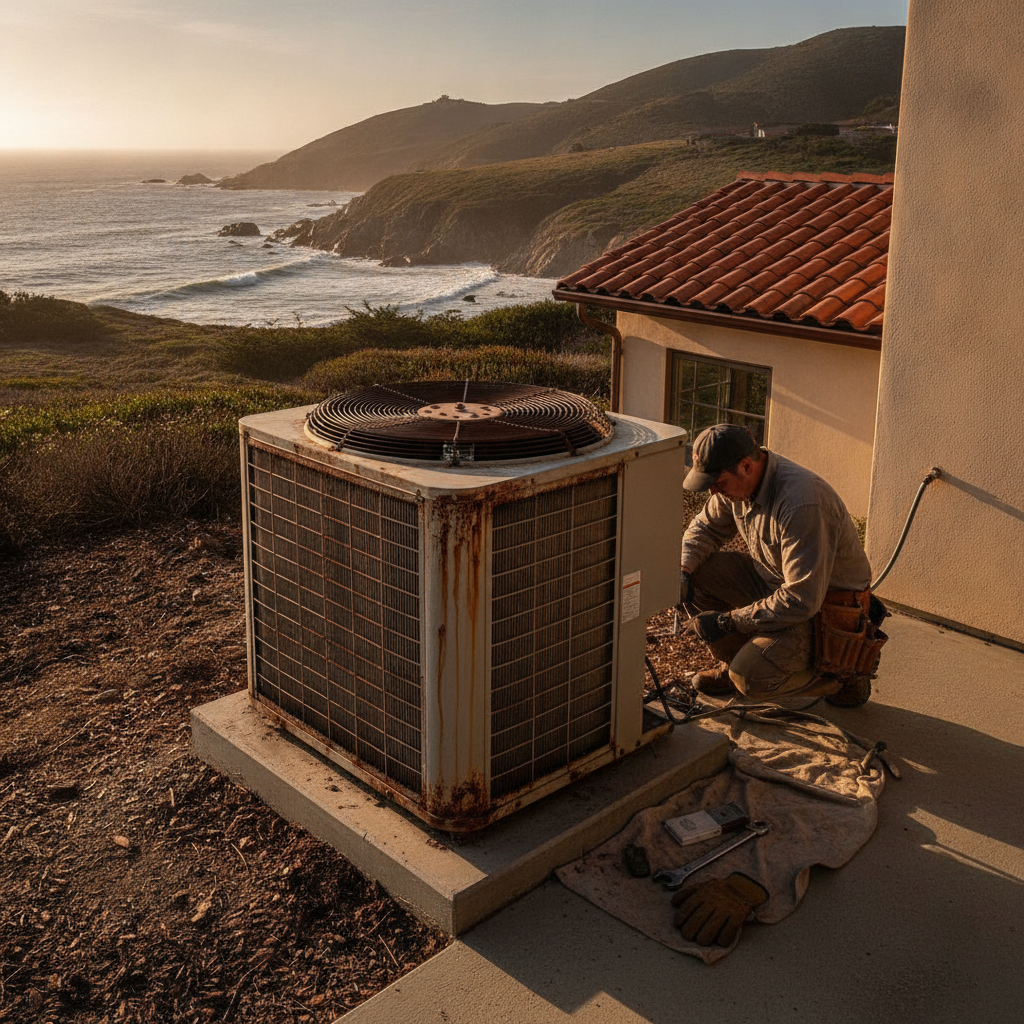
What Bodega Bay and Coastal Sonoma County Homeowners Should Know About HVAC in a Salt Air Environment — Why Your System Corrodes Faster and What to Do About It
If you live in Bodega Bay or anywhere along the Sonoma Coast, your HVAC system is quietly fighting a battle you probably don’t think about until something breaks. Salt-laden air off the Pacific is one of the most corrosive environments heating and cooling equipment can operate in — and the closer you are to the water, the faster it eats through coils, cabinets, electrical connections, and refrigerant lines. A system that might last 15 to 18 years in Santa Rosa could show serious degradation in 8 to 10 years at a coastal property if it wasn’t selected, installed, and maintained with that environment in mind. This isn’t a scare tactic — it’s just the physics of salt and metal working against each other, every single day.
Why Salt Air Is Different From Normal Wear and Tear
Most HVAC equipment is engineered and tested under standard conditions — moderate humidity, average particulate levels, nothing chemically aggressive in the air. The Sonoma Coast doesn’t offer those conditions. The marine layer that rolls in through Bodega Bay and up through the valleys toward Occidental and Forestville carries microscopic salt particles that settle on every exposed metal surface. Over time, those particles pull moisture from the air and create an electrochemical reaction that rusts steel, oxidizes aluminum, and degrades copper faster than normal oxidation alone.
What this means practically:
- Condenser coils — the outdoor component of your AC or heat pump — are especially vulnerable. The aluminum fins and copper tubing are constantly exposed, and once corrosion takes hold, heat transfer efficiency drops and the system starts working harder than it should.
- Electrical connections and control boards corrode at terminals, leading to intermittent failures that are notoriously hard to diagnose because they don’t show up consistently until the damage is advanced.
- Cabinet and housing corrosion looks cosmetic at first but eventually allows moisture intrusion that damages internal components.
- Refrigerant line connections can develop micro-leaks at fittings that were perfectly tight when installed but have since corroded at the joint.
None of this happens overnight, but it accelerates significantly the closer you are to the water — and Bodega Bay sits right on the ocean. Even properties a few miles inland, toward Bodega or Valley Ford, see meaningfully more corrosion than homes in Sebastopol or Santa Rosa.
What Most Contractors Miss — and What Competitors Don’t Talk About
Here’s a gap that’s worth naming directly: most HVAC contractors in Sonoma County don’t differentiate their recommendations based on coastal exposure. You’ll get the same equipment suggestion whether you’re in Rohnert Park or on Doran Beach Road. That’s a problem, because standard residential equipment — even from quality brands — isn’t rated for severe coastal environments without additional protective measures.
There are a few things an experienced local contractor should discuss with any coastal homeowner:
Coil Coatings Are Not Optional Near the Ocean
Several manufacturers — including Carrier, Trane, and Daikin — offer factory-applied or field-applied coatings on condenser coils specifically designed to resist salt air and humidity. These epoxy or polymer coatings create a barrier between the metal and the environment. On a standard installation, this is often skipped because it adds cost and most installers don’t bring it up unless you ask. Near the Sonoma Coast, it’s one of the better investments you can make in equipment longevity.
Some manufacturers designate certain product lines as rated for coastal or marine environments. If you’re replacing equipment at a Bodega Bay property, asking your contractor about coil coating options — or whether a specific unit is coastal-rated — is one of the first questions you should raise.
Equipment Placement Matters More Than You Think
Where you position the outdoor unit on your property can meaningfully slow down corrosion. Shielding equipment from prevailing onshore winds, keeping it elevated off the ground to prevent moisture pooling, and ensuring adequate clearance for airflow all contribute to longer service life. If a previous installer just put the condenser wherever was convenient without thinking about wind direction, you may be accelerating the problem unnecessarily.
Heat Pumps Are Often a Smart Fit — With the Right Specs
Coastal Sonoma County’s climate — mild, rarely freezing, reliably moderate year-round — is genuinely well-suited to heat pump systems. You don’t need a gas furnace to handle the coldest nights the way you would in colder inland climates. The challenge is making sure the heat pump you select is equipped for the coastal environment, meaning coil protection and corrosion-resistant components. A heat pump that fails in eight years because of salt corrosion isn’t actually saving you money over a gas system — it’s just adding a different kind of expense.
What a Proper Maintenance Schedule Looks Like for Coastal Properties
Standard HVAC maintenance recommendations call for a tune-up twice a year — typically spring and fall. For coastal properties, that schedule is a minimum, not a ceiling. Depending on how close you are to the water and how aggressively the marine layer hits your property, you may benefit from more frequent coil cleaning and inspection.
At a minimum, a good maintenance visit for a coastal Sonoma County home should include:
- Thorough coil cleaning — not just a rinse, but chemical cleaning to remove salt deposits that build up between fins
- Inspection of all electrical connections and terminals for corrosion, tightening or replacing as needed
- Checking refrigerant pressure and looking for signs of micro-leaks at line connections
- Inspecting and treating cabinet surfaces where rust or oxidation is starting
- Reviewing coil coating condition and re-applying if coverage has degraded
This is more involved than a standard tune-up, and not every technician approaches coastal properties with this level of specificity. It’s worth asking your contractor directly: what do you do differently for a home this close to the ocean? If you get a blank look, that tells you something.
When Repair Stops Making Sense
One of the harder conversations with coastal homeowners involves deciding when corrosion damage has progressed far enough that repair is throwing good money after bad. A corroded condenser coil can sometimes be cleaned and coated to extend its life by a few more years. But if the coil has developed pinhole leaks throughout, or if corrosion has reached the internal components of the system, replacement is the more honest recommendation — and any contractor worth trusting should tell you that directly rather than collecting repeated repair bills.
If you’re evaluating a coastal property for purchase, or if you’ve inherited an older system at a vacation rental or second home in Bodega Bay, it’s worth having an independent assessment done before deciding whether to repair or replace. The age of the unit matters, but so does the condition of the coils and the corrosion history — and those aren’t the same thing.
Frequently Asked Questions
How close to the ocean does a home need to be for salt air to be a real concern?
Generally, properties within about a mile of the coastline see the most aggressive corrosion. But the marine layer regularly reaches inland communities along the Sonoma Coast — Bodega, Valley Ford, parts of Occidental — so if you regularly see heavy fog and feel that characteristic coastal dampness, it’s worth treating your property as a coastal environment regardless of distance.
Are there specific HVAC brands that hold up better in coastal environments?
Several brands offer specific coastal or marine-rated product lines with enhanced corrosion protection, including Carrier, Trane, Daikin, and Mitsubishi Electric. The key is less about brand and more about whether the specific unit has coated coils and corrosion-resistant components. A good contractor should be able to show you which units in their lineup are rated for severe environments.
Can I apply a coil coating after installation if I didn’t get one from the factory?
Yes — field-applied coil coatings are available and can be applied during a maintenance visit. They’re not quite as durable as factory applications, but they’re a meaningful improvement over no protection at all and are worth asking about if your current system is in otherwise good shape.
Does salt air affect indoor components too, or just the outdoor unit?
The outdoor condenser is most vulnerable since it’s directly exposed, but if your home has poor sealing around penetrations where refrigerant lines enter the building, or if you have whole-house ventilation pulling in outdoor air without adequate filtration, salt air can affect indoor components over time. It’s another reason why residential ventilation strategy matters at coastal properties.
Should I be concerned about corrosion on a vacation rental or second home that sits unused part of the year?
Absolutely — systems that run infrequently but sit in a salt air environment still accumulate corrosion. In some ways, a system that runs regularly is easier to monitor because you notice problems sooner. A second home that’s vacant for weeks or months may develop significant issues between visits. A pre-season inspection before you or your renters arrive is a smart habit to build in.
Work With Someone Who Knows the Sonoma Coast
Stout’s Heating & AC, Inc. has been serving Sonoma County since 1992 — and that includes coastal communities that have specific needs a standard HVAC approach doesn’t account for. We’re a local, family-owned company, not a franchise chain, and we give homeowners honest information about what their equipment actually needs rather than a one-size-fits-all recommendation.
If you have a home in Bodega Bay, along the coast, or anywhere in the inland communities affected by the marine layer, and you want an honest look at your system’s condition or want to talk through a replacement with coastal factors in mind, give us a call at (707) 527-1504 or reach out through our contact page. We’re happy to come take a look and give you a straight answer about what you’re working with.