
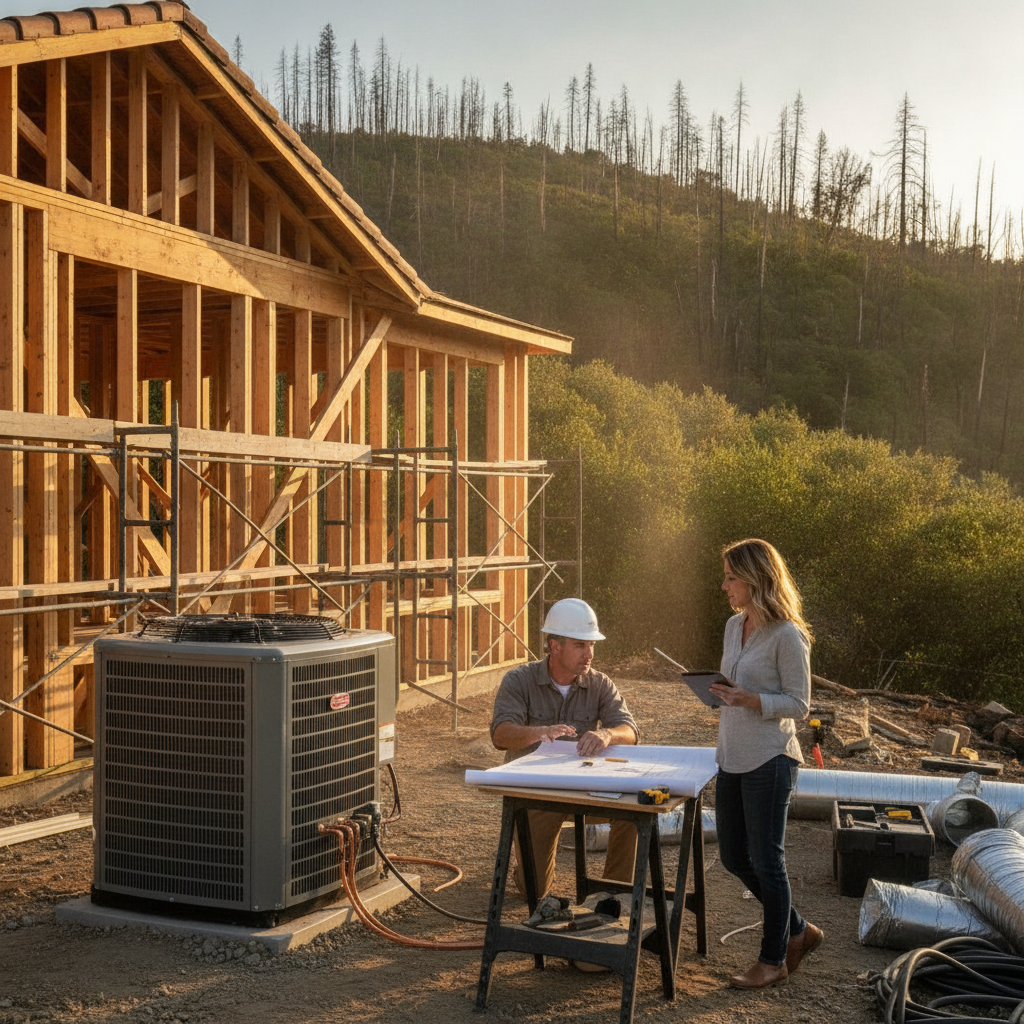
What Santa Rosa Homeowners Should Know About HVAC and Wildfire Rebuilds — Choosing the Right System When You’re Starting From Scratch
If you’re rebuilding a home in Santa Rosa after a wildfire — whether that’s in Coffey Park, Fountaingrove, or somewhere else in Sonoma County that took a hit in recent fire seasons — the HVAC decision in front of you is one of the most important ones you’ll make. You’re not patching an old system or working around someone else’s choices. You’re starting with a blank floor plan, and that’s actually an opportunity most homeowners never get. The system you install now will likely be with you for 20 years or more. Getting it right matters a lot more than getting it cheap or getting it fast.
We’ve been doing HVAC work in Santa Rosa since 1992, and we’ve seen the rebuild process up close. Here’s what we think every homeowner starting over should understand before the mechanical rough-in begins.
Why a Rebuild Is Different From a Replacement — And Why That Matters for HVAC
When you replace an HVAC system in an existing home, you’re usually working around constraints — duct locations, closet sizes, electrical panel capacity, ceiling heights. A lot of decisions get made by default because tearing into finished walls is expensive and disruptive.
In a rebuild, none of those constraints exist yet. That means you can design the mechanical system correctly from the start: properly sized equipment, well-routed ductwork, the right refrigerant lines, adequate electrical capacity, and a logical placement for your air handler and outdoor unit. You can also choose the type of system that actually makes sense for your house and your climate — rather than just replicating whatever you had before.
The temptation during a rebuild is to move quickly. Permits, contractors, insurance timelines, temporary housing — it all creates pressure to just pick something and move on. We understand that. But spending even a few hours thinking through your HVAC options before the slab is poured can save you thousands of dollars over the life of the system.
Heat Pumps Are the Default Choice for Most Santa Rosa Rebuilds — Here’s Why
Santa Rosa’s climate is well-suited to heat pumps. Our summers are hot and dry, our winters are mild by most standards, and we rarely see extended periods of hard freeze. A heat pump handles both heating and cooling from a single system, and in our climate it operates efficiently throughout the year without needing backup heat for most of the season.
There are also practical reasons a rebuild is an ideal time to go all-electric with a heat pump. California’s Title 24 building energy standards — which apply to new construction and major rebuilds — are increasingly pushing toward electrification. Many jurisdictions in Sonoma County have adopted reach codes or policies that favor electric systems. If you’re pulling a permit for a full rebuild, your plan checker is likely to flag these requirements early. Building to meet them from the start is far easier than retrofitting later.
Federal tax credits under the Inflation Reduction Act also apply to qualifying heat pump installations, and PG&E offers rebates that can meaningfully offset equipment costs. When you’re already absorbing the cost of rebuilding, every dollar of incentive matters. You can find current offers and financing options at our HVAC offers page.
When a Dual Fuel or Hybrid System Makes Sense for Rebuilds
Some homeowners rebuilding in Fountaingrove, Windsor, or areas at higher elevations in Sonoma County may face occasional winter nights cold enough to push a heat pump’s efficiency down. If your rebuild site experiences more sustained cold snaps, or if you’re gas-connected and want a backup, a dual fuel system pairs an electric heat pump with a gas furnace. The system runs on the heat pump the vast majority of the time — capturing all the efficiency and rebate benefits — and automatically switches to gas only when temperatures drop low enough that the heat pump would be working too hard.
This isn’t necessary for every rebuild, but it’s worth having the conversation with your HVAC contractor before you finalize your mechanical plan. The rough-in decisions you make now — where the gas line goes, what size electrical circuit you run to the air handler — will determine what your options are later.
Ductwork Design: The One Thing You Can Get Right This Time
In homes that burned, ductwork problems were often invisible until the HVAC system started underperforming. Leaky ducts, poorly routed runs, undersized returns — these are extremely common in older Sonoma County construction, and they’re a primary reason systems run longer, work harder, and die sooner than they should.
In a rebuild, you have the chance to design ductwork the right way: properly sized for the equipment, sealed at every joint, insulated to meet current standards, and routed through conditioned space wherever possible. If your HVAC contractor is involved before framing begins, they can work with your builder to route ducts through interior walls and chases instead of hot attic spaces. That single decision can noticeably improve system efficiency and comfort.
If your rebuild is a smaller footprint than what you had before — or if you’re incorporating an ADU or a room that sits away from the main structure — a ductless mini-split may be worth considering for that space rather than extending a central duct system. It’s not always the right answer, but it’s one worth discussing. Learn more about how we approach heat pump systems for both ducted and ductless applications.
Indoor Air Quality Planning Belongs in the Rebuild Conversation
Homeowners rebuilding in fire-affected areas of Santa Rosa and Sonoma County should think carefully about indoor air quality from the beginning. Wildfire smoke seasons have become a recurring reality here, and a home that’s being built new has the opportunity to include better filtration infrastructure than older homes ever had.
That means sizing the air handler and ductwork to support higher-MERV filtration without excessive static pressure, planning for a fresh air ventilation strategy that includes the ability to close off outside air intake during smoke events, and potentially roughing in for a whole-home air purification system. These aren’t expensive additions when planned at the design stage — but they become costly retrofits if you try to add them later.
Frequently Asked Questions: HVAC and Wildfire Rebuilds in Santa Rosa
Do I have to install a heat pump if I’m rebuilding in Sonoma County?
Not necessarily, but it depends on your local jurisdiction and what your permit requires. California Title 24 and local reach codes have been moving toward electrification, and some cities have adopted stricter requirements than the state baseline. Talk to your permit office early, and have your HVAC contractor review your mechanical plan before you submit. We’re familiar with what’s being required in Santa Rosa and surrounding areas and can help you navigate this.
Can I use my insurance settlement to cover a heat pump upgrade over what I had before?
Insurance typically covers like-for-like replacement. If you want to upgrade to a heat pump from a standard gas furnace and AC, you may need to cover the cost difference yourself — but federal tax credits and PG&E rebates can help close that gap significantly. It’s worth running the numbers before you assume a heat pump is out of reach.
When in the rebuild process should I bring in an HVAC contractor?
Ideally before framing is complete. The earlier we’re involved, the more options you have. HVAC rough-in involves running refrigerant lines, ductwork, electrical conduit, and flue penetrations — all of which are far simpler to plan around before walls are closed. If you’re already past that stage, we can still work with you, but earlier is always better.
What HVAC systems work best for Coffey Park-style single-story rebuilds?
Single-story homes with open floor plans tend to do very well with ducted heat pump systems, especially when ductwork is designed correctly from scratch. Attic-routed ducts can work, but interior-routed systems perform better in our summer heat. If the home has a detached garage or studio structure on the same lot, a separate ductless head unit for that space is usually the most cost-effective solution.
Are there financing options available for HVAC on a rebuild?
Yes. We offer financing options that can help spread out the cost of a new system while you’re managing the broader expenses of rebuilding. Check our current offers for details, and ask us about federal and state incentives that may apply to your specific equipment choices.
Get It Right the First Time — We’re Here to Help
Rebuilding a home in Santa Rosa or anywhere else in Sonoma County is an enormous undertaking. The HVAC decision shouldn’t be an afterthought made under deadline pressure. We’ve been doing this work in this community since 1992, and we know the local climate, the local code environment, and the specific challenges that come with building or rebuilding in Sonoma County.
If you’re in the planning stages of a rebuild and want an honest conversation about your HVAC options — no upsell, no pressure — reach out to us. We’re happy to look at your plans, talk through what makes sense for your site and your budget, and give you a straight answer. Contact Stout’s Heating & AC, Inc to schedule a free consultation or request an estimate. We’ll make sure the system you build now is one you won’t regret five years from now.