
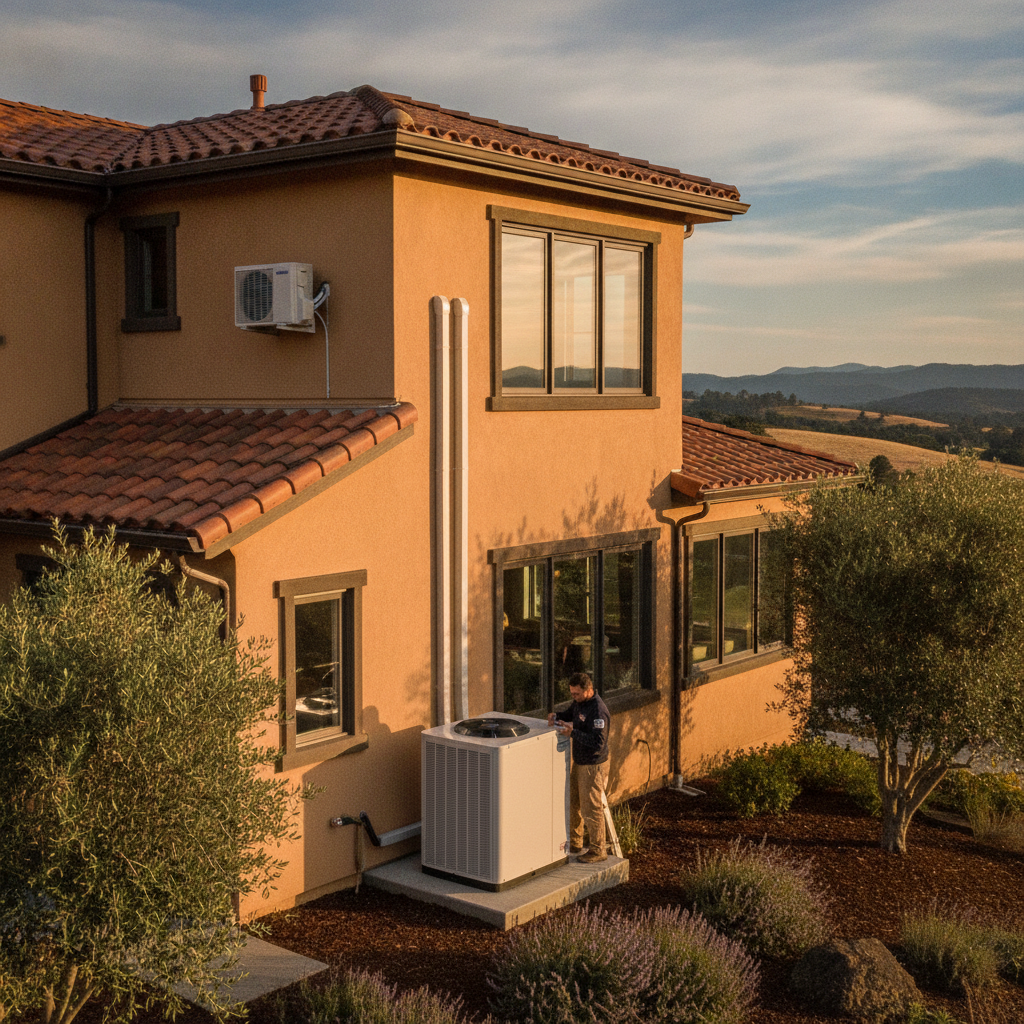
What Santa Rosa Homeowners Should Know About Ductless Mini-Split Systems — When They Make Sense, What They Cost, and How Installation Actually Works
If your Santa Rosa home doesn’t have existing ductwork — or has rooms that your central system just can’t seem to reach — a ductless mini-split system is probably worth a serious look. Mini-splits heat and cool individual rooms or zones without needing ducts at all, using a small wall-mounted indoor unit connected to an outdoor compressor. They’re not a new technology, but they’ve become dramatically more efficient and more affordable in recent years, and they’re one of the most versatile solutions we install across Sonoma County. The bigger question isn’t whether mini-splits work — they do — it’s whether they’re the right fit for your specific home and situation.
Why Mini-Splits Come Up So Often in Santa Rosa
Santa Rosa has a wide variety of housing stock, and that’s a big part of why we talk about mini-splits so frequently. Older neighborhoods like Railroad Square, the West End, and South Park are full of homes built before central forced-air systems were standard — craftsman bungalows, mid-century ranches, and two-story Victorians that were either never ducted or were retrofitted with ductwork that runs poorly. Installing new ducts in these homes is expensive, disruptive, and sometimes structurally impractical.
At the same time, newer construction in areas like Fountaingrove and Windsor typically has well-designed central systems. Homeowners there might consider a mini-split for a specific problem area — a finished garage, an ADU, a room over a garage that the central system can’t adequately serve — rather than replacing the whole system.
Sebastopol and Healdsburg see similar patterns. Many homes in those communities are older, have partial ductwork, or were built as single-story ranch homes where adding ducts would require opening up walls and ceilings. For those situations, a mini-split often costs significantly less than a full duct installation while doing a better job of conditioning the space.
How a Ductless Mini-Split Actually Works
The system has two main components: an outdoor unit (the condenser/compressor) and one or more indoor air handlers that mount high on the wall. They’re connected by a refrigerant line, a power cable, and a condensate drain line — all of which pass through a small hole in the wall, typically about three inches in diameter. That’s it. No duct runs, no dropped ceilings, no major construction.
Most mini-splits sold today are heat pumps, which means they both heat and cool from a single system. In Santa Rosa’s Mediterranean climate — hot dry summers, cool wet winters — that’s a genuinely useful combination. You’re not buying a cooling system and a heating system separately. One outdoor unit handles both, and in our climate, a heat pump-based mini-split will cover the majority of your heating needs efficiently, even on cold winter nights.
Multi-zone systems take this further. A single outdoor unit can connect to two, three, four, or more indoor air handlers in different rooms, each controlled independently. That means you can heat the bedroom at night without running the living room unit, or cool just the home office where someone’s working during the day. For households where people have different comfort preferences — or where you’re trying to manage PG&E energy costs carefully — that kind of control makes a real difference.
What Installation Looks Like — and What It Costs
Installation is typically a one- to two-day job for a single-zone system, and two to three days for a multi-zone setup. The work involves mounting the indoor unit, setting the outdoor condenser on a pad or wall bracket, running the refrigerant lines, making the electrical connections, and commissioning the system. It’s cleaner and faster than a duct installation by a significant margin.
Costs vary based on the number of zones, the specific equipment, and the complexity of the installation — running lines through finished walls adds time and labor. A single-zone system installed in a straightforward location typically runs in the $3,000–$5,500 range. Multi-zone systems cost more, depending on how many indoor units are involved and how the lines are routed. These are real-world ranges, not promotional numbers — the only way to know what your specific project will cost is to have someone come out and look at it.
The good news is that there’s real financial help available right now. California’s CPUC and PG&E both offer rebates for qualifying heat pump systems, and federal tax credits under the Inflation Reduction Act provide an additional 30% credit (up to $2,000) for heat pumps installed in primary residences. Those credits are worth factoring in when you’re comparing upfront costs. We also offer financing options that can make a system more manageable if paying for it all at once isn’t realistic right now.
When a Mini-Split Is the Right Answer — and When It Isn’t
Mini-splits are genuinely the best solution in certain situations:
- Homes without existing ductwork that would need expensive retrofitting
- Room additions, converted garages, or ADUs that sit outside the reach of a central system
- Historic homes in Coffey Park, the Railroad Square area, or Petaluma where duct installation would be highly invasive
- Specific problem rooms — a master bedroom, a home office, a studio — where the central system consistently underperforms
- Situations where you want independent temperature control by room or zone
That said, mini-splits aren’t always the answer. If you have a well-functioning central system with good ductwork and you’re just having a maintenance issue, a mini-split won’t solve your underlying problem — it’ll just add another system to manage. And if you’re trying to heat or cool an entire large home with mini-splits instead of a central system, the upfront cost can exceed what a central system replacement would run. It depends heavily on the layout of your home and how many zones you’d need.
When we come out for an estimate, we’ll look at your home’s layout, your existing equipment, and what you’re actually trying to accomplish — and give you an honest recommendation, not just the most expensive option on the table. We’ve been doing this in Santa Rosa since 1992, and we’re not in the business of selling people systems they don’t need.
Brands and What to Expect From Equipment Quality
We install and service Mitsubishi Electric, Fujitsu, Daikin, LG, and other major brands. These aren’t interchangeable — different brands have different strengths in different applications, and the right choice for a small guest room is not necessarily the right choice for a large open-plan living area. SEER ratings (a measure of cooling efficiency) vary widely between models, and higher-SEER systems tend to qualify for better rebates and have lower operating costs over time.
What we’d caution against is choosing a system based solely on the lowest upfront price. Heat pump-based mini-splits are long-term investments — a quality system installed correctly should last 15–20 years. Cheap equipment installed by someone who cut corners on refrigerant charging or line routing will cause you problems within a few years, and the repair costs will eat up any savings quickly.
Frequently Asked Questions About Mini-Splits in Santa Rosa
Can a mini-split heat my home effectively in winter?
Yes — in Santa Rosa’s climate, modern heat pump mini-splits handle winter heating comfortably in most cases. They’re rated to operate efficiently down into the low 20s°F, which is well below anything we typically see here. For older, poorly insulated homes, you may want to pair a mini-split with existing heating for the coldest nights, but for most homes in Sonoma County, a properly sized mini-split handles heating without issue.
Do mini-splits work well for wildfire smoke season?
They can, depending on the indoor unit’s filter. Some higher-end models include multi-stage filtration. That said, if indoor air quality during smoke season is a primary concern, we’d talk to you about adding a dedicated air purification layer rather than relying solely on the mini-split’s built-in filter. The two work well together.
How disruptive is installation?
Much less than most homeowners expect. For a single-zone system in a straightforward location, installation is typically done in a day with minimal mess. There’s no drywall cutting, no attic work, and no duct runs. The main work is mounting the units and running the small refrigerant and electrical lines.
Can I add a mini-split to just one room if I already have central AC?
Yes, and this is actually one of the most common scenarios we handle. If you have a room that your central system doesn’t reach well — a garage conversion, an upstairs bedroom, a home office addition — a single-zone mini-split is a clean solution that doesn’t require touching your existing system.
Are there rebates available right now for mini-splits in California?
Yes. PG&E offers rebates for qualifying heat pump systems, and the federal Inflation Reduction Act provides a 30% tax credit (up to $2,000) for heat pump installations in primary residences through 2032, per the U.S. Department of Energy. The specific rebate amounts change periodically, so it’s worth confirming current amounts when you’re getting estimates.
Ready to Find Out If a Mini-Split Makes Sense for Your Home?
We’re happy to come out, take a look at your space, and give you a straight answer about whether a ductless system is the right move — and what it would actually cost. No pressure, no upselling, just an honest assessment from a team that’s been working on homes across Santa Rosa and Sonoma County for over 30 years. Contact Stout’s Heating & AC, Inc to schedule a free estimate and we’ll take it from there.