
What Santa Rosa Homeowners Should Know About HVAC and Smart Thermostats — Whether Upgrading Your Thermostat Actually Makes a Difference and Which Systems It Works With
Yes, upgrading to a smart thermostat can genuinely lower your energy bills and make your home more comfortable — but it’s not a plug-and-play solution for every Santa Rosa home. The thermostat you pick off the shelf at the hardware store may not be compatible with your heating and cooling system, and installing an incompatible device can damage your equipment or simply leave it not working the way you expected. Before you spend $150 to $350 on a Nest, Ecobee, or similar device, here’s what you actually need to know.
Why Smart Thermostats Work — and Why They Sometimes Don’t
The honest pitch for a smart thermostat is straightforward: a programmable schedule, remote control via your phone, and automatic adjustments based on when you’re home. For a household in Santa Rosa that forgets to turn the heat down before bed or leaves the AC running while away, the energy savings can be real — the Department of Energy estimates around 8% savings on heating and cooling bills for homes that use setback scheduling consistently.
What the marketing doesn’t emphasize is that compatibility matters enormously. Most smart thermostats are designed around standard 24-volt wiring systems used in forced-air furnaces and central air conditioning. If your home has a heat pump, a two-stage furnace, radiant heat, a whole-house fan, or an older system with unusual wiring, the compatibility picture changes quickly. Installing the wrong thermostat on a heat pump without the right configuration can result in backup heat running constantly — which is expensive — or the system short-cycling and wearing out components ahead of schedule.
The C-Wire Problem That Nobody Warns You About
One of the most common issues we see when homeowners in Santa Rosa install smart thermostats themselves is the missing C-wire. Smart thermostats require a constant 24-volt power supply to run their Wi-Fi radio, display, and sensors. That power comes from what’s called a common wire, or C-wire, in the thermostat wiring bundle at your wall.
Older homes — and there are quite a few of them in neighborhoods like Coffey Park, Rincon Valley, and the older tracts in Rohnert Park and Petaluma — were wired for simple two or three-wire thermostats that didn’t need a C-wire. If yours is missing one, you have a few options: run a new wire, use an add-a-wire adapter, or choose a thermostat that can harvest power from the existing wiring. Some work fine without a C-wire; others will cause your furnace or air handler to behave erratically, or will simply drain and die repeatedly.
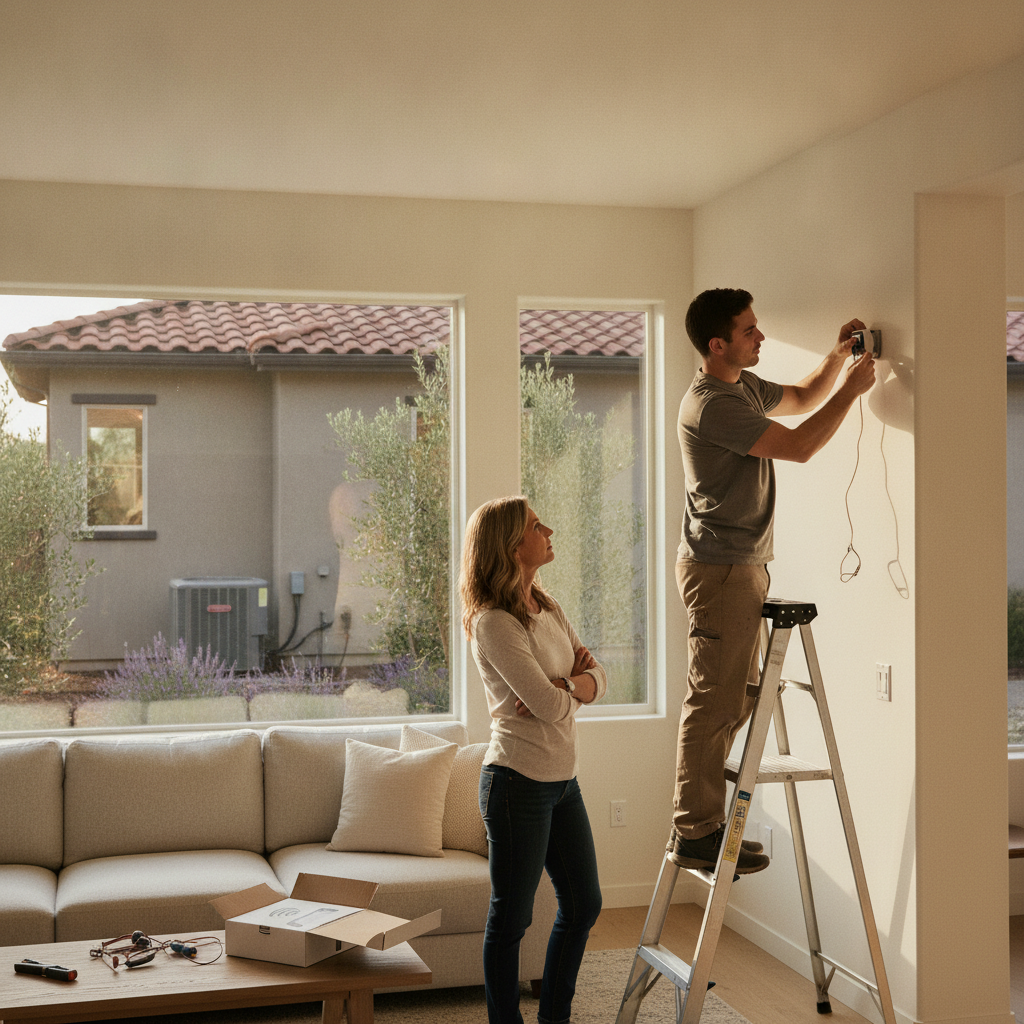
This isn’t something most homeowners discover until after installation. It’s one reason we recommend having a licensed HVAC technician handle the swap — not because thermostat installation is complicated, but because diagnosing your existing wiring setup and confirming compatibility before you open the box saves a lot of frustration.
Heat Pumps Require a Different Kind of Smart Thermostat
This is the section most competitor websites skip entirely, and it’s one of the most important things to understand if your Santa Rosa home uses a heat pump for year-round heating and cooling.
Heat pumps use a different set of control signals than conventional furnaces and air conditioners. They require an O/B reversing valve wire to switch between heating and cooling modes, and many have specific requirements for how auxiliary or emergency heat is controlled. A generic smart thermostat that isn’t explicitly labeled as heat-pump compatible can lock your system into one mode, run your auxiliary electric strip heat when it shouldn’t, or fail to control the reversing valve correctly — resulting in a system that blows warm air when you want cool, or vice versa.
If you’ve recently installed a heat pump — or if your home already had one when you moved in — make sure any thermostat you’re considering explicitly lists heat pump support, including multi-stage heat pump configurations if your system has variable-speed operation. Ecobee and Nest both offer heat pump compatible versions, but the configuration still needs to be done correctly during setup.
What Smart Thermostats Actually Save in Santa Rosa’s Climate
Sonoma County’s Mediterranean climate works in your favor here. Santa Rosa doesn’t get the brutal summer heat of Sacramento or the bone-deep cold of mountain communities. Most homes in the area are heating or cooling moderately rather than fighting extreme temperatures, which means your system isn’t running at maximum capacity for months on end.
That said, we do get heat waves — the kind that push temperatures into the high 90s or low 100s for a week at a stretch — and cold snaps in January and February that have homeowners in Windsor and Healdsburg scrambling when the heat goes out. A smart thermostat’s ability to pre-condition your home before a heat wave or drop temperatures overnight when it’s naturally cooler outside can make a meaningful difference in both comfort and energy use during those stretches.
The bigger savings opportunity in this region is probably shoulder-season programming. Because Santa Rosa’s spring and fall are genuinely mild, a lot of heating and cooling runs unnecessarily during months when opening a window would do the job. A smart thermostat with an outdoor temperature sensor — or one that uses local weather data — can avoid firing up your system during those periods entirely.
PG&E Rebates for Smart Thermostats
PG&E has periodically offered rebates on smart thermostats as part of their energy efficiency programs, and California’s utility rebate landscape changes frequently. If you’re already thinking about upgrading your thermostat, it’s worth checking current PG&E offers before you buy — the rebate can offset a significant portion of the purchase price on qualifying models. Ecobee and Nest devices have both appeared on past eligible lists. You can also pair a thermostat upgrade with other efficiency improvements to stack rebates where available. We’re happy to point you toward current offers when you call — see our current HVAC offers page for what we’re running on the service side as well.
When a Smart Thermostat Isn’t the Right First Move
If your HVAC system is already struggling — running constantly, failing to reach set temperatures, or producing unusual noises — a new thermostat won’t fix it. A thermostat controls your system; it doesn’t improve your system’s performance. Homeowners in Fountaingrove and Sebastopol who’ve called us after a DIY thermostat install sometimes find that the problem they were trying to solve was actually a refrigerant issue, a failing heat exchanger, or ductwork that was leaking too much conditioned air to hold temperature regardless of how good the control logic is.
Start with a system tune-up if you haven’t had one recently. A bi-annual maintenance visit — which we offer at $90 — will tell you whether your system is in shape to benefit from a thermostat upgrade or whether there’s a bigger issue to address first. It’s a much cheaper diagnostic than replacing a thermostat and then calling us anyway two weeks later.
Frequently Asked Questions
Will any smart thermostat work with my existing furnace?
Not necessarily. Most standard gas furnaces with 24-volt wiring are compatible with popular smart thermostats, but two-stage furnaces, variable-speed air handlers, and older systems with non-standard wiring can cause problems. Always check the compatibility tool on the manufacturer’s website using your furnace model number before purchasing.
Do I need a C-wire for a smart thermostat in an older Santa Rosa home?
Many smart thermostats require a C-wire for consistent power, and older homes in Sonoma County often weren’t wired with one. Options include running a new wire, using an adapter, or choosing a thermostat model designed to work without one. A technician can assess your wiring and recommend the right path before you buy anything.
Can I install a Nest or Ecobee on a heat pump system?
Yes, but you need to select a model that explicitly supports heat pump configurations and set it up correctly for your specific system type — including whether you have auxiliary or emergency heat. Incorrect configuration is one of the more common issues we troubleshoot on heat pump systems after DIY thermostat installs.
How much can I actually save with a smart thermostat in Santa Rosa?
Results vary depending on how the thermostat is programmed and how much your system was running unnecessarily before. Homes where occupants weren’t adjusting their old thermostat consistently tend to see the biggest gains. In Santa Rosa’s moderate climate, shoulder-season programming and away schedules tend to deliver the most noticeable savings.
Does PG&E offer rebates on smart thermostats?
PG&E has offered rebates on qualifying smart thermostats through their energy efficiency programs, though program availability and eligible models change. Check the PG&E website for current offerings, or ask us when you call — we can point you in the right direction and help ensure your installation qualifies.
Ready to Upgrade or Just Want a Second Opinion?
At Stout’s Heating & AC, Inc., we’ve been working on heating and cooling systems in Santa Rosa and across Sonoma County since 1992. We’re not here to sell you a thermostat — we’re here to make sure whatever you install actually works with your system the way it’s supposed to. If you want someone to assess your current setup, confirm compatibility before you buy, or handle the installation and configuration so it’s done right the first time, give us a call at (707) 527-1504 or reach out through our contact page. We serve homeowners throughout Santa Rosa, Petaluma, Windsor, Sebastopol, Healdsburg, Rohnert Park, and the surrounding area.