
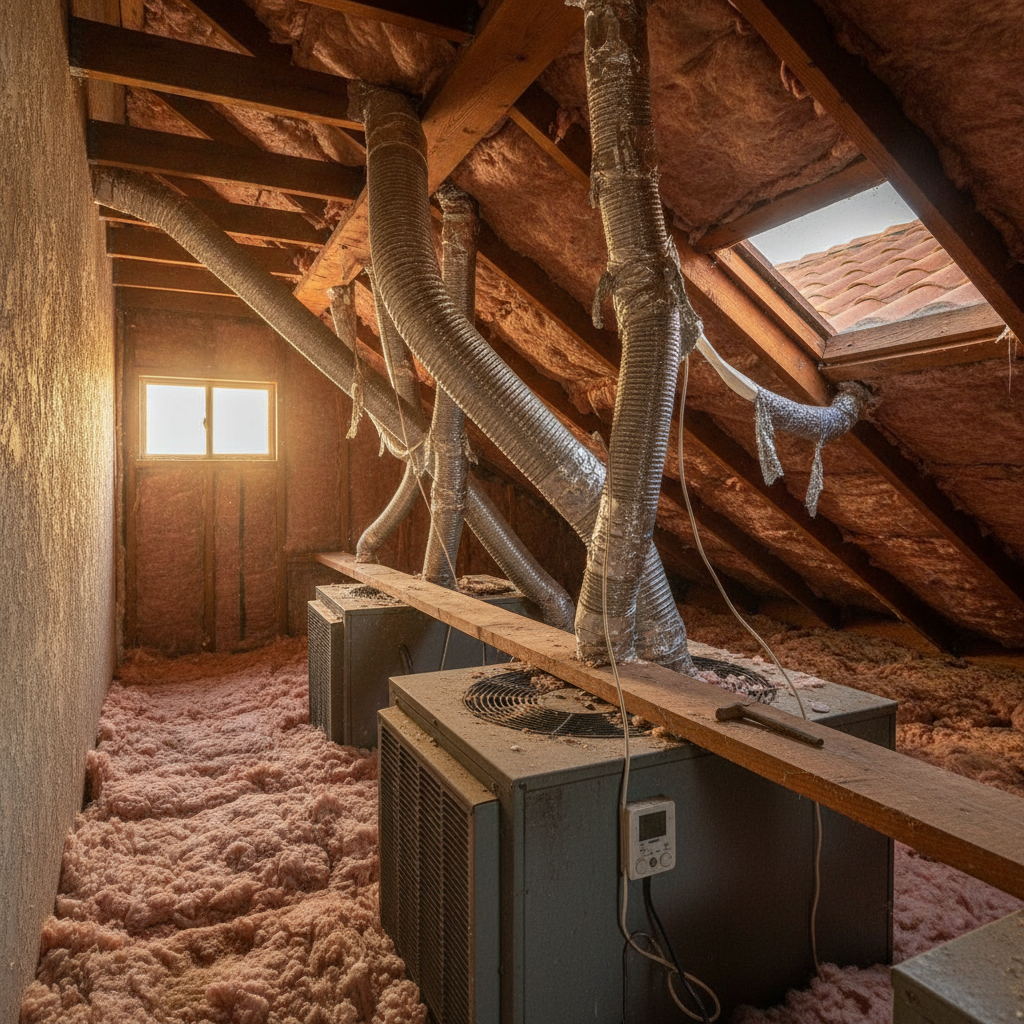
What Santa Rosa Homeowners Should Know About HVAC Ductwork — Why Hidden Leaks and Poor Design Are Costing You Money Every Month
If your heating or cooling bill feels higher than it should be, or some rooms in your house are always too warm while others never quite get comfortable, there’s a good chance your ductwork is the culprit — not your furnace or AC. In Santa Rosa, we work in homes every week where a relatively new, well-functioning system is being undermined by ducts that are leaking, undersized, or just poorly laid out. The frustrating part is that most homeowners don’t know this is happening until a technician actually looks.
Ductwork is probably the least glamorous part of an HVAC system, and it’s almost always out of sight — tucked in attics, crawl spaces, or inside walls. That invisibility is exactly why it goes unaddressed for years. But in a region where PG&E energy costs keep climbing and our summers push systems hard, what your ducts are doing behind the scenes matters more than most people realize.
What Duct Leaks Actually Look Like — and Why They’re So Easy to Miss
A duct leak isn’t usually a dramatic blowout. More often, it’s a small gap at a connection point, a section of flexible duct that’s pulled loose from a fitting, or old duct tape (the cloth kind, not the aluminum foil type used in HVAC) that’s dried out and lost its seal. These gaps can be as small as a quarter-inch, but over time they add up fast.
According to the U.S. Department of Energy, a typical home loses 20 to 30 percent of its conditioned air through duct leaks. In practical terms, that means your system is running longer and working harder to deliver air that’s escaping into your attic or crawl space instead of reaching your living room. You’re paying to condition space you’re not living in.
In older Santa Rosa neighborhoods like Bennett Valley, Coffey Park, and Rincon Valley, it’s common to find duct systems that were installed 30 or 40 years ago with materials and techniques that simply don’t hold up over time. Flexible ductwork in particular degrades — the inner liner can collapse or sag, and older mastic or tape seals eventually fail.
The Problem That Most HVAC Websites Don’t Talk About: Poor Duct Design
Leaks get the most attention, but poor duct design is actually the more common — and more expensive — problem in Sonoma County homes. This is the gap that most of our local competitors’ websites don’t address at all. They talk about sealing leaks, but they rarely explain that a duct system can be perfectly airtight and still deliver terrible results if it was designed wrong in the first place.
What does poor design look like? A few examples:
- Undersized ducts that restrict airflow and force your blower motor to work at high static pressure — shortening its life and reducing efficiency
- Too many bends and turns in flex duct runs, each one creating friction that slows airflow before it reaches the register
- Ducts that are too long for the system’s capacity, so air loses pressure before it gets to far rooms
- Unbalanced supply and return systems, where there’s plenty of supply air going out but not enough return air coming back — creating negative pressure that pulls unconditioned air into the home
- Ducts routed through unconditioned spaces without adequate insulation, so the air temperature changes significantly during transit
Many of these issues were baked into a home during original construction or a renovation where someone made shortcuts. They’re not something a standard tune-up will catch — you need a technician who actually evaluates your duct system, not just your equipment.
How to Know If Your Ducts Are the Problem
You don’t need a pressure test to notice warning signs. Here’s what to pay attention to:
- Rooms that are noticeably hotter or cooler than the rest of the house, regardless of the thermostat setting
- Weak airflow from one or more registers, even when the system is running full blast
- Your system runs constantly but the house never reaches the set temperature
- Unusually high energy bills compared to similar-sized homes in Petaluma or Windsor
- Excessive dust accumulating on surfaces shortly after cleaning — often a sign of return air leaks pulling in attic or crawl space air
- Noisy ducts that pop, bang, or whistle when the system kicks on
If you’re seeing two or more of these, it’s worth having someone evaluate the duct system directly — not just the equipment. A good HVAC technician will check static pressure, inspect accessible ductwork, and look at airflow readings at the registers. This is different from a standard tune-up, so it’s worth asking specifically about duct evaluation when you schedule.
Duct Sealing vs. Duct Replacement: What’s the Right Call?
This is a question we get often, and the honest answer is: it depends on the condition and configuration of your existing system.
If your ductwork is basically well-designed but has developed leaks over time — especially in a home that was rebuilt or significantly renovated after the 2017 Tubbs Fire, where many Coffey Park properties went through complete reconstruction — targeted duct sealing with mastic sealant or metal tape (not cloth duct tape) is often the right move. It’s less invasive and less expensive than replacement, and it can make a meaningful difference.
If the system was poorly designed from the start — wrong duct sizes, too many bends, inadequate returns — sealing alone won’t fix it. You may need to modify or partially replace sections of the duct system to get real results. This isn’t always a full replacement job; sometimes it’s strategic changes to the most problematic runs.
There’s also a middle path worth knowing about: for homes where duct access is limited (some older two-story homes in the West End or Railroad Square area, for example), aeroseal duct sealing is a pressurized process that seals leaks from the inside without tearing into walls or ceilings. It’s not something every contractor offers, so ask specifically if you’re in a home where access is an issue.
If you’re evaluating a full residential AC repair or system replacement, that’s also an ideal time to assess your ducts — because installing a new, high-efficiency system in a leaky duct system is like putting a new engine in a car with flat tires. You won’t get the performance you paid for.
The Energy Efficiency Connection — and What It Means for PG&E Bills
With PG&E rate increases hitting Sonoma County households harder every year, duct efficiency isn’t just a comfort issue — it’s a financial one. A well-sealed, properly designed duct system running a standard-efficiency unit will often outperform a high-efficiency unit running through leaky ducts. If you’ve been told your system is working fine but your bills don’t reflect it, the ducts deserve a serious look before you spend money on equipment upgrades.
California’s Energy Upgrade program and certain PG&E rebates cover duct sealing work in eligible homes. It’s worth asking about current rebate availability when you’re getting quotes, since these programs change periodically. You can also check our current HVAC offers and financing page for any active deals on diagnostic services and efficiency upgrades.
A Note for Homeowners in Healdsburg, Sebastopol, and Rohnert Park
Duct problems look a little different depending on where you live. In Healdsburg, we see a lot of older ranch homes with crawl space ductwork that’s been exposed to decades of moisture and rodent activity — both of which can compromise insulation and connections. In Sebastopol and western Sonoma County, homes that were built with radiant heat and later had central forced air added often have duct systems that were retrofitted into spaces not really designed for them, leading to awkward routing and airflow problems. In Rohnert Park, the mid-century tract homes along the 101 corridor frequently have original ducts that were never updated.
The point isn’t that any of these homes are beyond help — they’re not. But the right solution in each case depends on understanding what you’re actually working with, which requires a real inspection, not a guess.
Frequently Asked Questions About HVAC Ductwork in Santa Rosa
How long should ductwork last in a Sonoma County home?
Sheet metal ducts can last 25 years or more if they’re in good condition and properly sealed. Flexible ductwork typically has a shorter lifespan — roughly 15 to 20 years — and is more prone to sagging, kinking, and liner degradation, especially in hot attic spaces.
Can I seal my own ducts with duct tape from the hardware store?
Not effectively. Standard cloth duct tape dries out and fails within a few years — ironically, it’s one of the worst materials to use on ducts. Proper duct sealing uses mastic sealant or foil-backed metal tape, applied by someone who can actually access and inspect the connections. DIY sealing of visible register seams can help at the margins, but it won’t address leaks inside the system.
Will sealing my ducts affect my indoor air quality?
In a positive way, yes. Return duct leaks in particular can pull air from attics, crawl spaces, or wall cavities — air that may carry dust, mold spores, rodent dander, or during wildfire season, smoke particles. Sealing those leaks reduces the amount of unfiltered air entering your living space.
What’s the difference between duct sealing and duct insulation?
These are two separate things. Sealing addresses gaps and leaks that let air escape. Insulation addresses thermal loss — how much heat or cooling the air loses as it travels through ducts in unconditioned spaces like attics. Both matter for efficiency, and both are worth evaluating during the same inspection.
Do ductless mini-splits avoid these problems entirely?
Yes — ductless systems deliver conditioned air directly to the room without any duct runs, so duct leakage and design problems don’t apply. This is one reason they’re a strong option for older Santa Rosa homes where adding or upgrading ductwork is impractical or cost-prohibitive. That said, they come with their own installation considerations and aren’t the right fit for every situation.
Ready to Find Out What Your Ductwork Is Really Doing?
At Stout’s Heating & AC, Inc, we’ve been working in Santa Rosa and Sonoma County homes since 1992. We know what duct systems look like in the neighborhoods here, what shortcuts were taken during different construction eras, and how to give you an honest evaluation of whether sealing, modification, or a different approach makes the most sense for your specific home.
If you’re dealing with uneven temperatures, high energy bills, or a system that just doesn’t perform the way it should, we’d encourage you to let us take a look at the whole picture — not just the equipment. Contact us to schedule an evaluation or ask any questions. No pressure, no upsell — just a straight answer about what’s going on with your system.