
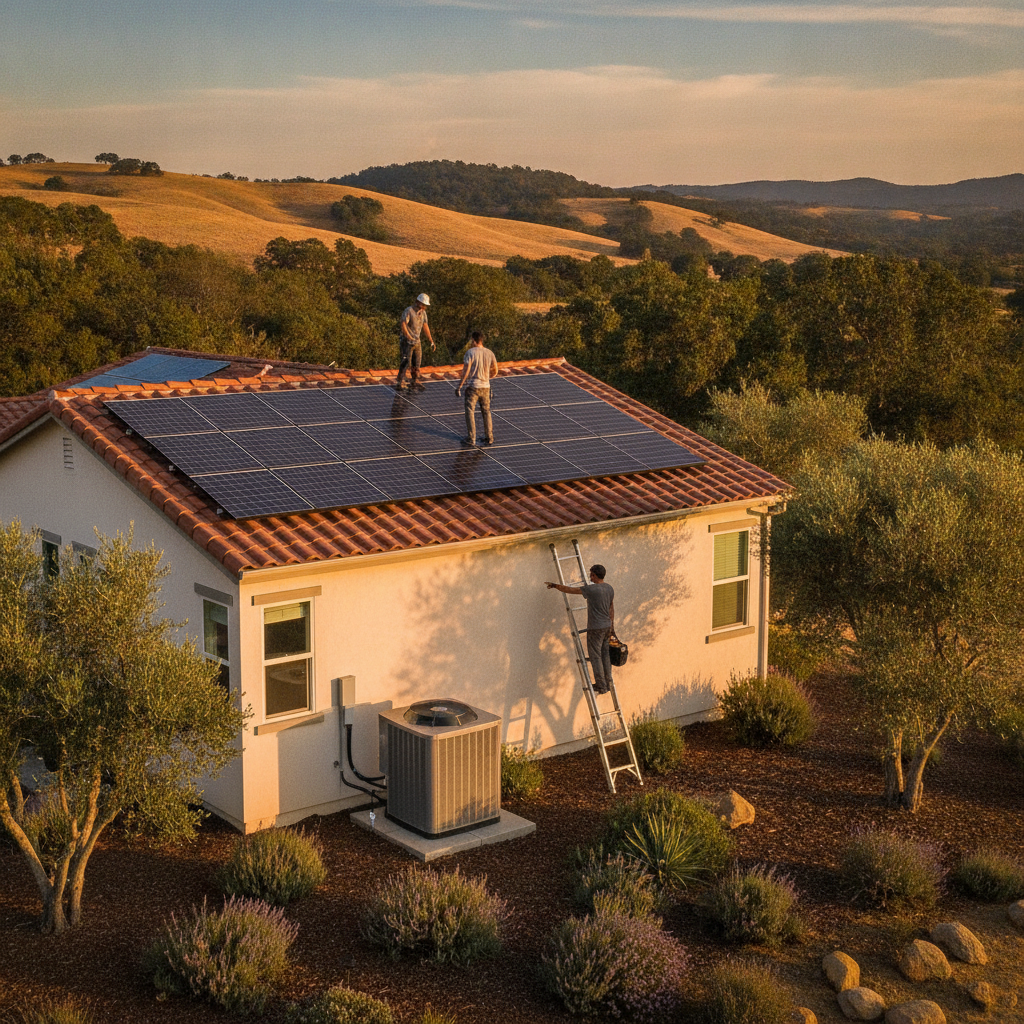
What Santa Rosa Homeowners Should Know About HVAC and Solar Panels — How Going Solar Affects Your Heating and Cooling System, Energy Bills, and Equipment Choices
If you’re going solar in Santa Rosa, your HVAC system is almost certainly the largest single load on your home’s electrical panel — and the one that will determine whether your solar array actually covers your energy use. Most solar salespeople will show you a chart of your PG&E bills and size a panel system around your historical usage. What they typically won’t tell you is that if your heating and cooling equipment is old, gas-dependent, or undersized, those numbers are going to shift — and not always in the direction you expect. Getting both systems planned at the same time, with an HVAC contractor in the loop, is one of the most practical things you can do before signing a solar contract.
Why HVAC and Solar Can’t Be Planned in Separate Conversations
Here’s the situation we see regularly in Santa Rosa and surrounding parts of Sonoma County: a homeowner installs solar panels based on their current electricity usage, then a year or two later decides to replace their old gas furnace with a heat pump. The heat pump is more efficient, but it runs on electricity instead of gas. Suddenly the solar array that was sized to cover their old load is running short — especially in winter when sun hours are limited and heating demand is highest.
The reverse also happens. A homeowner installs a heat pump first, watches their electricity bill climb under PG&E’s tiered rates, and then goes solar — sometimes with a system that still isn’t quite big enough because nobody accounted for the full annual heat pump load from the start.
Neither situation is a disaster, but both are avoidable with a little coordination. If you’re planning a solar installation, it’s worth having a conversation with your HVAC contractor before you sign anything — not after.
The Equipment Decision That Matters Most: Heat Pump vs. Gas Furnace
Sonoma County’s Mediterranean climate — warm, dry summers and mild, wet winters — is genuinely well-suited for heat pump technology. Heat pumps don’t generate heat by burning fuel; they move heat from one place to another using refrigerant, which makes them significantly more efficient than a gas furnace at the same output. In Santa Rosa’s moderate winter temperatures, a quality heat pump from Daikin, Mitsubishi Electric, or Trane will typically produce two to three times more heating energy than the electricity it consumes.
That efficiency ratio is exactly why heat pumps and solar panels are such a natural pairing. When your heating and cooling runs on electricity and your solar array is generating electricity, you can offset a large portion of your HVAC operating cost — sometimes most of it, depending on system sizing, home insulation, and how much of your usage falls during daylight hours.
The tradeoff is that a heat pump adds to your electrical load year-round, while a gas furnace keeps your winter energy consumption split between electricity (for the air handler and controls) and gas (for the burner). Which approach makes more financial sense depends on your specific situation — your current equipment age, your PG&E rate tier, your solar array size, and whether you plan to add battery storage.
What About Dual Fuel Systems?
One option worth knowing about — and one that’s underrepresented in most solar conversations — is a dual fuel or hybrid heat pump system. This pairs a heat pump with a gas furnace backup. The system runs on the heat pump during mild weather when the heat pump is at its most efficient, then switches automatically to the gas furnace when outdoor temperatures drop far enough that gas becomes the more cost-effective choice.
In Santa Rosa, where we rarely see extended hard freezes, the heat pump handles most of the work. The gas furnace is essentially insurance for the coldest nights. For homeowners who already have a newer gas furnace and are adding solar, a dual fuel setup can be a smart middle step — it reduces your gas consumption without requiring you to fully replace equipment that still has years of useful life.
Sizing: The Gap Most Solar Proposals Leave Open
When a solar company sizes your array, they’re typically looking at twelve months of past electricity bills. If those bills reflect a home heated primarily by gas, they don’t reflect the electricity demand of a future heat pump. A good solar proposal should include a projection of what your electrical load will look like after any planned equipment changes — and that number needs to come from someone who understands HVAC loads, not just kilowatt-hour averages.
For a typical three-bedroom home in Santa Rosa or Rincon Valley running a ducted heat pump system, you might add anywhere from 2,000 to 5,000 kilowatt-hours per year to your electrical load compared to the same home with a gas furnace. That’s not a rounding error — it can mean the difference between a solar system that covers your bills and one that leaves you with a significant PG&E true-up charge every spring.
Homeowners in Fountaingrove and other hillside neighborhoods with larger square footage and more exposure to summer sun will typically see even higher HVAC loads. Getting an accurate Manual J load calculation done on your home before solar sizing is one of the most practical things you can do, and it’s something we can help with.
California Incentives: How Solar and HVAC Rebates Stack
One angle that most local competitors haven’t done a good job covering is how solar and HVAC incentives can stack. Right now, California homeowners who install a heat pump may be eligible for PG&E rebates, California Energy Commission incentives, and the federal 25C tax credit — which covers up to 30% of heat pump installation costs. Solar installations also qualify for a separate 30% federal investment tax credit under the Inflation Reduction Act.
These aren’t combined into a single program — they come from different sources — but they can be used in the same tax year. A homeowner who installs both a qualifying heat pump system and a solar array in the same calendar year could claim federal tax credits on both. The specific amounts and eligibility rules change, so it’s worth confirming current terms with your tax advisor. But the general principle — that electrifying your HVAC and going solar are both incentivized simultaneously — is real and worth understanding before you make either decision.
You can check our current HVAC financing and rebate offers to see what’s available right now for heat pump installations.
Practical Advice Before You Commit to Either System
- Have your HVAC system assessed before solar sizing. An honest evaluation of your current equipment’s age and efficiency — and whether a heat pump upgrade makes sense — should happen before the solar proposal is finalized.
- Ask the solar company to show you projections with and without a heat pump. If they can’t or won’t do this, that’s a gap in their proposal.
- Don’t assume your current ductwork will work with a new heat pump. Older homes in Windsor, Petaluma, and parts of Santa Rosa often have duct systems sized for gas furnace airflow, which is different from what a heat pump needs. Leaky or undersized ducts reduce system efficiency and can void warranty terms on some equipment.
- Consider battery storage if wildfire-related outages are a concern. Solar panels alone don’t power your home during a grid outage — only solar-plus-storage does. Healdsburg and Sebastopol homeowners who’ve experienced PSPS events know this firsthand.
- Check panel capacity. Adding both a heat pump and solar (especially with battery storage) often requires a main electrical panel upgrade. This is a real cost that should be in the planning conversation from the beginning.
Frequently Asked Questions
Will solar panels actually save me money if I switch to a heat pump in Santa Rosa?
In most cases, yes — but the savings depend heavily on accurate system sizing. A heat pump is significantly more efficient than a gas furnace, and when paired with a right-sized solar array, many Santa Rosa homeowners see their combined electricity and gas bills drop substantially. The key is planning both systems together rather than independently.
Can I add solar to my home without changing my HVAC system?
Yes. Solar panels work with any existing HVAC equipment. But if your furnace or AC is nearing end of life, it’s worth having the conversation about heat pump replacement before you finalize the solar system size — especially given available incentives.
How does Rohnert Park’s or Petaluma’s climate compare to Santa Rosa for heat pump performance?
All three cities share a similar Mediterranean climate profile — hot, dry summers and mild winters with occasional cold snaps. Heat pumps perform well across Sonoma County. The main variable is how well-insulated the home is, not the outdoor temperature alone.
Does a dual fuel system qualify for the same incentives as a full heat pump?
Federal and California incentives for heat pumps generally apply to the heat pump component of a dual fuel system. The specifics depend on equipment efficiency ratings and current program rules — it’s worth confirming with your HVAC contractor and tax advisor before installation.
How do I know if my current ducts can handle a heat pump?
A qualified HVAC contractor should do a duct assessment before any heat pump installation. We check airflow capacity, leakage, and insulation as part of our evaluation process. Homes built before the 1990s in older Santa Rosa neighborhoods often need duct repairs or modifications before a heat pump will perform correctly.
Get the Full Picture Before You Commit
Going solar is a smart long-term move for most Santa Rosa homeowners — but the return on investment depends heavily on how well your HVAC system works with it. We’ve been in business since 1992 and we work with homeowners across Sonoma County every day who are navigating exactly this kind of decision. We’re not solar installers, but we know HVAC loads, equipment efficiency, duct performance, and what systems make sense for specific homes and budgets.
If you’re trying to figure out whether a heat pump, a dual fuel system, or keeping your current equipment makes the most sense alongside a planned solar installation, we’re happy to talk it through — no sales pressure, just straight answers from people who’ve been doing this work locally for more than thirty years. Contact Stout’s Heating & AC, Inc to schedule an evaluation or ask us your questions directly.