
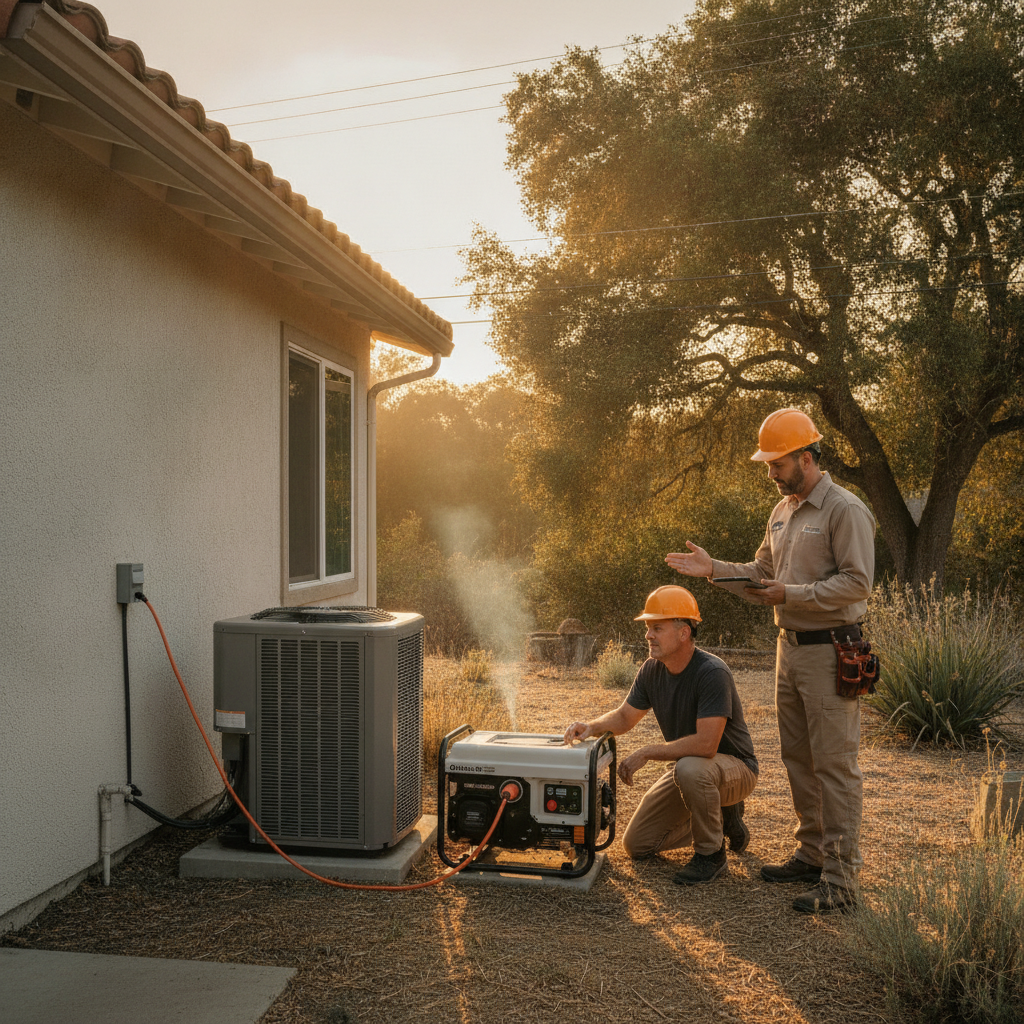
What Santa Rosa Homeowners Should Know About HVAC and Home Backup Generators — How Your Heating and Cooling System Behaves When the Grid Goes Down
If you live in Santa Rosa or anywhere in Sonoma County, you already know that losing power isn’t a hypothetical. PG&E’s Public Safety Power Shutoff program — PSPS events triggered during high fire-risk weather — has made multi-day outages a regular part of life here, particularly in hillside neighborhoods like Fountaingrove and Rincon Valley, and further north toward Healdsburg and Cloverdale. The question most homeowners haven’t fully answered yet is a practical one: what actually happens to your heating and cooling system when the grid goes down, and what does it take to keep it running?
This isn’t something most local HVAC contractors talk about in detail. It’s one of the clearest content gaps we’ve seen compared to what competitor sites cover — they mention generators in passing at best. So here’s a straightforward look at what you’re dealing with as a Sonoma County homeowner.
Your HVAC System Needs Electricity — Even If It Runs on Gas
This surprises a lot of people. If you have a gas furnace, you might assume a power outage is no big deal — after all, the fuel is still flowing. But modern gas furnaces rely on electricity to run the blower motor, the control board, the ignition system, and the thermostat. No power means no heat, even with a full gas supply. The same applies to gas-powered central air conditioning: the compressor outside, the air handler inside, and the thermostat all need electricity to operate.
Heat pumps are entirely electric, so they’re equally affected by outages — though as we’ll cover below, the generator math looks a little different depending on your system.
What It Actually Takes to Run HVAC on a Generator
Generator sizing is where most homeowners get into trouble, and it’s also where generic advice falls apart quickly. The right generator size depends heavily on your specific equipment — not a one-size-fits-all recommendation from a big-box store.
Starting Load vs. Running Load
HVAC equipment — especially air conditioners and heat pumps — draws a large surge of electricity the moment it starts up. This is called the starting load, and it can be two to three times higher than the steady running load. A central AC unit that runs at 3,000–4,000 watts might demand 7,000–9,000 watts on startup. If your generator can’t handle that surge, the system either won’t start or you risk tripping the generator’s overload protection repeatedly.
This is why a small 3,500-watt portable generator — the kind many Sonoma County households already own for basic outage preparedness — typically cannot power central air conditioning or a whole-home heat pump. It can often handle a gas furnace’s blower motor (which is a much lighter load), but that’s about it on the HVAC side.
Rough Generator Size Ranges for HVAC
- Gas furnace only (blower + controls): 1,000–2,000 watts running load. Many mid-size portable generators can handle this alongside other essential loads.
- Central AC or heat pump (3-ton system): Typically requires a generator rated for 7,500–10,000+ watts to handle startup surge.
- Whole-home standby generator: A 14kW–22kW standby unit can usually run your entire home including HVAC, depending on what else is drawing power simultaneously.
These are general ranges. Your actual requirements depend on your system’s rated amperage, efficiency rating, age, and what else you’re running at the same time. Before investing in a generator, it’s worth having an HVAC technician review your specific equipment and give you accurate numbers — not estimates from a product listing.
Heat Pumps and Generators: A More Complicated Relationship
Heat pumps have become increasingly popular in Santa Rosa and across Sonoma County because they handle both heating and cooling from one system — a smart fit for our Mediterranean climate where winters are mild enough that you don’t always need a gas furnace’s raw output. But heat pumps draw more electricity than a gas furnace, and that changes the generator conversation significantly.
If you’ve made the switch to a heat pump system or are considering one, generator compatibility is a question worth asking upfront. Some newer variable-speed heat pumps are actually more generator-friendly than older single-stage units because they ramp up gradually rather than demanding a full surge at startup. That said, they still typically require more generator capacity than a gas furnace blower.
One practical hybrid approach that works well in Sonoma County: a dual fuel or heat pump hybrid system pairs an electric heat pump with a gas furnace backup. During a power outage, your gas furnace can take over — and since it draws far less electricity than the heat pump, a mid-size generator may be sufficient to keep you warm through a PSPS event. It’s a resilience argument for dual fuel systems that rarely gets discussed alongside the efficiency and cost arguments.
Ductless Mini-Splits and Generator Power
Ductless mini-split systems — common in older Santa Rosa homes in areas like West End and Railroad Square where adding central ductwork isn’t practical — tend to have lower startup surge demands than traditional central systems. This makes them somewhat more generator-compatible in certain configurations, though you’d still want to verify wattage requirements for your specific unit before assuming your existing generator can handle it.
Automatic Standby vs. Portable Generators: What’s the Difference for HVAC?
Portable generators require you to be home, manually start them, run extension cords or use a transfer switch, and refuel them. For HVAC equipment, they typically need to be wired through a properly installed transfer switch — you should never backfeed a generator into your home’s panel without one, and you should never run HVAC equipment on extension cords.
Automatic standby generators (the kind permanently installed outside your home and connected to natural gas or propane) start on their own within seconds of an outage and can be sized to run your full HVAC system without any manual intervention. They’re a bigger upfront investment, but for households in high fire-risk zones like Windsor, Healdsburg, or the eastern hills above Santa Rosa, the convenience and safety case is real — especially if someone in the household has medical equipment or extreme temperature sensitivity.
Generator installation is outside our scope as an HVAC company, but properly sizing your HVAC load is squarely in it. If you’re working with an electrician on a standby generator project, loop in your HVAC contractor too — the two conversations need to happen together, not separately.
What to Check on Your HVAC System Before Outage Season
Regardless of your generator situation, there are a few things worth doing before wildfire season and PSPS season overlap — typically late September through November in Sonoma County:
- Have your furnace or heat pump serviced before fall so it’s running efficiently and there are no latent issues that an outage could worsen.
- Know where your HVAC system’s disconnect switches are and how to safely power it down if needed.
- If you have a smart thermostat, understand how it behaves during a power interruption — some lose programming and need to be reset.
- If you use a portable generator, confirm you have a properly installed transfer switch before connecting HVAC equipment to it.
Our bi-annual tune-up service is a good starting point — it catches problems before they become emergencies, and fall is the right time to service your heating system before the rains and cold arrive. You can review our current service offers and financing options if you’ve been putting maintenance off.
Frequently Asked Questions
Can I run my furnace on a small portable generator during a PG&E outage?
Possibly, but it depends on your furnace’s blower motor size. A standard gas furnace typically draws 500–1,500 watts at running load, which many mid-range portable generators can handle. The key is using a proper transfer switch — never plug HVAC equipment directly into a generator via extension cord.
Will a PSPS outage damage my HVAC system?
The outage itself typically won’t cause damage, but power restoration can. When the grid comes back on, it sometimes delivers a voltage surge. This is worth knowing if you have an older system with a sensitive control board. A whole-home surge protector is a relatively inexpensive safeguard worth discussing with an electrician.
I have a heat pump. Can I still use it during an outage if I have a generator?
Yes, but you’ll need a generator with enough capacity to handle the startup surge, which is higher for heat pumps than for gas furnace blowers. A whole-home standby generator is usually required to reliably power a central heat pump. Talk to both your electrician and your HVAC contractor before assuming compatibility.
What’s the best heating backup option for a Sonoma County home during wildfire season outages?
It depends on your home and existing equipment. A dual fuel system gives you gas furnace backup during outages with minimal generator requirements. Ductless mini-splits in lower-wattage configurations can also be more generator-friendly. There’s no single answer, but it’s a conversation we’re happy to have based on your specific setup.
Does Stout’s Heating & AC offer emergency service during power outages or extreme weather events?
Yes. We’ve been serving Santa Rosa and Sonoma County since 1992, and we’re available for same-day and emergency service calls. If your system fails during a heat wave, cold snap, or after power is restored from an outage, give us a call and we’ll get someone out as quickly as possible.
Talk to a Local HVAC Contractor Who Knows Sonoma County
Generator preparedness and HVAC reliability go hand in hand in this part of California — and it’s not a conversation that gets enough attention from local contractors. If you’re not sure how your heating and cooling system would hold up through a multi-day outage, or if you’re planning a generator installation and want to make sure your HVAC system is part of the load calculation, we’re glad to help.
Stout’s Heating & AC has been a locally owned business in Santa Rosa since 1992. We’re not a franchise, we don’t have a call center, and we don’t send whoever’s available from three counties away. When you call us, you’re talking to people who live and work in Sonoma County and understand what our climate and our grid actually demand from your equipment. Contact us to schedule a service call or ask us your questions directly — no pressure, just straight answers.