
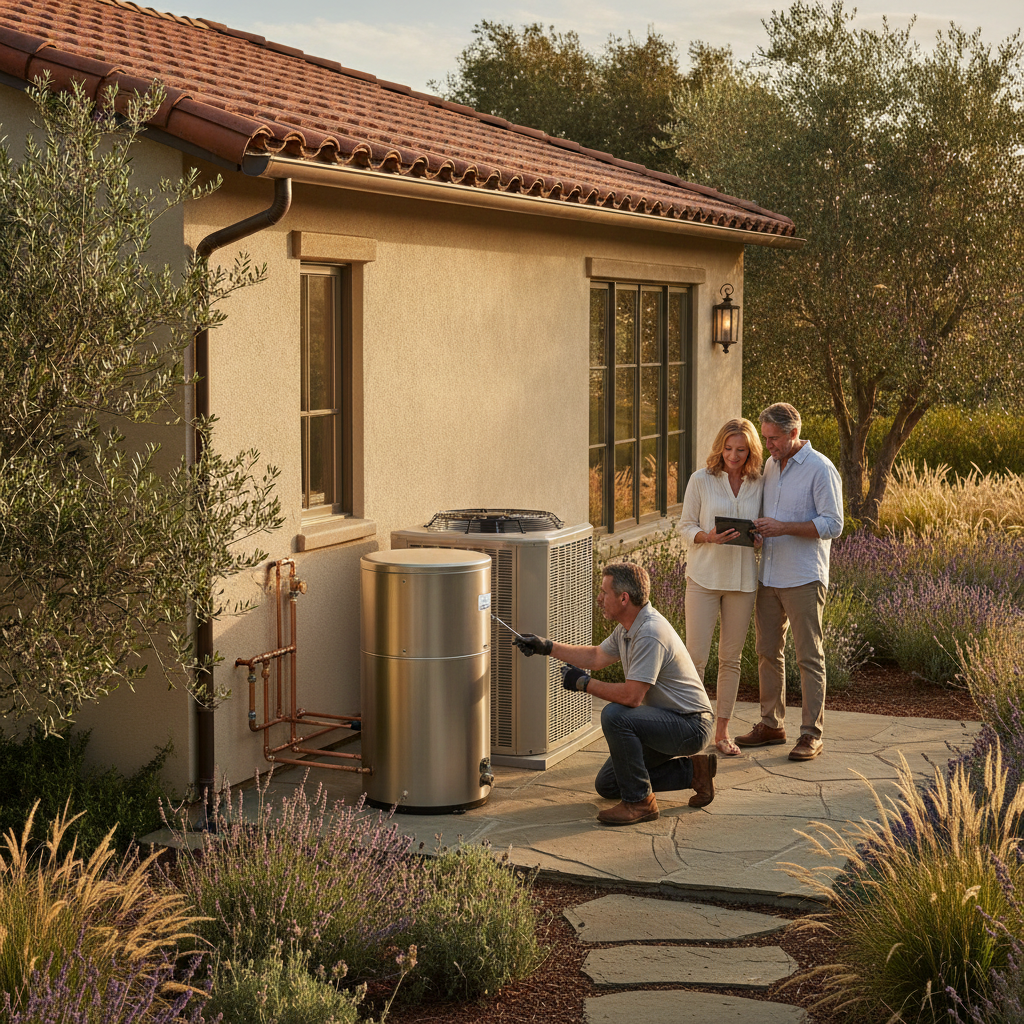
What Healdsburg and Sonoma County Homeowners Should Know About Heat Pump Water Heaters — How Pairing One With Your HVAC System Can Cut Energy Bills Significantly
If you’ve been looking for ways to lower your PG&E bill without a major renovation, a heat pump water heater might be the most underrated upgrade you haven’t considered yet. For homeowners in Healdsburg, Windsor, Cloverdale, and across Sonoma County’s North County corridor, the combination of available rebates, California’s moderate climate, and rising electricity rates makes this an unusually good moment to look seriously at how your water heating and HVAC systems work together — or don’t.
Most HVAC contractors won’t bring this up. It’s not really their department, and water heater installers usually focus on the appliance itself without thinking about how it fits into your home’s overall comfort and energy picture. We’ve been servicing heating and cooling systems in Santa Rosa and surrounding communities since 1992, and over the years we’ve seen a lot of homes where expensive HVAC upgrades were only solving half the problem. Water heating is typically the second-largest energy expense in a home. It’s worth understanding.
What a Heat Pump Water Heater Actually Does — and Why It Matters for Your HVAC
A heat pump water heater doesn’t generate heat the way a traditional electric resistance tank does. Instead, it pulls heat from the surrounding air — the same basic principle your heat pump or air conditioner uses — and transfers that heat into the water. It’s two to three times more efficient than a standard electric water heater, and it qualifies for both federal tax credits and significant PG&E rebates right now.
Here’s the part most people don’t realize: because a heat pump water heater pulls heat from the air around it, it also cools and dehumidifies that space slightly. In a garage or utility room during a Healdsburg summer, that’s actually a nice side effect. But in a hallway closet or a conditioned interior space during winter, it can work against your heating system — pulling warmth out of a room your furnace is trying to heat. The placement of these units matters, and it’s the kind of thing worth thinking through before you buy.
Conversely, if the unit is installed in an unconditioned garage or a utility space with adequate airflow, the HVAC interaction becomes largely a non-issue — and you get the full efficiency benefit without any thermal penalty.
Why Sonoma County’s Climate Makes This a Strong Fit
Heat pump water heaters perform best when the air around them stays above roughly 40–50°F. In most of Sonoma County, that’s most of the year. Even in January, Healdsburg and Windsor don’t see sustained freezing temperatures the way inland foothills or mountain communities do. Our Mediterranean climate — warm dry summers, cool but mild winters — is actually close to ideal operating conditions for this technology.
Compare that to homeowners in colder climates where these units switch to less-efficient backup resistance heating for months at a time. In Sonoma County, that backup mode rarely kicks in, which means you’re capturing efficiency gains year-round rather than just in warmer months. For a family of four, the annual savings compared to a conventional electric tank can run several hundred dollars — and the systems typically pay for themselves within four to six years, faster if you’re claiming available incentives.
The Rebate and Tax Credit Picture Right Now
This is an area that moves fast, so we’ll give you the framework rather than specific dollar amounts that might be outdated by the time you read this. As of this writing, federal tax credits under the Inflation Reduction Act cover 30% of the cost of a qualifying heat pump water heater, up to a cap. PG&E offers additional rebates for qualifying models, and income-qualified households may be eligible for even higher incentive amounts through separate programs.
The key detail is that these incentives are available now and are designed to decline over time as adoption increases. If you’ve been on the fence about this upgrade, the financial case is stronger at this moment than it’s likely to be in a few years. We always recommend checking current PG&E rebate listings and consulting with your tax advisor, but the structure is favorable for most Sonoma County homeowners right now.
You can also look at our current HVAC offers and financing options — energy efficiency upgrades often pair well with 0% financing when you’re making multiple improvements at once.
What This Has to Do With Your HVAC System — the Part Competitors Skip
We’ve looked at how other local contractors talk about heat pump water heaters online, and there’s a gap worth addressing directly: almost nobody discusses how the appliance choice affects the rest of your home’s mechanical systems. Here’s what actually matters:
- Electrical load: Heat pump water heaters run on a standard 240V circuit, but they draw significantly less amperage than electric resistance tanks when in heat pump mode. If you’re also planning a heat pump HVAC upgrade or EV charger installation, understanding your panel capacity becomes important. These decisions are connected.
- Air volume requirements: These units need a minimum of roughly 700–1,000 cubic feet of surrounding air to operate efficiently. A closet installation usually doesn’t meet this. A garage, basement, or utility room typically does. If your home doesn’t have an obvious location, it’s worth a conversation before you purchase.
- Interaction with whole-home HVAC: As mentioned above, an interior installation in a conditioned space will impose a small cooling load in winter. For most homes this is minor and manageable, but if your heating system is already undersized — which is common in older Santa Rosa and Healdsburg homes — it’s worth factoring in.
- Noise: Heat pump water heaters are quieter than you’d expect but not silent. They produce a low compressor hum similar to a mini-split indoor unit. Garage or utility room placement is usually a non-issue. A hallway adjacent to a bedroom may warrant consideration.
None of these factors should scare you off the technology. They’re just things worth knowing before the installer shows up, so you’re making a fully informed decision rather than a reactive one.
How This Fits Into a Broader Home Electrification Strategy
Many Sonoma County homeowners are thinking about electrification — moving away from natural gas for both environmental and cost reasons as PG&E rates continue to rise. A heat pump water heater pairs naturally with a heat pump HVAC system as part of a phased approach. You don’t have to do everything at once. Some households start with the water heater because the payback period is shorter, then move to a heat pump for space conditioning in a subsequent year when the budget allows.
For homes in Cloverdale, Windsor, and other parts of the North County where natural gas infrastructure is reliable but rates are climbing, a hybrid approach also makes sense — keeping gas backup for the coldest days while shifting the base load to electric heat pump technology. This is essentially the same logic as a dual fuel HVAC system applied to water heating.
Frequently Asked Questions
Can I install a heat pump water heater in my garage in Healdsburg?
In most cases, yes. A garage is actually one of the better locations — there’s usually adequate air volume, it’s unconditioned so the slight cooling effect of the unit doesn’t work against your HVAC, and noise isn’t an issue. The main question is whether your electrical panel can support the new 240V circuit. A licensed electrician can assess that in a short visit.
Will a heat pump water heater work during a Sonoma County winter?
Yes, for the vast majority of Sonoma County homes. These units operate efficiently down to around 40–50°F and switch to backup resistance heating below that threshold. Our winters in the Santa Rosa and Healdsburg areas rarely sustain temperatures that low, so efficiency losses from cold weather are minimal compared to colder climates.
How does this interact with my existing furnace or heat pump HVAC?
The main interaction is thermal: if installed in a conditioned space, the unit pulls some heat from that space while operating, which your HVAC must offset. In an unconditioned garage or utility space, this isn’t a meaningful concern. Electrically, the two systems are independent circuits and don’t interfere with each other directly.
What brands are worth considering?
Rheem, A.O. Smith, Bradford White, and GE Appliances all make qualifying heat pump water heaters. We don’t sell water heaters directly, but we can help you think through placement, electrical considerations, and how the installation fits with any HVAC work you’re planning at the same time.
Is there any downside to making this switch?
The honest answer is: upfront cost and installation complexity are higher than a standard electric tank. Recovery time (how quickly the unit reheats after heavy use) is slower in heat pump mode, though most families with adequate tank sizing don’t notice this in practice. And as noted, placement matters more than it does with a conventional tank. These are real tradeoffs worth knowing about — not deal-breakers for most households, but worth considering.
Ready to Think Through Your Options?
At Stout’s Heating & AC, Inc., we’ve been helping Sonoma County homeowners make smart, lasting decisions about their home comfort systems since 1992. We’re not here to sell you something you don’t need — we’re here to give you the full picture so you can make the call that’s right for your home and your budget.
If you’re considering a heat pump water heater and want to understand how it fits with your existing HVAC setup, or if you’re planning a broader electrification or efficiency project, we’re happy to walk through it with you. Contact us to schedule a conversation — no pressure, just straight answers from people who know these systems and know this area.