
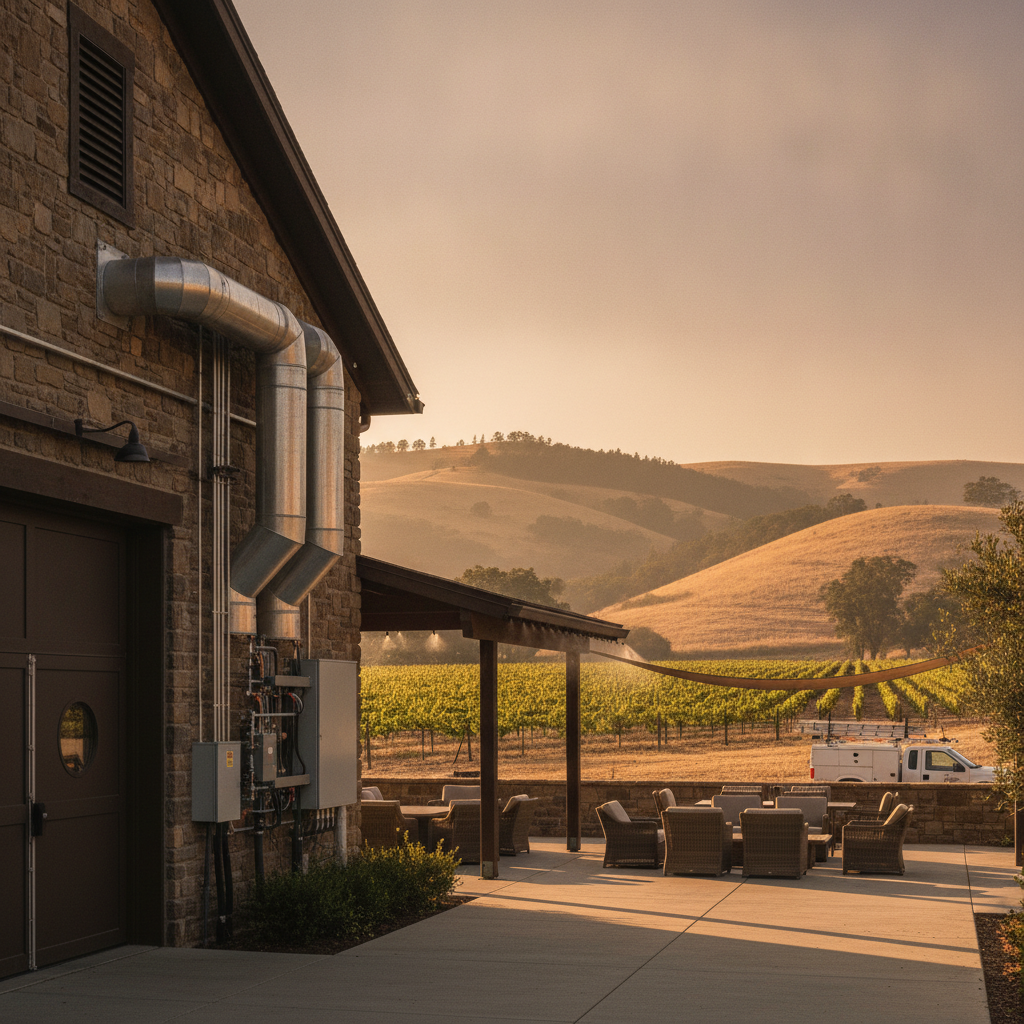
What Sonoma County Winery and Tasting Room Owners Should Know About Commercial HVAC — How to Keep Guests Comfortable, Protect Inventory, and Manage Seasonal Demand
If you own or manage a winery or tasting room in Sonoma County, your HVAC situation is more complicated than almost any other commercial property in the region — and most general HVAC contractors aren’t fully equipped to handle it. Between peak summer tourism traffic, wildfire smoke season, wine storage climate requirements, and the reality that your guests are paying for an experience, your heating and cooling system has to do a lot more than just keep a space livable. This guide covers what you actually need to know, whether you’re running a small estate tasting room in Kenwood, a larger production facility outside Healdsburg, or a wine country restaurant in Santa Rosa.
Why Wineries and Tasting Rooms Have Different HVAC Requirements Than Standard Commercial Spaces
Most commercial HVAC guides talk about square footage and occupancy loads. Those matter here too, but wine country hospitality businesses have a few layers on top of that.
First, tasting rooms often shift from nearly empty on a Tuesday morning to packed on a Saturday afternoon in harvest season — sometimes within the same day during a busy event. Your system needs to handle that swing without guests noticing a lag. A rooftop unit sized for average occupancy will struggle on a 100-degree August afternoon when you have 40 people inside and the doors are opening and closing constantly.
Second, many wineries have adjacent or integrated barrel rooms, fermentation areas, or production spaces that need to stay at very specific temperatures year-round — typically in the mid-50s to low 60s Fahrenheit. If your HVAC contractor doesn’t understand that those spaces require separate zoning and often dedicated climate control, you’re looking at potential product loss, not just discomfort.
Third, Sonoma County’s Mediterranean climate is beautiful for growing grapes, but it also means your system has to swing between hot, dry summers and cool, wet winters — sometimes with very little transition time between them. That range puts more wear on equipment that isn’t sized and configured correctly for it.
The Wildfire Smoke Problem Most Tasting Room Owners Don’t Plan For
Wildfire smoke season has changed the calculus for outdoor hospitality in wine country. What used to be an occasional disruption is now a predictable annual challenge for businesses in areas like Glen Ellen, Kenwood, Cloverdale, and the hills east of Santa Rosa. When air quality drops, guests who planned to sit on your patio move inside — and your HVAC system suddenly becomes the entire guest experience.
Standard commercial HVAC filtration is not designed to handle wildfire smoke particulates. If your system is pulling in outdoor air through standard filters, you’re recirculating fine smoke particles that guests can smell and that affect anyone with respiratory sensitivities. The solution isn’t just closing the dampers — it requires the right filtration approach for your specific system and building configuration.
This is one of the most underserved areas in commercial HVAC guidance for wine country businesses. If a contractor is telling you your existing system is fine for smoke season without assessing your filtration, fresh air intake setup, and building envelope, that’s worth a second opinion. Commercial ventilation for hospitality spaces in Sonoma County requires a different conversation than it does for an office building in a city center.
Zoning and System Type: What Actually Works in a Tasting Room
Not every winery or tasting room is a good candidate for the same type of system. Here’s a straightforward breakdown of what tends to work and when.
VRF (Variable Refrigerant Flow) Systems
VRF systems are well-suited to wine country hospitality properties with multiple spaces that need independent temperature control — tasting room, barrel room, kitchen, private event space, and offices all on different schedules and setpoints. They’re quiet, efficient, and allow each zone to heat or cool independently, which matters when your barrel room needs to stay at 58°F while guests in your tasting room are more comfortable at 70°F. The upfront cost is higher than a standard split system, but the long-term operational savings and flexibility are real.
Heat Pumps
For tasting rooms that don’t need extreme temperature differentials between zones, a commercial heat pump system offers year-round heating and cooling from a single system with strong efficiency ratings. Sonoma County’s climate is actually ideal for heat pump performance — you rarely hit the extreme cold temperatures that push heat pumps to their limits. If you’re also thinking about reducing your gas usage or taking advantage of current rebates and incentives, a heat pump system deserves a serious look. Heat pumps can also help with energy cost management as PG&E rates continue to rise.
Rooftop Units With Proper Zoning
Many mid-size wineries and larger tasting rooms use rooftop package units. These can work well if they’re properly sized and configured with zone dampers — but they’re frequently undersized or installed without adequate zoning, which means you end up with one thermostat trying to manage too much square footage with too many variables. If your current rooftop unit is struggling, the fix might not be a bigger unit; it might be a zoning overhaul.
Seasonal Demand and Tourism Timing: What Your System Needs to Handle
Harvest season — roughly September through November — is when Sonoma County wine country sees its heaviest hospitality traffic. It’s also when outdoor temperatures are still warm, wildfire risk is at its peak, and your team is the most stretched. This is exactly the wrong time for an HVAC system to fail.
The practical implication: don’t schedule your system maintenance for October when you’re in the middle of your busiest season. A spring tune-up — ideally in April or May — lets your contractor catch anything that might cause a problem before the heat arrives. If you’re in Healdsburg or Cloverdale where summer heat can be more intense than closer to the coast, that spring check becomes even more important.
We also see a second demand spike in late November and December for wine country businesses doing holiday events. Your heating system needs to be just as reliable as your cooling. Getting a fall check done in September — before harvest traffic peaks — means you’re not scrambling for an emergency service call on a Saturday in December.
What to Ask Before You Hire a Commercial HVAC Contractor
Commercial HVAC for hospitality is a different skill set than residential work or standard office HVAC. Before signing any service or installation contract, ask these questions:
- Have you worked in tasting rooms or similar hospitality spaces before? Ask for specific examples, not just a general yes.
- How do you handle zoning for mixed-use spaces? If they don’t ask about your barrel room, event space, or production area before quoting, that’s a sign they’re not thinking about the full picture.
- What’s your approach to wildfire smoke season? A contractor who doesn’t have a clear answer about filtration and fresh air management hasn’t thought it through.
- Do you offer commercial maintenance agreements? A one-time install without ongoing support isn’t enough for a hospitality business with this many variables.
- What brands do you service? Make sure they can work on whatever system you have or are considering — Trane, Carrier, Daikin, Lennox, and Mitsubishi Electric are all common in commercial applications here.
Frequently Asked Questions
How often should a tasting room HVAC system be serviced?
Twice a year is the standard recommendation — spring before cooling season and fall before heating season. For high-traffic wine country hospitality spaces, that schedule maps well to your busiest demand periods. A spring tune-up before summer tourism and a fall check before harvest and holiday events gives you the best shot at avoiding a breakdown at the worst time.
Can I use the same HVAC system for my tasting room and barrel room?
Typically no, at least not without careful zoning. Barrel rooms need to stay in a narrow temperature band year-round. Tasting rooms fluctuate with occupancy and outdoor conditions. Putting both on the same system without proper zone control usually means one of them is always compromised. A separate or independently zoned system for the barrel room is almost always worth the investment.
What filtration do I need to handle wildfire smoke in my tasting room?
At minimum, you want MERV-13 filtration if your system can handle the static pressure increase. HEPA-grade air purification added to the system provides better protection. The right answer depends on your existing equipment — some older systems can’t accommodate high-MERV filters without straining the blower. A proper assessment from a commercial HVAC contractor familiar with smoke season requirements is the starting point.
Are there rebates available for upgrading commercial HVAC in Sonoma County?
Yes. PG&E offers commercial rebates on qualifying high-efficiency equipment, and California has additional incentive programs that can apply to commercial heat pumps and VRF systems. Federal tax incentives under the Inflation Reduction Act also apply to certain commercial energy efficiency upgrades. The rebate landscape changes, so it’s worth asking your contractor what’s currently available before you commit to a specific system. You can also check current offers and financing options from Stout’s directly.
What happens if my tasting room HVAC goes down on a busy weekend?
That’s exactly the scenario you want to have a plan for before it happens. Make sure your HVAC contractor offers emergency service, not just scheduled appointments. For a wine country hospitality business, an HVAC failure on a Saturday in August isn’t just an inconvenience — it’s lost revenue and a bad guest experience. Know your contractor’s after-hours availability before you need it.
Ready to Talk Through Your Tasting Room or Winery HVAC Needs?
Stout’s Heating & AC, Inc has been serving commercial and residential customers across Sonoma County since 1992. We understand the specific demands that wine country hospitality businesses face — the seasonal swings, the guest experience expectations, the wildfire smoke realities, and the storage climate requirements that most general contractors don’t think about. Whether you’re upgrading an aging rooftop unit, trying to figure out why your barrel room won’t hold temperature, or planning a new installation for a tasting room expansion, we’re glad to take a look and give you a straight answer.
Reach out to us at stoutshvac.com/contact-us or call (707) 527-1504 to schedule a consultation. We offer free estimates on equipment installations and replacements, and we’ll give you a clear picture of what your system actually needs — without pushing you toward anything you don’t.